Sisyrinchium Bermudiana
Sisyrinche Bermudienne
About this plate
Description
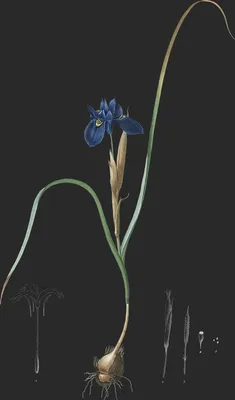
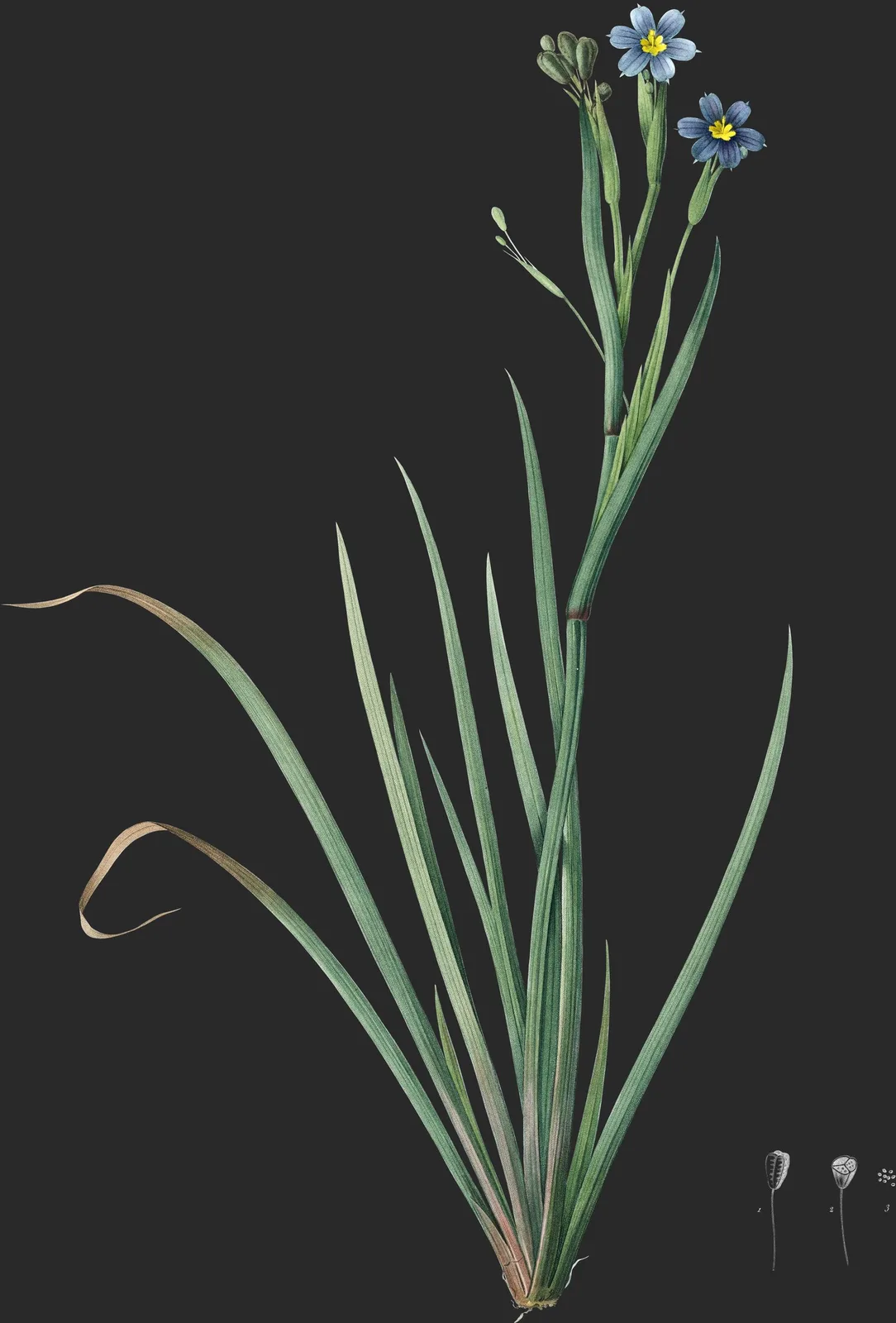
Cette plante, longtemps confondue avec le Sisyrinche-tranchant, en dillère certainement par ses spathes plas courtes que les fleurs, par sa tige moins fortement comprimée, par ses feuilles plus larges, par ses fleurs plus grandes, mélangées de bleu et de jaune; enfin elle est indigène d’un pays différent, et ne peut passer l’hiver hors de l’orangerie; tandis que le Sisyrinche-tranchant passe sans danger toute l’année en pleine terre.
Elle sélève jusqu’à 4–5 décimètres; ses racines sont des fibres simples et blanchatres. Sa tige est comprimée, à deux bords tranchants, droite, glabre; ainsi que le reste de la plante; ses feuilles sont engainées par le bord a la manière des Iris, disposées vers la racine en une espèce d’éventail, linéaires, pointues, larges d’un centimètre.
Les fleurs naissent vers le sommet des tiges, disposées environ 4 ensemble en faisceau, enveloppées de spathes, dont elles dépassent la longueur. Leur corolle est en roue, à 6 lobes oblongs, égaux entre eux, terminés par une petite pointe. Les étamines sont au nombre de trois, réunies ensemble par les filets en un tube cylindrique. Le style porte trois stigmates pointus. Le fruit est une capsule arrondie, à trois loges, à trois valves chargées chacune d’une cloison à plusieurs graines.
J’ai va une monstruosité ou une maladie de cette plante, qui paraissait due à ce que l’individu avait fleuri pendant l’hiver dans l’orangerie. Les fleurs étaient, les unes d’un blane verdatre, les autres d’un Lilas pâle; les premières seules, quoiqu’en apparence plus altérées, donnaient des ovaires fertiles, tandis que les secondes étaient absolument stériles. Le style était à peu près égal aux étamines dans les fleurs fertiles, trois fois plus long qu’elles dans les fleurs stériles. Le même pied, transporté au printemps, en plein air, donna des fleurs colorées et conformées comme à l’ordinaire.
Histoire
Cette plante est originaire des iles Bermudes, d’où elle a été anciennement apportée en Europe: on la cultive dans l’orangerie. ♃.
Elle fleurit au printemps.
Explication de la planche
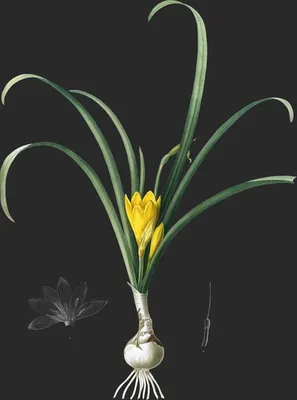
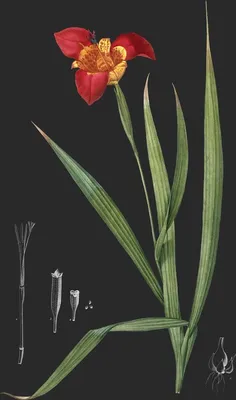
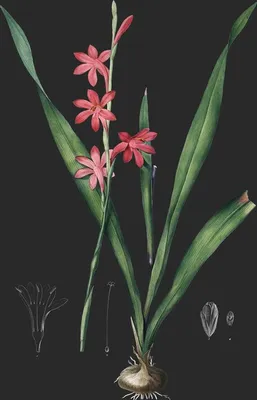
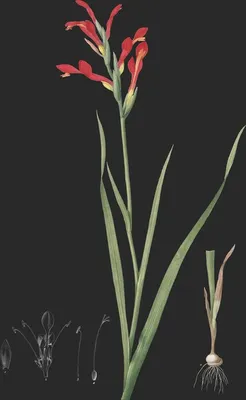
La Plante de grandeur naturelle.
- La capsule.
- La capsule coupée en travera.
- Quelques graines.
Fam. des Iridées. Juss.—Gynandrie ou Monadelphie triandrie. Lin.
- Sisyrinchium Bermudiana. S. caule ancipiti ramoso folioso, spathis sulæqualibus flore brevioribus. Lam. Dict. 1. p. 408. Cav. diss. 6. p. 346. t. 192. f. 1.
- Sisyrinchium Bermudiana. S. scapo ancipiti ramoso folioso, spathâ sabquadrillorâ floribus breviore, petalis mucronatis, foliis ensiformibus. Willd. Spec. 3. p. 578. Gaul. in Ann. bot. 1. p. 246.
- Sisyrinchium Bermudianum. S. foliis gladiolatis amplexicaulibus peduncalis brevioribus. Mill. Dict. n. 1.
- Sisyrinchium Bermudiana var. β. Lin. Spec. 1353. Hort. cliff. 431. Hort. Ups. 278.
- Sisyrinchium Bermudiense, Moribus parvis ex cœruleo et aureo mistis. Pluck. Alm. 348. t. 61. f. 2.
- Bermudiana Tridis folio radice fibrosâ. Tourn. inst. 388. Dill. Elth. 48. t. 41. f. 48.
Twelve ways of seeing
- measured cast blue
- upright 1.48 : 1
- published 1805
- Plate 149
Not a catalogue entry but a way of looking: how to stand, what to notice, how the line was cut, when it flowers, where it came from, who made it — and then the poems and the classics that taught China to see the same flower. Read the twelve in order and the plate opens.
-
First Look
竖划三寸,当千仞之高;横墨数尺,体百里之迥。
—— 南朝宋·宗炳《画山水序》
A vertical stroke of three inches stands for a cliff of a thousand fathoms; a few feet of ink holds a hundred li.
The sheet is vertical: the eye climbs and settles in the upper half. Let the plant stand before you look for detail. Then step in close: watch where colour meets line, and whether the line ever breaks. Third, find where the green is deepest: the whole tonal order is measured from that patch. The pose leans right: the upper half carries 9 points further right than the lower — a living thing, not a diagram.
-
Name and Thing
The binomial is Sisyrinche bermudienne: the first word is the genus it belongs among, the second the epithet that sets it apart. Two words carry a whole provenance. The older system filed it under Iridaceæ by overall affinity; Linnaeus, counting stamens only, placed it in Gynandria — two ways of asking what a plant is. No established Chinese name exists, so it is cited by its binomial alone.
-
Form and Colour
Measured on this plate: flower colour is sparing, 0.9% of the sheet against 4.0% of foliage, the cast tending blue — as with pale or white blooms, outline and tone do the talking. Irises carry rhizomes or bulbs, sword-shaped leaves in two ranks, and six tepals — three falls drooping, often bearded or speckled, three standards erect. Filed under green — a moss green, a colour that comes mostly from leaf and stem. Read the outline, then the colour layers, then the brush.
-
Composition
Tall and narrow, the plant rising in one movement with generous margins — the upright format of most floras. (about 1.48 : 1) No details are appended: a plate for looking, not for keying out. The plant covers only 12% of the sheet, centred below centre; the emptiness is where the eye rests. Blank paper is not unfinished work: it is where the eye rests.
-
Line and Colour
The first half of the nineteenth century moved from copper to steel to lithography; stipple could render the softest transition. Take a loupe to three places: petal edge, leaf vein, caption. An unbroken line means engraving; colour crossing the outline means a hand.
-
Season
Late spring to early summer, peaking in April and May, before the summer rains. The year 1805 on the plate is that of publication, not of flowering — the gathering came a year or two earlier. The best time to read such a plate is its flowering season: three minutes under the tree explains what no text can.
-
Provenance
Temperate north. In China iris and sweet flag belong to the Dragon Boat festival; in Europe Iris germanica gave the perfume trade its orris root. The volume was made in 1802-1816, when most of this knowledge came from living plants under glass.
-
The Book and the Hand
“The Liliaceae” was drawn by Pierre-Joseph Redouté and published 1802-1816. This plate is Plate 149, book page 149. The image is public domain; the hand-colouring is still one person's hand.
-
Poetic Resonance
知道君家当瀑布,菖蒲潭在草堂前。
—— 唐·王建《送顧非熊秀才歸丹陽》
The poem gives the mood first and the picture supplies the form; set the line beside the plate and the green the corolla becomes its resting point.
-
The Written Tradition
写气图貌,既随物以宛转;属采附声,亦与心而徘徊。
—— 南朝梁·刘勰《文心雕龙·物色》
In tracing the spirit and drawing the shape one follows the object; in choosing colour and sound one lingers with the heart.
The Bencao Gangmu lists iris and sweet flag among herbs; the Jingchu seasonal records describe hanging mugwort and flag at the door at midsummer — a custom unbroken for a thousand years. You need not parse every word: take the line, and the flower acquires a second face.
-
Symbolism
In China sweet flag hung at the door wards off evil at midsummer; in Europe the iris is the messenger, since Iris was the rainbow goddess who carried divine words. Meanings change their tune: the same flower can say opposite things within a century.
-
What to Take Away
Carry three rules away: whole before detail; line before colour; picture before book. The flower of that year is dust, yet its image on paper has outlived every living cousin.