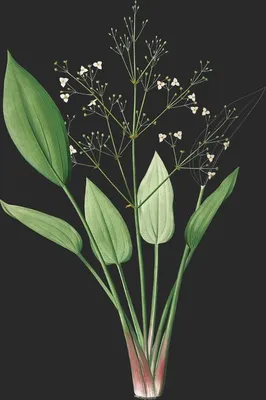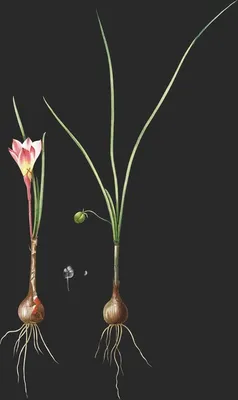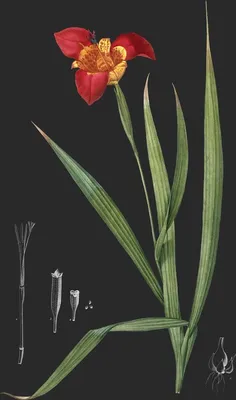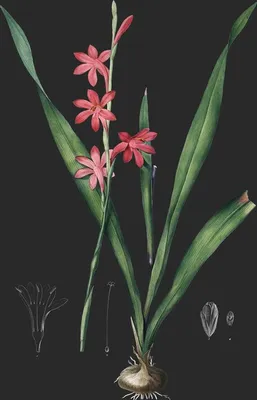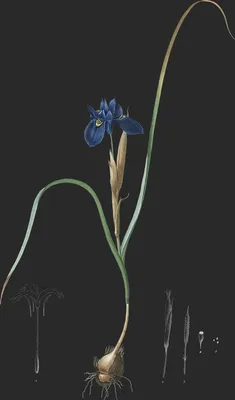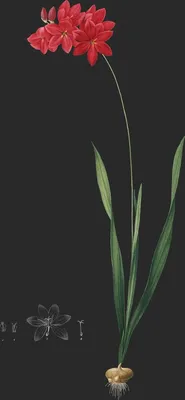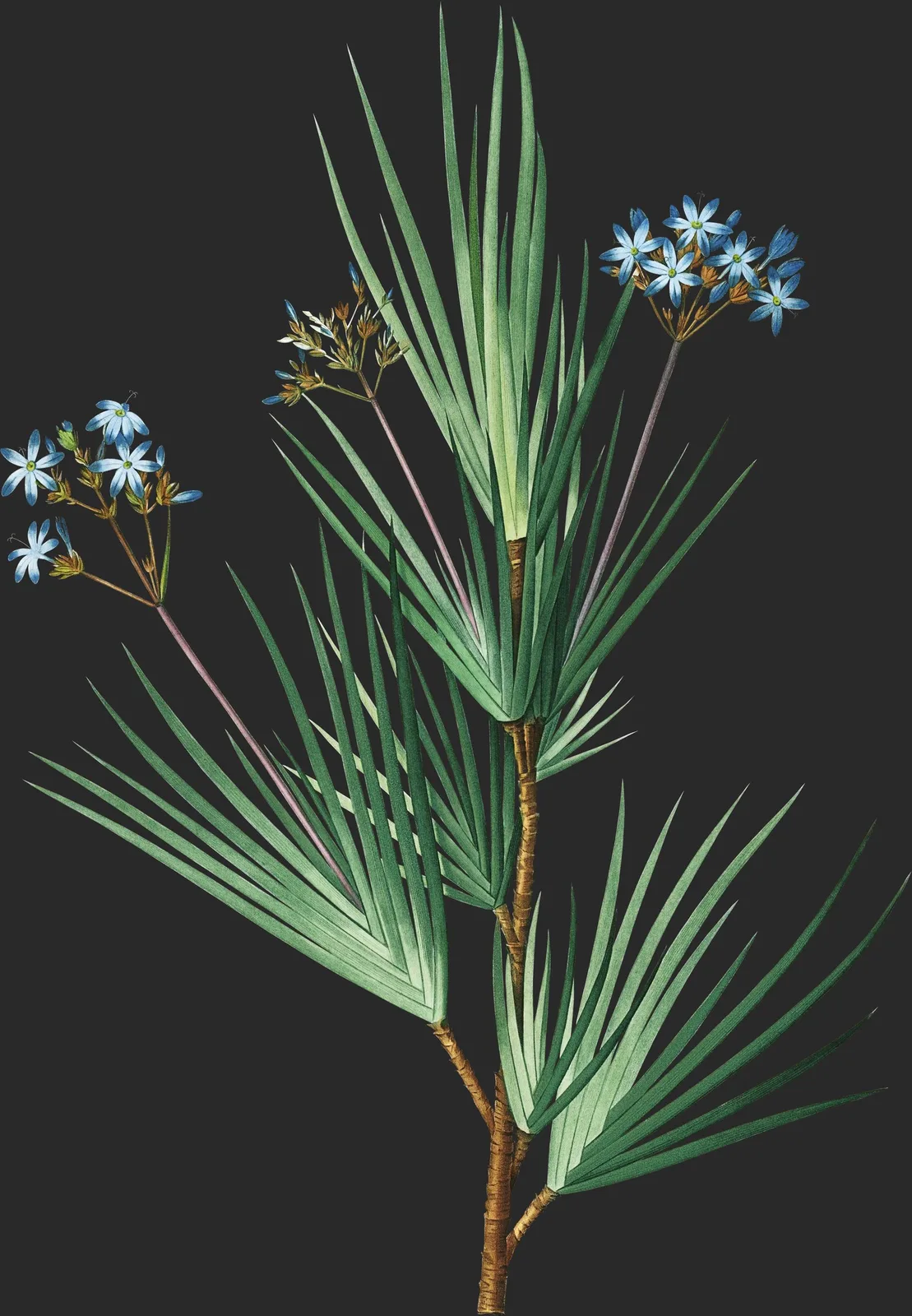
Witsenia Corymbosa
Witsenia Peniculé
Witsenia Peniculé
About this plate
Description
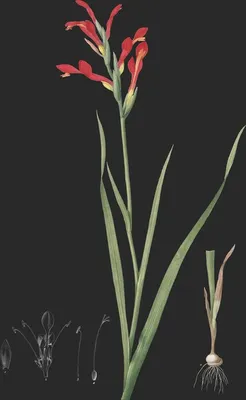
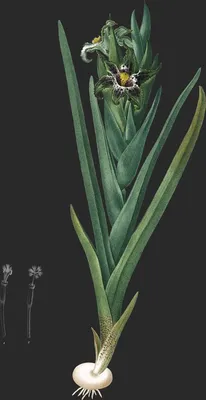
Tige fratescente, droite, produisant à sa base beaucoup de jeunes rameaux qui forment la touffe. Cette tige est anguleuse, et parait comme articulée, son écorce étant circulairement écailleuse ou marquée par des anneaux déchirés, qui persistent après la chute d’anciennes feuilles. Toutes les pousses nouvelles de cette plante consistent en feuilles linéaires, ensiformes, aiguës, engainantes à la base, disposées en éventail, longues de huit centimètres à treize centime. tres et demi (trois à cinq pouces). La gaine des feuilles est un sillon comprimé, creusé dans le tiers inférieur de la lame, membraneux sur les bords; la lame est tres-finement striée, un peu glauque sur ses faces, brune ou rougeâtre par ses bords à son sommet. Les rameaux sont comprimés, et dentés aux points d’où les feuilles sont tombées.
Les fleurs sortent d’entre les feuilles, en corybe, dont le pédoneule allonge est comprimé, lisse, non strie, à deus tranchants. Ce pédoncule produit plusieurs rameaux triangalaires, inégaus, solitaires ou géminés, dichotomes et floriférés à leur sommet. Une feuille subulée est placée sous l’aisselle du premier rameau du corymbe; une très-petite écaille brune accompagne les rameaus partiels. Les fleurs sont verticales, et la plupart géminées; elles sont maintenues chacune par une spathe de plusieurs valves qui sont serrées contre Je tube du périgone. Cette spathe est de quatre valves alternes, opposées, en-tières, engainantes. La plas intérieure de ces valves est la plus roide; la seconde est en grande partie membraneuse, et les deux dernières sont tout-à-fait sèches et membraneuses.
Le périgone est infundibuliforme, a limbe ouvert en roue, a six divisions ovales-linéaires, longues de huit mètres (trois lignes et demie), portées sur un tube cylindrique de même longueur. Trois étamines sont insérées à Torifice du tube, et répondent à la base de trois des divisions alternes du pé rigone. Les filets sont blancs et extrêmement courts; les anthères sont jaunes, biloculaires, en cour, et se montrent à peine hors de la gorge du tube. Le style seul s’élève considérablement hors du tube; il se termine par trois stigmates un peu velus, en crite, recourbés, obtus.
Histoire
M. Gawler nous apprend que le Witseria carymbosa est venu, en Angleterre, de graines du Cap de Bonne-Espérance, et a été élevé par M. Hibbert, cultivateur distingué.
Cette plante est nouvelle à Paris dans le jardin de M. Boussaut, où nous T’avons décrite. Elle fleurit au mois de septembre, et a besoin d’ètre rentrée es hiver dans la serre tempérée.
Fam. des Iris. Juss.—Triandrie monogynie. Lin.
- Witsenia corymbosa. W. caule ramoso, frutescente; folis linearibus, distichis; floribus corymbosis, sub-umbellatis, limbo rotato, pistillo exserto.
- Witsenia corymbosa. W. inflorescentia corymboso-paniculata; spatha bivalvi, uni-bracteata; corolla hypocrateriformi; tubo erecto, spatham plaries, limbum explanatum parim excedente; filamentis suballis; pistillo corollam sub-superante. Gawl. in botan. mag. tab. 895.
Ten ways of seeing
- measured cast amber
- upright 1.44 : 1
- published 1814
- Plate 453
Not a catalogue entry but a way of looking: how to stand, what to notice, how the line was cut — then, halfway, a line of Chinese poetry: how the ancients saw this same flower. After it, the flower's language, its season and homeland, its book; and at the end one line of classical prose — and a pair of eyes to take away.
-
First Look
夫象物必在于形似,形似须全其骨气。
—— 唐·张彦远《历代名画记》
Likeness is the threshold; bone-and-breath is the point.
The sheet is vertical: the eye climbs and settles in the upper half. Let the plant stand before you look for detail. Then step in close: watch where colour meets line, and whether the line ever breaks. Third, find where the green is deepest: the whole tonal order is measured from that patch.
-
Name and Thing
The binomial is Witsenia corymbosa: the first word is the genus it belongs among, the second the epithet that sets it apart. Two words carry a whole provenance. The older system filed it under Iridaceæ by overall affinity; Linnaeus, counting stamens only, placed it in Triandria — two ways of asking what a plant is. No established Chinese name exists, so it is cited by its binomial alone.
-
Form and Colour
Measured on this plate: flower colour covers 2.3% of the sheet, foliage 11.2%, the cast amber with a second note of blue. No other plate shares exactly this measure. Irises carry rhizomes or bulbs, sword-shaped leaves in two ranks, and six tepals — three falls drooping, often bearded or speckled, three standards erect. Filed under green — a moss green, a colour that comes mostly from leaf and stem. Three things fix the habit: leaf arrangement, tepal count, and how the flower is borne.
-
Composition
Tall and narrow, the plant rising in one movement with generous margins — the upright format of most floras. (about 1.44 : 1) No details are appended: a plate for looking, not for keying out. The plant covers only 18% of the sheet, centred near the centre; the emptiness is where the eye rests. Blank paper is not unfinished work: it is where the eye rests.
-
Line and Colour
The first half of the nineteenth century moved from copper to steel to lithography; stipple could render the softest transition. Decide first whether it was printed or painted; only then discuss whether it is beautiful. If you mean to copy it: take its skeleton, its margins and the order of its colours; the burin's hatching is the language of copper — suggest it with pencil density, do not imitate it stroke for stroke.
-
Poetic Resonance
蓝田日暖玉生烟。
—— 唐·李商隐《锦瑟》
In warm sun over Lantian, the jade gives off smoke.
The poem gives the mood first and the picture supplies the form; set the line beside the plate and the green the corolla becomes its resting point.
-
Symbolism
In China sweet flag hung at the door wards off evil at midsummer; in Europe the iris is the messenger, since Iris was the rainbow goddess who carried divine words. In a flora it is a species first and a symbol second; the order is worth keeping.
-
Season and Place
Late spring to early summer, peaking in April and May, before the summer rains. Temperate north. In China iris and sweet flag belong to the Dragon Boat festival. The year 1814 on the plate is that of publication, not of flowering — the gathering came a year or two earlier. Read the locality and the flowering season both with a discount: one is hearsay, the other a ten-day peak.
-
The Book and the Hand
“The Liliaceae” was drawn by Pierre-Joseph Redouté and published 1802-1816. This plate is Plate 453, book page 453. The image is public domain; the hand-colouring is still one person's hand.
-
The Written Tradition
五月五日,采艾以为人,悬门户上,以禳毒气。
—— 南朝梁·宗懔《荆楚岁时记》
On the fifth of the fifth month they gather mugwort, shape it into a figure and hang it on the door to drive off fever — plant as medicine and as charm.
The Bencao Gangmu lists iris and sweet flag among herbs; the Jingchu seasonal records describe hanging mugwort and flag at the door at midsummer — a custom unbroken for a thousand years. The difference is not of quality but of question: Europe asks what it is, China asks whom it resembles.
What to Take Away
Carry three rules away: whole before detail; line before colour; picture before book. A flora exists to be consulted; look long enough and you forget to consult — someone in 1814 gave a whole day to a single flower.