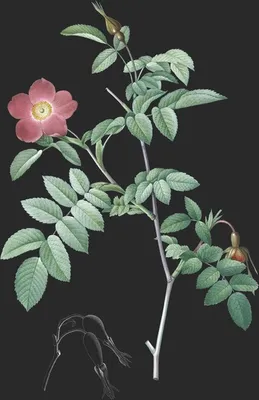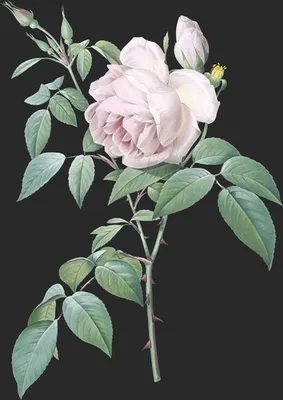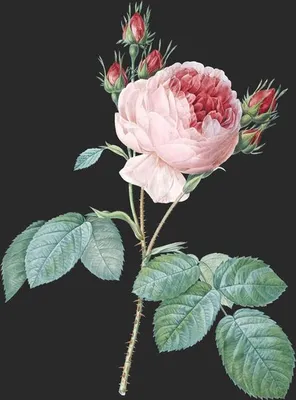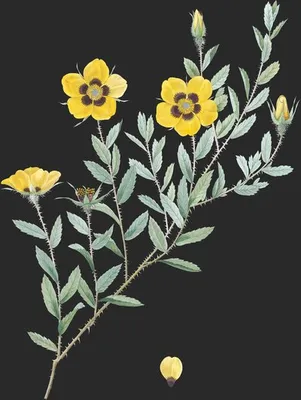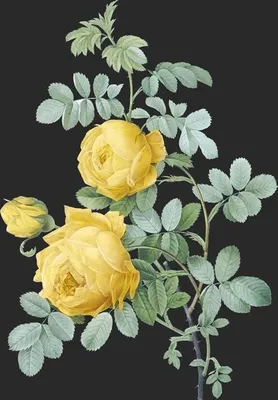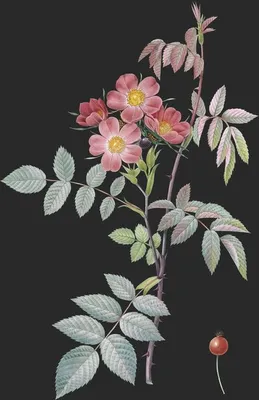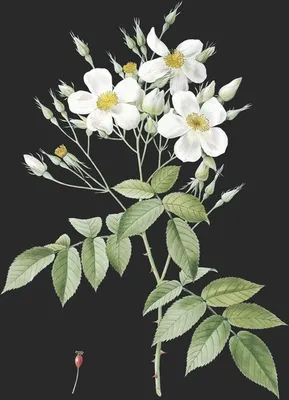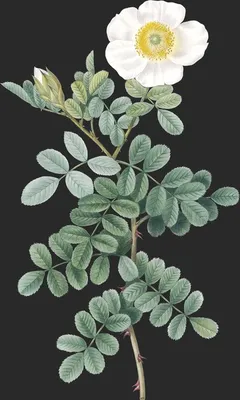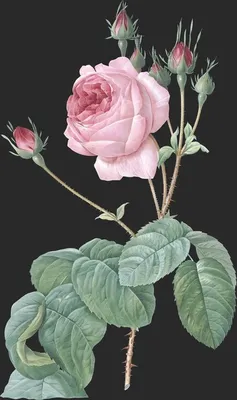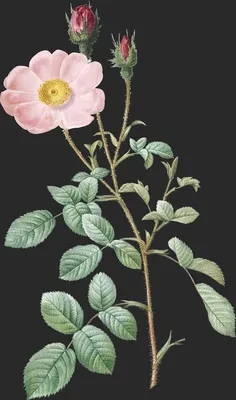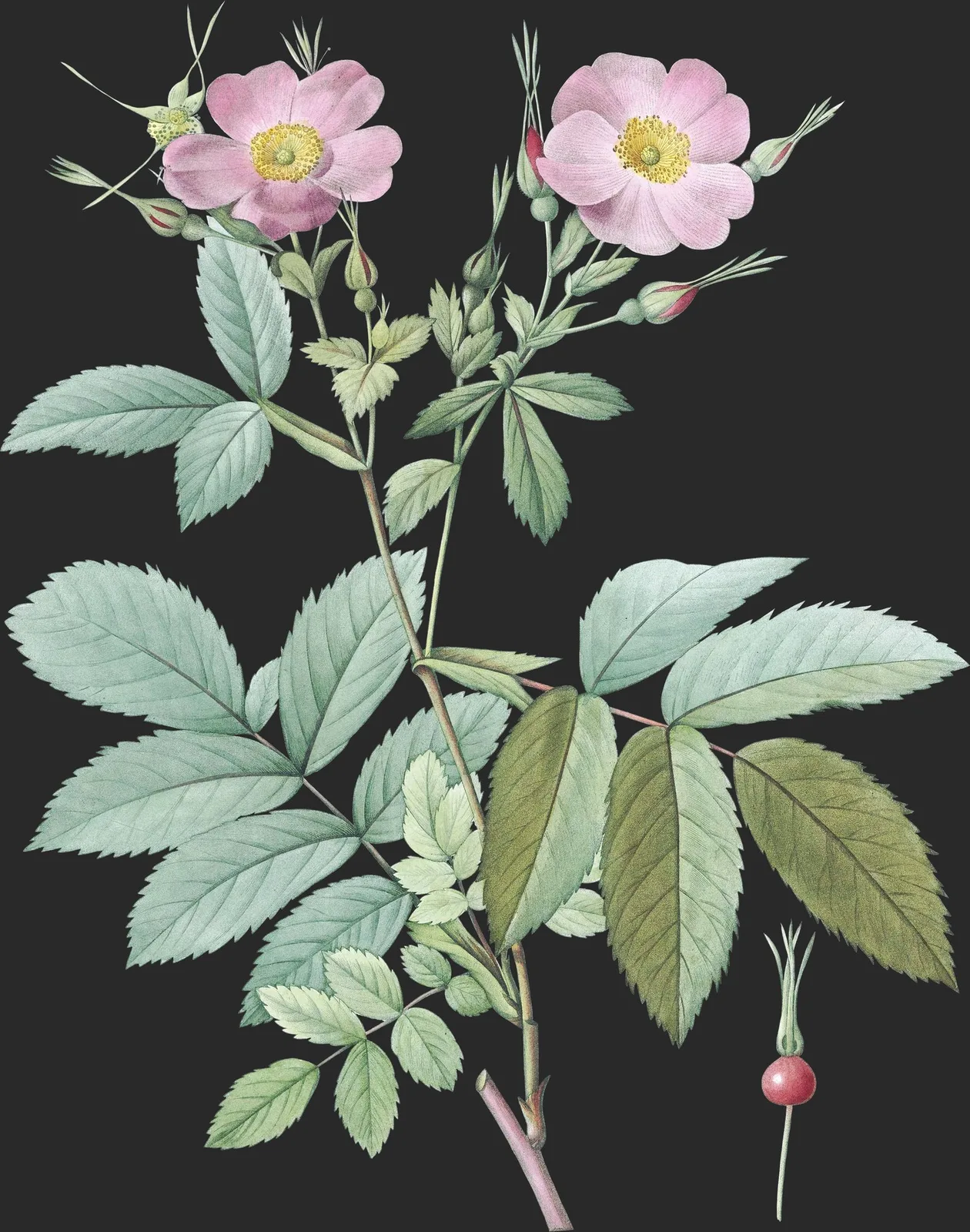
Rosa Alpina var Lævis
狗牙蔷薇
Le Rosier des Alpes
About this plate
Description
Cet arbuste s’élève à quatre ou cinq pieds; ses tiges allongées prennent, en vieillissant, une couleur rougeâtre à-peu-près semblable à celle qu’on remarque dans le Rosier carelle: elles sont entièrement dépourvues d’aiguillons. Les feuilles, de cinq, sept ou neuf folioles, ovales, glabres, presque toujours doublement dentées, sont portées par des pétioles légèrement hispides, munis à leur base de stipules larges et denticulées. Les fleurs, tantôt solitaires, tantôt deux ou trois ensemble, terminales et axillaires, sont supportées par des pédoncules glabres garnis de bractées ovales légèrement dentées. L’ovaire est de forme globuleuse, et les lobes du calice, entiers, linéaires, spatulés au sommet, sont cotonneux en leurs bords. Corolle de cinq pétales échancrés, d’un rouge vif, un peu blancs vers l’onglet; un grand nombre d’étamines. Styles distincts.
Observations
On a souvent confondu l’Alpina Lœvis avec le Rosier ca-nelle (R. Cinnamomea), à cause de l’analogie qui existe entre les ovaires globuleux et la couleur des tiges des deux indi-vidus. Mais les aiguillons stipulaires, et les folioles allongées et toujours simplement dentées de cette dernière espèce, la distinguent suffisamment de celle dont nous avons donné la figure.
L’arbuste croît naturellement sur les Alpes et dans les départements méridionaux de la France. On le cultive dans nos jardins, où il donne successivement des fleurs pendant une grande partie de l’été. Cette variété trace beaucoup.
- R. Germinibus globosis pedunculisque glabris; foliolis bidentatis, caule inermi. (N.)
- R. Alpina lœvis. Desv. Journ. de Bot. 1813, p. 119, Var. χ.
Twelve ways of seeing
One plate, read twelve times over: its name, its colour, the burin and the brush, the shape of the sheet, the season, the soil it came from, the book it belongs to, its language of flowers, the poem it answers to, the lore behind it, how to look, and what remains.
-
The Name
The plate is titled “Rosa Alpina var Lævis”, numbered Plate 18 (book page 18). Its binomial is Rosa alpina; the genus name Rosa means what it still means in Latin: Rosa is simply the Latin for rose, from Greek rhodon. The Chinese name 狗牙蔷薇 is a modern rendering of the Latin, not an old garden name — between a plant and its names there is always translation.
-
Form and Colour
Roses are shrubs or scramblers with pinnate leaves of three to seven serrated leaflets; the double flowers open in crumpled, inward-curling layers around a small knot of yellow stamens. Filed under green — a moss green. That colour comes mostly from leaf, calyx and stem; the flower occupies a small patch. A botanical plate establishes the plant before it points at the bloom. Three things fix the habit: leaf arrangement, tepal count, and how the flower is borne.
-
Line and Colour
The first half of the nineteenth century moved from copper to steel to lithography. Stipple could render the softest transition — Redouté's roses depend on it — while lithography suited broad, gentle washes. Look closely at the line and the colour: an unbroken line means engraving, colour crossing the outline by half a millimetre means hand-colouring. Craft leaves franker evidence than inscriptions.
-
Composition
Slightly taller than wide, the plant set a little above centre so the eye lands on the flower. (about 1.27 : 1). No details are appended: this is a plate for looking, not for keying out.
-
Season
Late spring into early summer, peaking in May — the first flush of the garden year. The year 1817 on the plate is the year of publication, not of flowering — the gathering came a year or two earlier.
-
Provenance
Widespread in the temperate north. Chinese gardeners knew roses since the Han; the ever-blooming modern rose is a nineteenth-century crossing of European and Chinese stock. The localities on the plate are those of a century ago; plants travel and places change their names.
-
The Book
“Les Roses” was drawn by Pierre-Joseph Redouté and published 1817-1824. This plate is Plate 18, book page 18. The image is in the public domain; the hand-colouring on the paper is still one person's hand, two centuries ago.
-
Symbolism
In Europe the rose means love and secrecy ('sub rosa'); in Chinese verse the rambling rose leans and clings — lingering attachment rather than ardour. Meanings change their tune: the same flower can say opposite things within a century.
-
Poetic Resonance
有情芍药含春泪,无力蔷薇卧晓枝。
—— 宋·秦观《春日》
The peony, feeling, holds spring tears; the rose, strengthless, lies across the morning branch.
The poem gives the mood first and the picture supplies the form; set the line beside the plate and the green the corolla becomes its resting point.
-
Classical Lore
Tradition places roses in the Han imperial park; Song and Ming manuals named the double forms 'Baoxiang' and 'Ten Sisters', and Qing compendia separated rose, rugosa and monthly rose. Chinese flower books ranked plants by character; European floras described them by form and name. This plate belongs to the second tradition, yet bears reading by the first. Printed in 1817, at the moment the two traditions began to see each other.
-
How to Look
Read the petals first — outer ones reflexed, inner ones still clasped. Then the thorns and serrations: their sharpness betrays the engraver's hand. Finally, the edge of the sheet: where the plant is cropped tells you how it was seen — specimen, garden plant, or wild thing.
-
Afterword
The flower of 1817 is dust, yet its image on paper has outlived every living cousin.