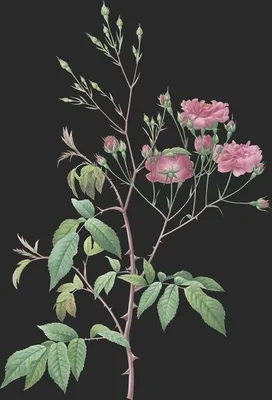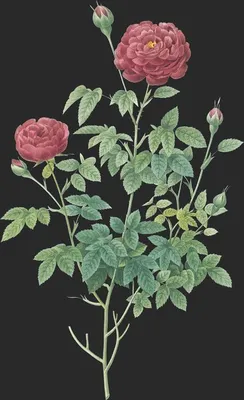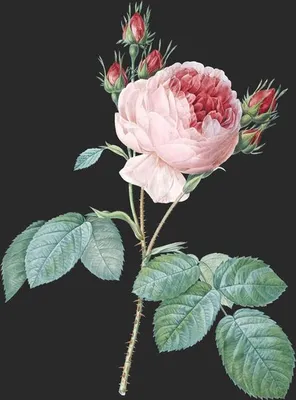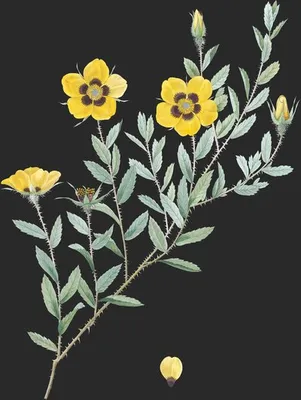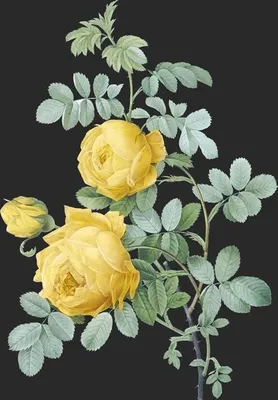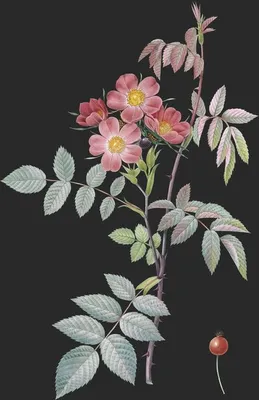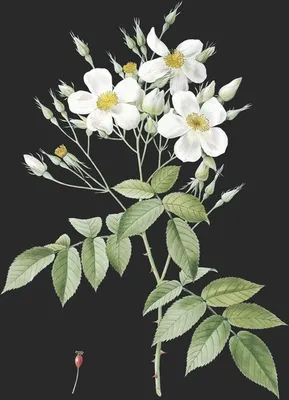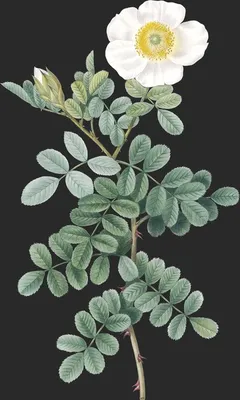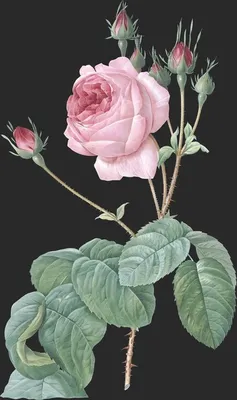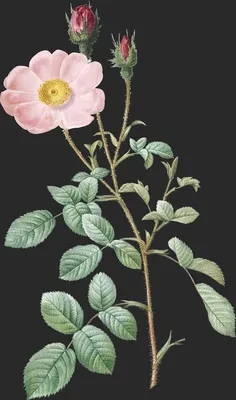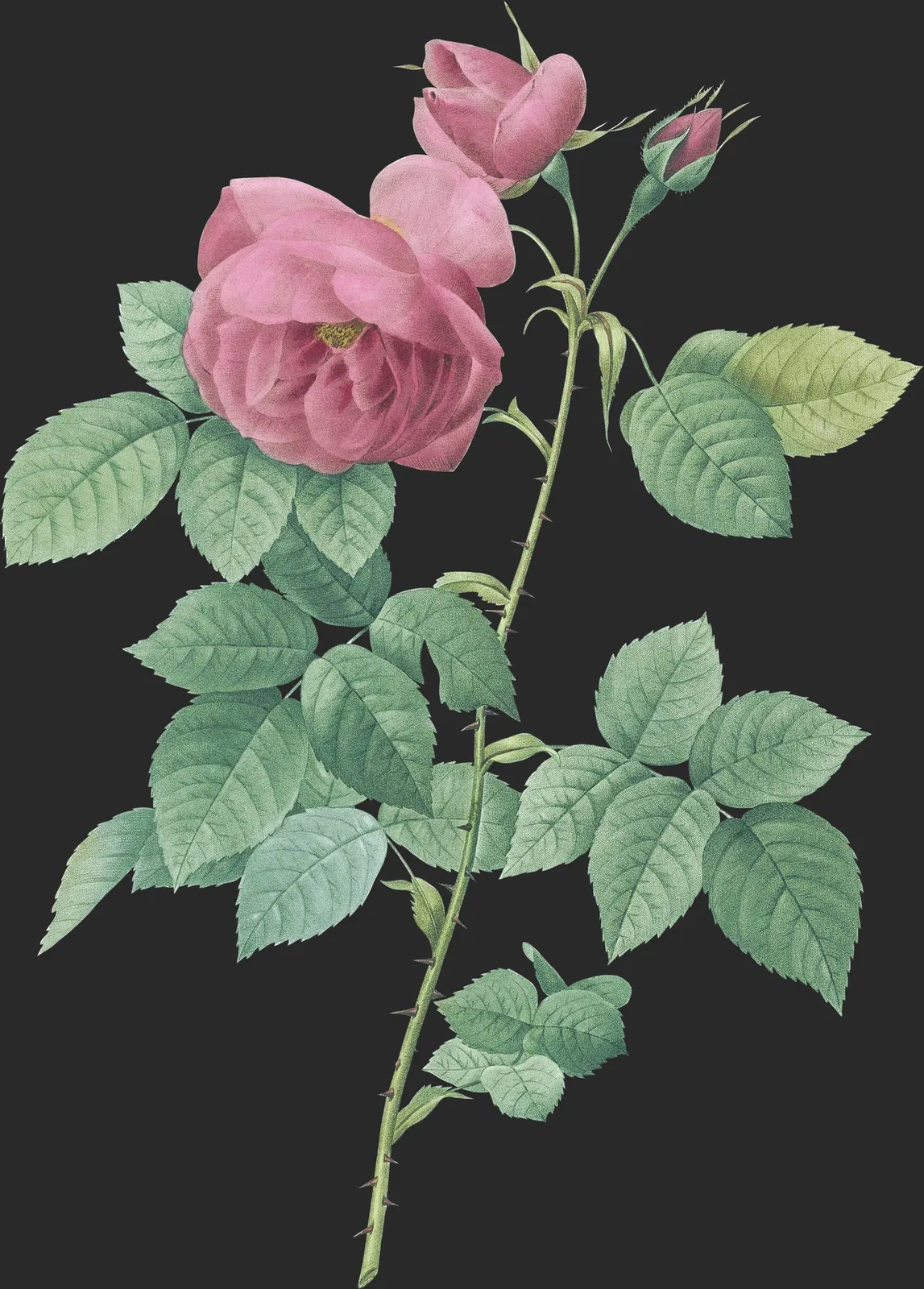
Rosa Canina Burboniana
狗牙蔷薇、落叶冬青
Le Rosier de L’Ile de Bourbon
Ten ways of seeing
- measured cast red
- upright 1.40 : 1
First Look
凡画山水,意在笔先。
—— 唐·王维《山水论》
In painting, the intention precedes the brush.
The sheet is vertical: the eye climbs and settles in the upper half. Let the plant stand before you look for detail. Then step in close: watch where colour meets line, and whether the line ever breaks. Third, find where the green is deepest: the whole tonal order is measured from that patch. The pose leans left: the upper half carries 8 points further left than the lower — a living thing, not a diagram.
Name and Thing
Only the genus Rosa is given; species-level names came later. No established Chinese name exists, so it is cited by its binomial alone.
Form and Colour
Measured on this plate: flower colour covers 8.1% of the sheet, foliage 13.5%, the cast red with a second note of crimson. No other plate shares exactly this measure. Roses are shrubs or scramblers with pinnate leaves of three to seven serrated leaflets; the double flowers open in crumpled, inward-curling layers around a small knot of yellow stamens. a moss green. Three things fix the habit: leaf arrangement, tepal count, and how the flower is borne.
Composition
The sheet is tall. No details are appended: a plate for looking, not for keying out. The plant takes about 37% of the sheet, centred near the centre — the easy measure most florists kept to.
Line and Colour
The first half of the nineteenth century moved from copper to steel to lithography; stipple could render the softest transition. Take a loupe to three places: petal edge, leaf vein, caption. An unbroken line means engraving; colour crossing the outline means a hand. If you mean to copy it: take its skeleton, its margins and the order of its colours; the burin's hatching is the language of copper — suggest it with pencil density, do not imitate it stroke for stroke.
Poetic Resonance
秋光欲雨棋声泻,粉帐不容花露香。
—— 宋·无名氏《鹧鸪天》
The poem gives the mood first and the picture supplies the form; set the line beside the plate and the green the corolla becomes its resting point.
Symbolism
In Europe the rose means love and secrecy ('sub rosa'); in Chinese verse the rambling rose leans and clings — lingering attachment rather than ardour. Flower language was added later; the flower knows nothing of it, and that innocence is part of its power.
Season and Place
Late spring into early summer, peaking in May — the first flush of the garden year. Widespread in the temperate north. Chinese gardeners knew roses since the Han. The year 1824 on the plate is that of publication, not of flowering — the gathering came a year or two earlier. See this kind of plate in the flowering season if you can: once you have met the living flower, you stop reading only colour.
The Book and the Hand
“Les Roses” carries only Pierre-Joseph Redouté's name. The image is public domain; the hand-colouring is still one person's hand.
What to Take Away
Carry three rules away: whole before detail; line before colour; picture before book. The flower of that year is dust, yet its image on paper has outlived every living cousin.
About this plate
Description
Arbrisseau rameux, touffu, vigoureux, qui s’élève à plusieurs pieds. Ses branches sont armées d’aiguillons rougeâtres, forts, recourbés, dilatés. Les feuilles se composent de cinq ou de sept folioles arrondies à la base, pointues au sommet, glabres sur les deux faces, vertes et luisantes en-dessus, plus pâles en-dessous, simplement dentées. Elles sont portées par un pétiole velu, garni de quelques petites glandes sessiles et de petits ai-guillons. A sa base, sont deux stipules décurrentes, pointues au sommet, denticulées en leur bordure. Les fleurs, d’une odeur douce et agréable, sont disposées plusieurs ensemble à l’extrémité des rameaux qui croissent le long des branches principales. Les pédoncules qui les supportent, chargés de petites glandes, présentent, à leur base, des bractées allongées ciliées et glan-duleuses. Le tube du calice est ovoïde et glabre. Les divisions du limbe sont pinnatifides à pinnulles presque sétacées. Corolle de trois à quatre rangs de pétales, échancrés en cœur au som-met, d’un rose éclatant. Fruit ovoïde, un peu arrondi et rouge à la maturité.
Observations
Ce Rosier, au rapport de S. A. R. Monseigneur le duc d’Or-léans, croît naturellement dans les lieux incultes de l’ile de Bourbon: des graines apportées il y a quelques années, l’ont reproduit dans ses jardins de Neuilly, où le peintre de cet ouvrage à fait son dessin. Son port est très-beau; l’abondance de ses fleurs, quelquefois presque simples, le plus souvent semi-doubles, leur belle couleur comme leur parfum, le feront sans doute rechercher pour l’ornement des jardins paysagistes.
- R. germinibus ovatis glabris, pedunculis hispidis, bractes glanduloso-ciliatis, caule petiolisque aculeatis. (N.)
- Non, R. Gallica Burboniana, Thy. in Red. R. vol. 1, p. et fig. 74. Idem, Prod. p. 17, var. ξ.
- Non, R. Burbonia Roess. Beschréi. der Ros. 2, p. 28; № 12; Non, R. Bourbon, Rose Pivoine, Rose de Jéricho, Guerr. Alm. des R. p. 55.