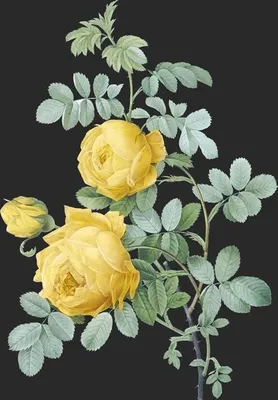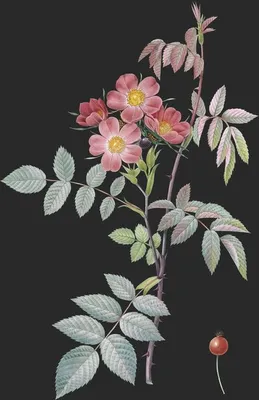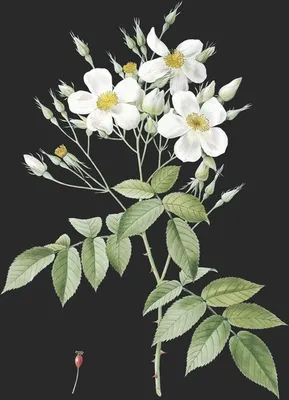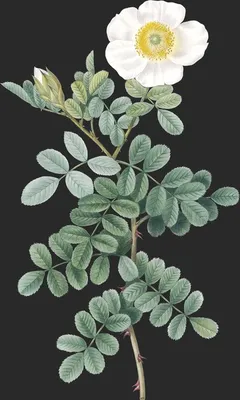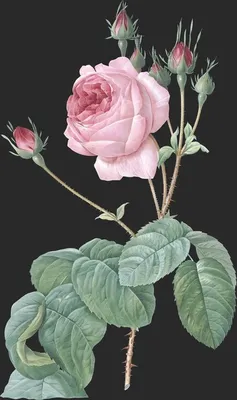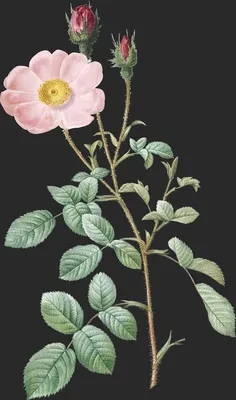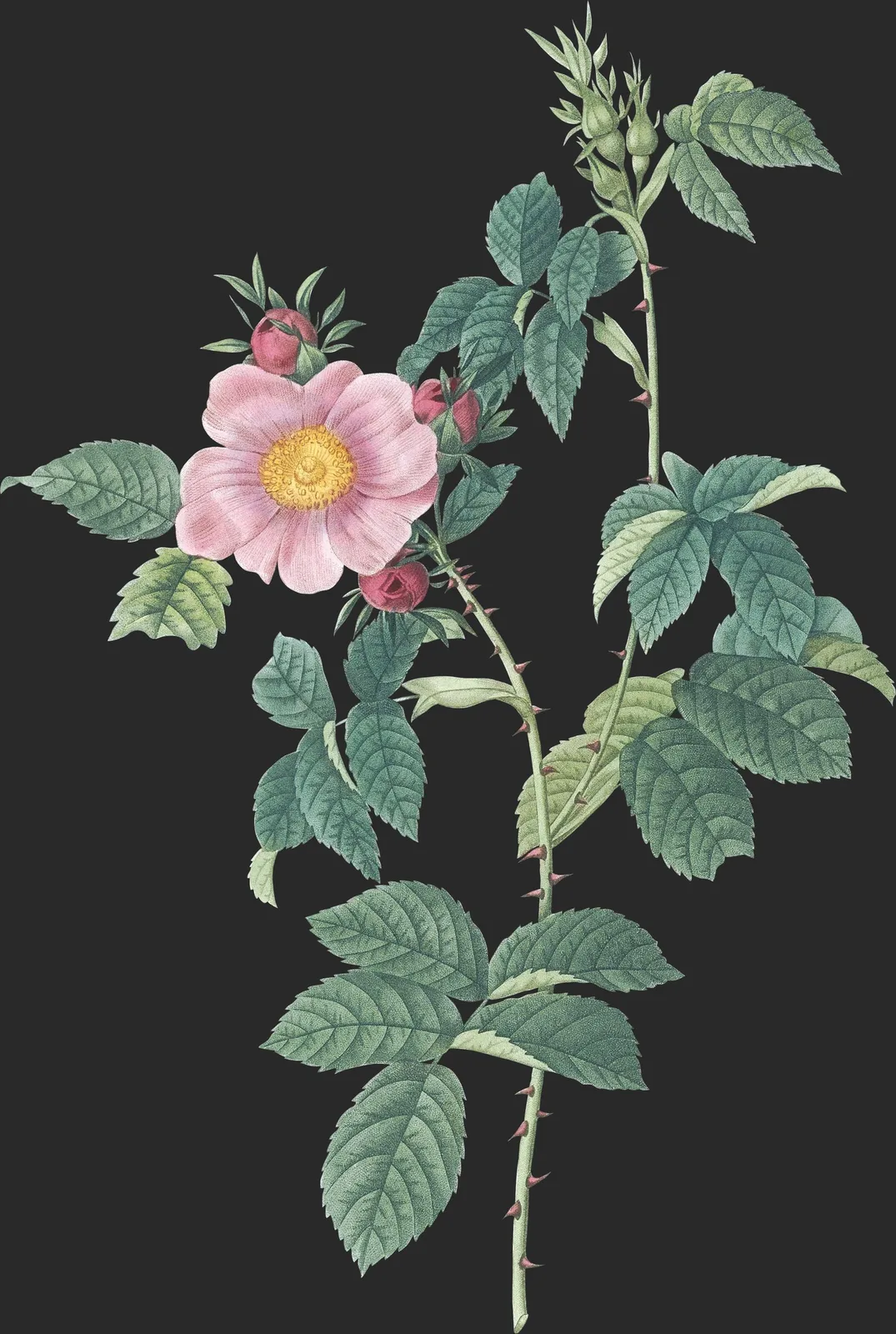
Rosa Canina Grandiflora
Rosa Canina Grandiflora
Le Rosier Canin
About this plate
Description
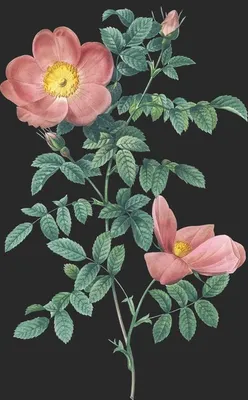
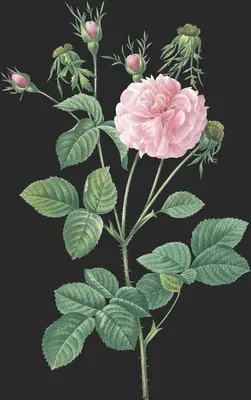
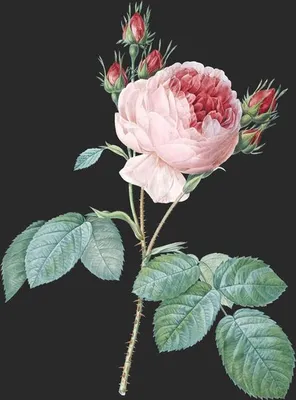
Arbrisseau rameux qui s’élève à la hauteur de trois ou quatre pieds. Ses branches sont armées d’aiguillons forts, recourbés, souvent réunis en verticille au-dessous des stipules. Les feuilles se composent de trois, cinq, même de sept folioles, glabres sur les deux faces, vertes en-dessus, plus pâles en-dessous. Le pétiole qui les supporte, garni de quelques petits aiguillons, est muni de poils serrés et glanduleux lesquels s’étendent sur la nervure principale et quelquefois sur les nervures latérales les plus saillantes: à sa base sont des stipules étroites, pointues au sommet, denticulées, ciliées et glanduleuses en leur bordure. Les fleurs, latérales et terminales, sont quelquefois solitaires, mais le plus souvent disposées par trois à l’extrémité des ramuscules qui croissent le long des branches principales. Elles sont portées par des pédoncules et des pédicelles garnis de quelques petits poils glanduleux; chaque pédicelle est muni, à sa base, de bractées opposées à bords ciliés et glanduleux. Le tube du calice, à-peu-près rond, est absolument glabre. Les divisions du limbe, trois pinnatifides et deux simples, offrent des pinnules courtes et arrondies en spatule. Corolle de cinq pétales, grands eu égard à ceux des fleurs de tous les individus du groupe des Caninæ, d’un rose tendre, jaunâtres vers l’onglet, irrégulièrement échancrés au sommet. Styles réunis en une tête sessile, au centre de la fleur. Fruit presque rond, et rouge à la maturité.
Observations
Cette jolie variété a été observée, l’année dernière, par M. Lemeunier de la Flèche, qui nous en a fait passer le pied vivant, lequel a fleuri au printemps dans notre jardin. Elle est très-distincte de toutes les autres par l’espèce de poussière glauque qui couvre la fleur avant l’anthère, par la grandeur de ses pé-tales, et l’éclat de ses fleurs, dernière circonstance d’après laquelle M. Lemeunier l’avait signalée sous le nom de R. Canina fulgens. Mais comme beaucoup de Roses des bois, on pourrait même dire toutes les Roses, offrent des couleurs éclatantes au moment de leur épanouissement, et qu’en adoptant cet adjectif l’observateur resterait souvent dans l’incertitude, nous avons cru devoir rapporter le nom de cette belle variété à la dimension des pétales, caractère d’après lequel on la distinguera toujours au premier coup d’œil.
- R. Germinibus subglobosis, glabris; pedunculis hispidis; petiolis cauleque aculeatis. (N.)
- R. Canina fugens. Index Rosar. quas Flexiæ incol. Lemeunier. MS.
Twelve ways of seeing
- measured cast red
- upright 1.49 : 1
- published 1824
- Plate 151
Not a catalogue entry but a way of looking: how to stand, what to notice, how the line was cut, when it flowers, where it came from, who made it — and then the poems and the classics that taught China to see the same flower. Read the twelve in order and the plate opens.
-
First Look
搜尽奇峰打草稿。
—— 清·石涛《苦瓜和尚画语录》
Exhaust the strange peaks, and then make the sketch.
The sheet is vertical: the eye climbs and settles in the upper half. Let the plant stand before you look for detail. Then step in close: watch where colour meets line, and whether the line ever breaks. Third, find where the green is deepest: the whole tonal order is measured from that patch.
-
Name and Thing
Only the genus Rosa is given; species-level names came later. No established Chinese name exists, so it is cited by its binomial alone.
-
Form and Colour
Measured on this plate: flower colour covers 2.2% of the sheet, foliage 10.4%, the cast red with a second note of amber. No other plate shares exactly this measure. Roses are shrubs or scramblers with pinnate leaves of three to seven serrated leaflets; the double flowers open in crumpled, inward-curling layers around a small knot of yellow stamens. Filed under green — a moss green, a colour that comes mostly from leaf and stem. Three things fix the habit: leaf arrangement, tepal count, and how the flower is borne.
-
Composition
Tall and narrow, the plant rising in one movement with generous margins — the upright format of most floras. (about 1.49 : 1) No details are appended: a plate for looking, not for keying out. The plant takes about 29% of the sheet, centred near the centre — the easy measure most florists kept to. Blank paper is not unfinished work: it is where the eye rests.
-
Line and Colour
The first half of the nineteenth century moved from copper to steel to lithography; stipple could render the softest transition. Craft leaves franker evidence than inscriptions.
-
Season
Late spring into early summer, peaking in May — the first flush of the garden year. The year 1824 on the plate is that of publication, not of flowering — the gathering came a year or two earlier. The plate records ten days of peak; the other three hundred are leaf, fruit and rest.
-
Provenance
Widespread in the temperate north. Chinese gardeners knew roses since the Han; the ever-blooming modern rose is a nineteenth-century crossing of European and Chinese stock. The volume was made in 1817-1824, when most of this knowledge came from living plants under glass.
-
The Book and the Hand
“Les Roses” was drawn by Pierre-Joseph Redouté and published 1817-1824. This plate is Plate 151, book page 151. The image is public domain; the hand-colouring is still one person's hand.
-
Poetic Resonance
水晶帘动微风起,满架蔷薇一院香。
—— 唐·高骈《山亭夏日》
The crystal blind stirs as a breeze rises; a trellis of roses perfumes the whole courtyard.
The poem gives the mood first and the picture supplies the form; set the line beside the plate and the green the corolla becomes its resting point.
-
The Written Tradition
插花不可太繁,亦不可太瘦。多不过二种三种,高低疏密,如画苑布置方妙。
—— 明·袁宏道《瓶史·宜称》
Flowers should be set neither too crowded nor too sparse — two or three kinds at most, tall and low, dense and open, arranged as a painter would compose.
Tradition places roses in the Han imperial park; Song and Ming manuals named the double forms 'Baoxiang' and 'Ten Sisters', and Qing compendia separated rose, rugosa and monthly rose. You need not parse every word: take the line, and the flower acquires a second face.
-
Symbolism
In Europe the rose means love and secrecy ('sub rosa'); in Chinese verse the rambling rose leans and clings — lingering attachment rather than ardour. In a flora it is a species first and a symbol second; the order is worth keeping.
-
What to Take Away
Appreciation is not knowledge but habit — one more look each time. Two centuries on, the plant may still flower in some garden; the one on this sheet stopped in the season of 1824.