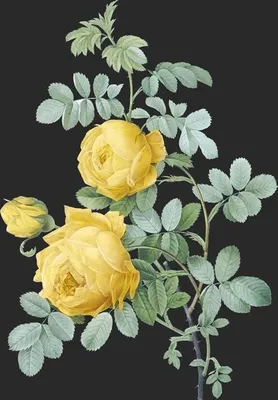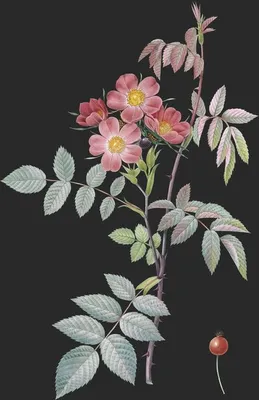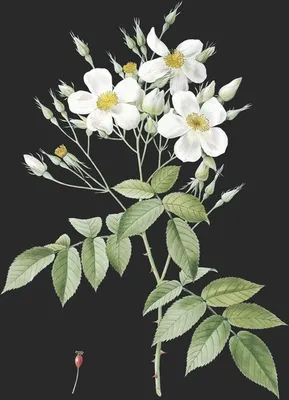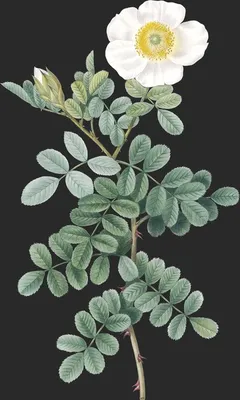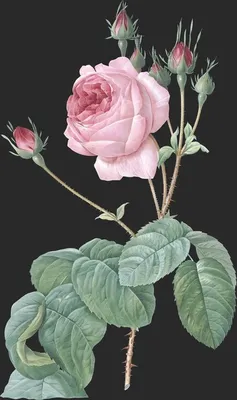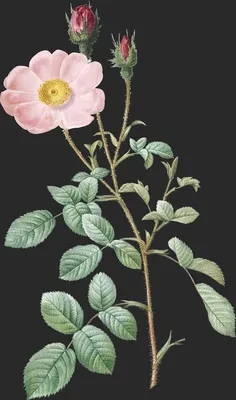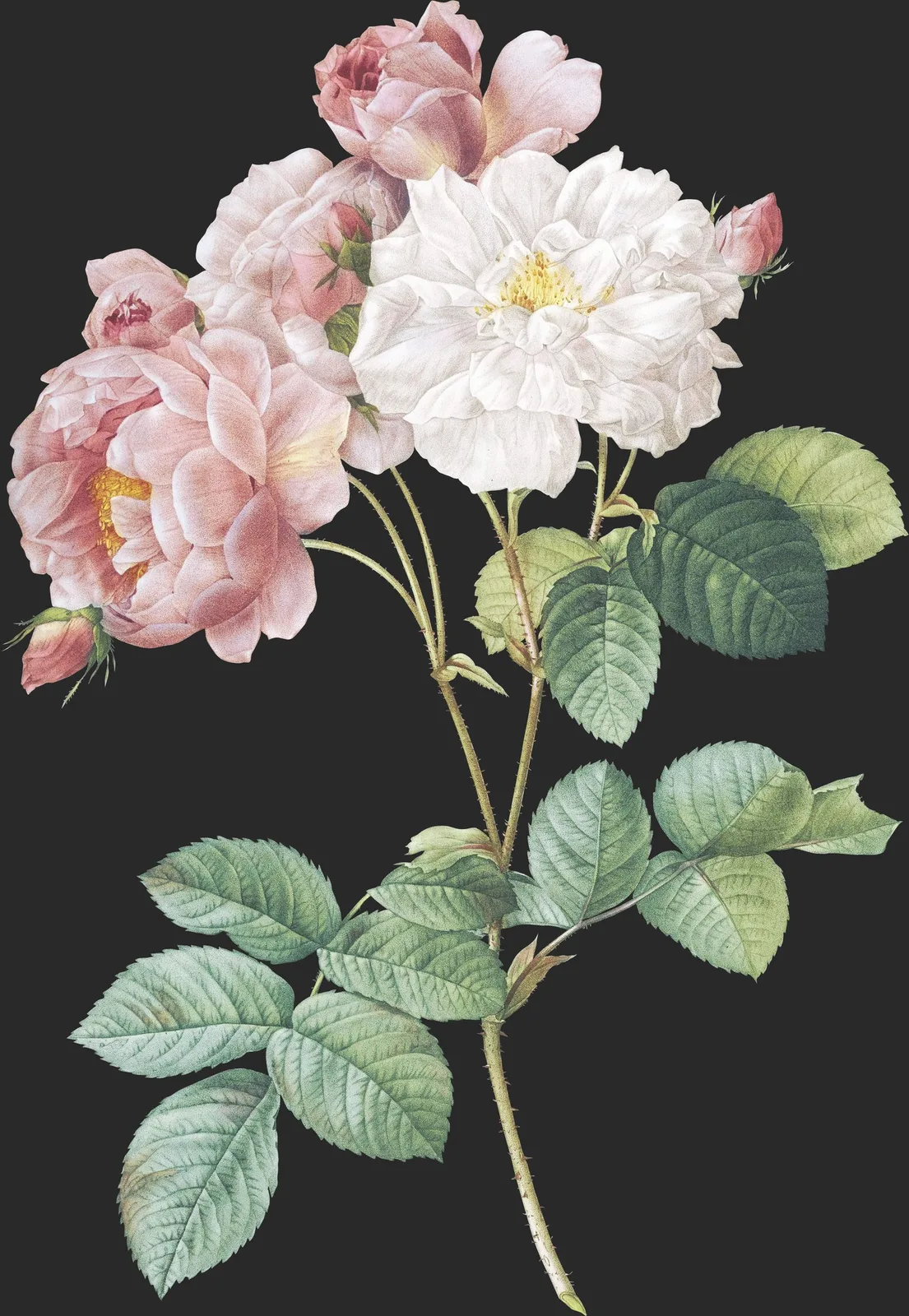
Rosa Damascena var Celsiana
狗牙蔷薇
Le Rosier de Cels
About this plate
Description
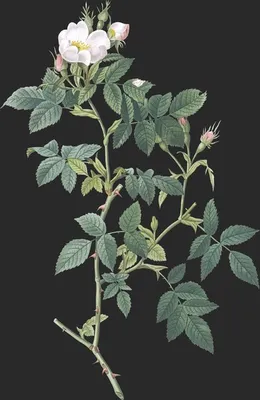
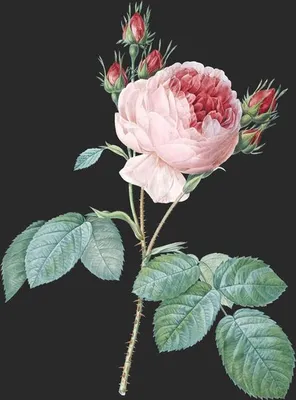
Ce Rosier s’élève en buisson à la hauteur de deux pieds et demi à trois pieds. Ses tiges sont armées d’aiguillons courts, inégaux (les plus longs presque droits), et parsemées d’un grand nombre de poils roides, glanduleux, qui se détachent promptement et laissent voir à leur place une multitude de petites cicatrices noirâtres. Les feuilles se composent de cing ou de sept folioles, ovales, d’un verd-elair en-dessus, plus pâles en-dessous, simplement dentées, supportées par un pétiole glanduleux, garni de plusieurs petits aiguillons rougeâtres et à-peu-près droits: à la base de ce pétiole sont deux stipules pointues au sommet, denticulées et munies de glandes en leur bord. Les fleurs, souvent larges de près de trois pouces, odo-rantes, érigées, se réunissent à l’extrémité des rameaux, en une espèce de corymbe. Les pédoncules et les pédicelles sont couverts de poils visqueux, roides, inégaux, surmontés de glandes. Le tube du calice, aminci aux deux extrémités et renflé au milieu, est presque glabre dans sa partie supérieure, et glanduleux à sa base. Les divisions du limbe sont pinnatifides, légèrement cotonneuses à l’intérieur, et glanduleuses extérieurement. Corolle de cinq à six rangs de pétales, échancrés en cœur au sommet, ceux du centre roulés et chiffonnés; les pétales sont, au moment de l’épanouissement, d’une couleur de rose-tendre; mais ils pâlissent, promptement, au point de devenir absolument blancs; de sorte que l’arbuste, qui fournit d’ailleurs un très-grand nombre de fleurs, paraît couvert de fleurs roses et de fleurs blanches en même temps. Ses fruits parviennent rarement à maturité.
Observations particulières à cet arbuste
Les botanistes et les amateurs se sont réunis pour dédier cette magnifique variété au célèbre pépiniériste qui, le premier, l’a répandue dans les jardins français, à Jacques-Martin Cels, auteur de savantes dissertations sur diverses branches d’agriculture, membre de l’Institut à l’époque de l’établissement de cette compagnie, et de la société d’agriculture du département de la Seine, mort à Paris au mois de mai 1806. Toutefois ce Rosier était connu dans les jardins d’Harlem bien avant l’époque où Cels l’a commu-niqué, puisqu’on le trouve peint dans plusieurs des tableaux du célèbre Van-Husum. II ne reste donc au savant pépiniériste que le mérite de l’avoir propagé dans sa patrie, et c’est, assurément, l’un des plus beaux présents qu’il ait pu faire aux amateurs de la Rose.
Le Rosier de Cels t’exige que la culture ordinaire, c’est-à-dire quelques labours dans la saison, et de l’eau dans les sécheresses. Il est d’un très-bel effet greffé sur le Rosier sauvage; mais pour jouir long-temps de ses fleurs, il faut l’abriter du grand soleil.
Ten ways of seeing
- measured cast red
- upright 1.45 : 1
- published 1821
- Plate 81
Not a catalogue entry but a way of looking: how to stand, what to notice, how the line was cut — then, halfway, a line of Chinese poetry: how the ancients saw this same flower. After it, the flower's language, its season and homeland, its book; and at the end one line of classical prose — and a pair of eyes to take away.
-
First Look
夫象物必在于形似,形似须全其骨气。
—— 唐·张彦远《历代名画记》
Likeness is the threshold; bone-and-breath is the point.
The sheet is vertical: the eye climbs and settles in the upper half. Let the plant stand before you look for detail. Then step in close: watch where colour meets line, and whether the line ever breaks. Third, find where the green is deepest: the whole tonal order is measured from that patch.
-
Name and Thing
The binomial is Rosa damascena: the first word is the genus it belongs among, the second the epithet that sets it apart. Here the epithet damascena means “of Damascus” — the name records the feature the namer noticed first. The Chinese name 狗牙蔷薇 is a modern rendering of the Latin, not an old garden name.
-
Form and Colour
Measured on this plate: flower colour covers 7.1% of the sheet, foliage 5.7%, the cast red with a second note of yellow-green. No other plate shares exactly this measure. Roses are shrubs or scramblers with pinnate leaves of three to seven serrated leaflets; the double flowers open in crumpled, inward-curling layers around a small knot of yellow stamens. Filed under green — a moss green, a colour that comes mostly from leaf and stem. Read the outline, then the colour layers, then the brush.
-
Composition
Tall and narrow, the plant rising in one movement with generous margins — the upright format of most floras. (about 1.45 : 1) No details are appended: a plate for looking, not for keying out. The plant fills 45% of the sheet, centred above centre — the herbarium way, drawn to be read whole. Old plates set the plant slightly off centre, with unequal margins — that small imbalance is what keeps it alive.
-
Line and Colour
The first half of the nineteenth century moved from copper to steel to lithography; stipple could render the softest transition. Take a loupe to three places: petal edge, leaf vein, caption. An unbroken line means engraving; colour crossing the outline means a hand. If you mean to copy it: take its skeleton, its margins and the order of its colours; the burin's hatching is the language of copper — suggest it with pencil density, do not imitate it stroke for stroke.
-
Poetic Resonance
有情芍药含春泪,无力蔷薇卧晓枝。
—— 宋·秦观《春日》
The peony, feeling, holds spring tears; the rose, strengthless, lies across the morning branch.
The poem gives the mood first and the picture supplies the form; set the line beside the plate and the green the corolla becomes its resting point.
-
Symbolism
In Europe the rose means love and secrecy ('sub rosa'); in Chinese verse the rambling rose leans and clings — lingering attachment rather than ardour. In a flora it is a species first and a symbol second; the order is worth keeping.
-
Season and Place
Late spring into early summer, peaking in May — the first flush of the garden year. the ever-blooming modern rose is a nineteenth-century crossing of European and Chinese stock. The year 1821 on the plate is that of publication, not of flowering — the gathering came a year or two earlier. The bud and the ripe fruit on one branch tell the season; the name in the title often tells the journey.
-
The Book and the Hand
“Les Roses” was drawn by Pierre-Joseph Redouté and published 1817-1824. This plate is Plate 81, book page 81. The image is public domain; the hand-colouring is still one person's hand.
-
The Written Tradition
庭下如积水空明,水中藻荇交横,盖竹柏影也。
—— 宋·苏轼《记承天寺夜游》
The courtyard seemed flooded with clear water, weeds crossing in it — in fact the shadows of bamboo and cypress.
Tradition places roses in the Han imperial park; Song and Ming manuals named the double forms 'Baoxiang' and 'Ten Sisters', and Qing compendia separated rose, rugosa and monthly rose. The difference is not of quality but of question: Europe asks what it is, China asks whom it resembles.
What to Take Away
Carry three rules away: whole before detail; line before colour; picture before book. Two centuries on, the plant may still flower in some garden; the one on this sheet stopped in the season of 1821.