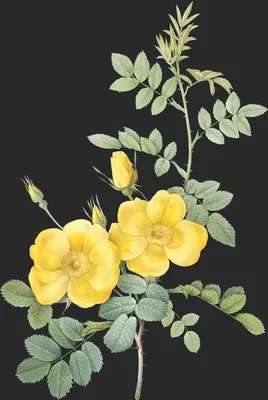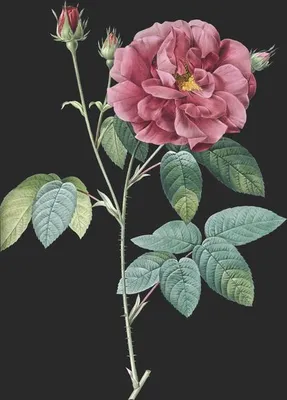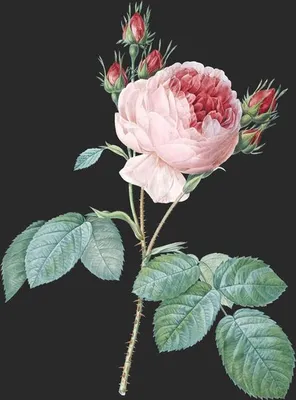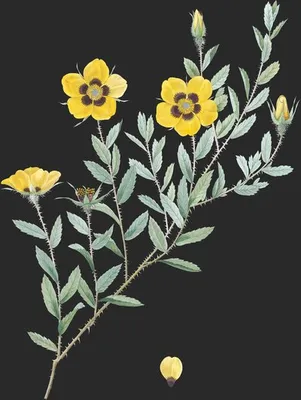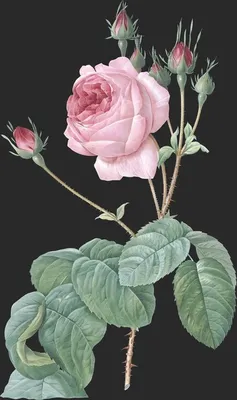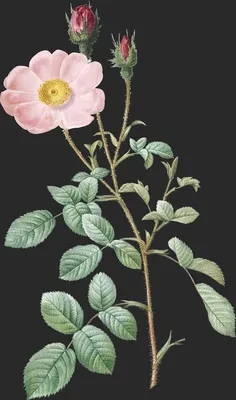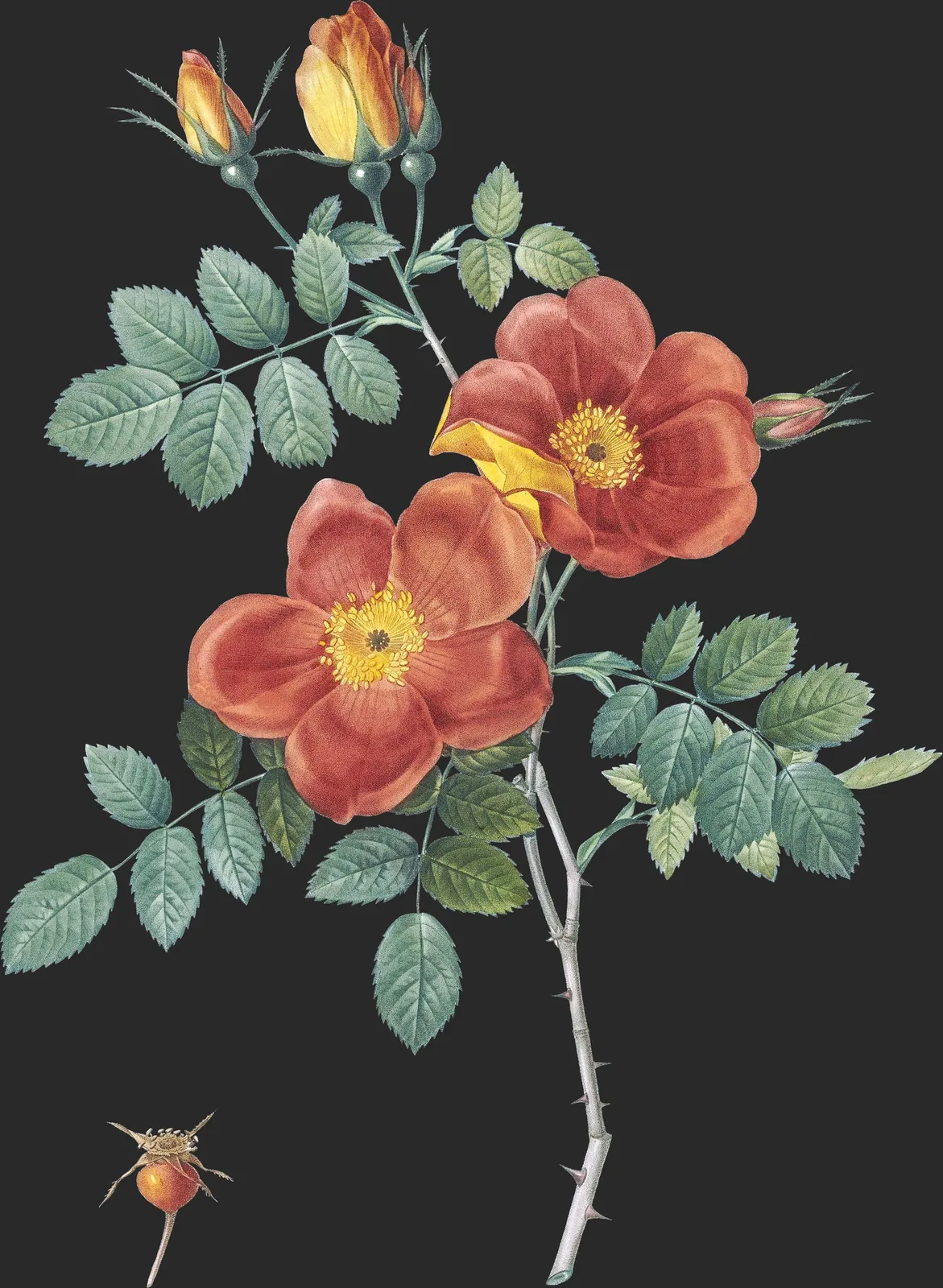
Rosa Eglanteria var Punicea
Le Rosier Églantier
Le Rosier Églantier
About this plate
Description
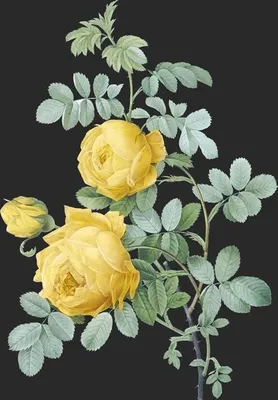
La fleur que produit ce Rosier est connue dans les jardins sous les noms vulgaires de Rose Capucine, Rose Comtesse, ou de Rose d’Autriche. La description que nous avons donnée de la fleur ainsi que de l’arbuste (p. 69), convient absolument à la variété qui nous occupe, sauf cependant les modifications suivantes:
- Les pétales offrent une belle couleur ocrée en-dedans, avec une teinte de jaune-orange en-dehors. Quelquefois ces mêmes pétales sont panachés par des bandes jaunes avec d’autres bandes plus ou moins pourpres; telle est celle que M. DUPONT a nommée Rose Tulipe.
- Une légère teinte de rouge se fait remarquer sur les tiges et sur les branches du R. ponceau, lorsque celles de l’églantier jaune sont d’un gris-verdâtre.
- Les fleurs dans cette variété sont moins fétides, et les feuilles moins odorantes.
Malgré ces différences, la plupart des naturalistes ont considéré les deux individus comme une seule et même espèce, par le motif très-admissible que les deux Roses se trouvent quelquefois réunies sur un même pied.
Cette plante est figurée dans l’ouvrage de Roessig.
Haller, dans son Hist. Stirpium indigenarum Helvetiæ, 2., pag. 39, № 1103; Leysser, dans sa Flora Hallensis, № 489, et d’autres auteurs, ont réuni la R. Eglanteria à la Rubiginosa, à cause du parfum des feuilles, qui est à-peu-près le même dans les deux espèces. Mais la couleur et le petit diamètre des fleurs de la Rubiginosa, qui est d’ailleurs bien éloignée de répandre l’odeur fétide de celles de l’Eglanteria; le tube du calice constamment globuleux dans celle-ci, tandis qu’il est très-variable dans la Rubiginosa; enfin l’habitus des deux Rosiers les éloignent l’un de l’autre suffisamment pour permettre d’en faire deux espèces distinctes.
La variété de couleur ponceau nous a paru moins disposée à s’élever que l’Eglantier Jaune. Elle trace beaucoup, et se plaît dans tous les terrains.
- R. Calycibus (subintegris) germinibus globosis, glandulosis, pedunculis glabris, foliolis ovatis glabris serratis, serraturis petiolisque glandulosis, floribus bicoloribus. Du Roi. Harbkesche, 2 p. 347. Corn. plant. Canad. hist. 11. Roessig, № 5.
- R. Bicolor. Jacq. Hort. Bot. Vindobonensis, 3, p. 1.
- R. Lutea. Ait. Kew. 2, p. 200, № 1, v. β. Willd. spec. 2, p. 1064, v. β. Poir. Encyc. vol. 6, p. 290, v. β. D. C. Catal. Monspel. p. 55, v. β.
- R. Eglanteria. D. C. Fl. Franç. 3694, v. β. Nouv. Duhamel, vol. 7, p. 45, v. β.
Twelve ways of seeing
- measured cast red
- upright 1.37 : 1
- published 1817
- Plate 24
Not a catalogue entry but a way of looking: how to stand, what to notice, how the line was cut, when it flowers, where it came from, who made it — and then the poems and the classics that taught China to see the same flower. Read the twelve in order and the plate opens.
-
First Look
搜尽奇峰打草稿。
—— 清·石涛《苦瓜和尚画语录》
Exhaust the strange peaks, and then make the sketch.
The sheet is vertical: the eye climbs and settles in the upper half. Let the plant stand before you look for detail. Then step in close: watch where colour meets line, and whether the line ever breaks. Third, find where the orange is deepest: the whole tonal order is measured from that patch.
-
Name and Thing
The binomial is Rosa eglanteria: the first word is the genus it belongs among, the second the epithet that sets it apart. The genus name Rosa: Rosa is simply the Latin for rose, from Greek rhodon. No established Chinese name exists, so it is cited by its binomial alone.
-
Form and Colour
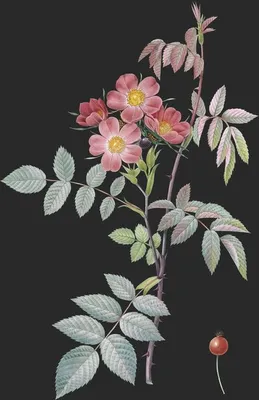
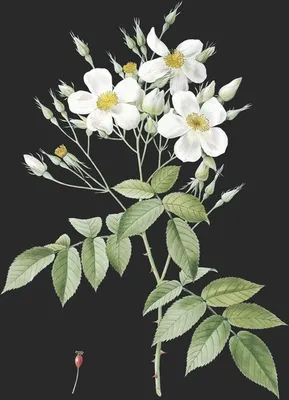
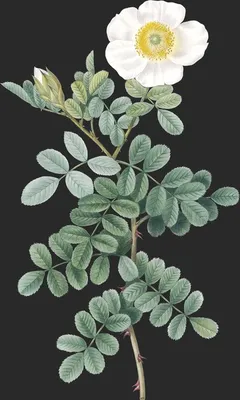
Measured on this plate: flower colour covers 14.3% of the sheet, foliage 5.1%, the cast red with a second note of amber. No other plate shares exactly this measure. Roses are shrubs or scramblers with pinnate leaves of three to seven serrated leaflets; the double flowers open in crumpled, inward-curling layers around a small knot of yellow stamens. Filed under orange — an amber orange, built in washes from a pale ground. A single plant, laid out with nothing hidden.
-
Composition
Tall and narrow, the plant rising in one movement with generous margins — the upright format of most floras. (about 1.37 : 1) No details are appended: a plate for looking, not for keying out. The plant takes about 32% of the sheet, centred near the centre — the easy measure most florists kept to. Old plates set the plant slightly off centre, with unequal margins — that small imbalance is what keeps it alive.
-
Line and Colour
The first half of the nineteenth century moved from copper to steel to lithography; stipple could render the softest transition. There is evidence on the back too: the plate mark pressed into the paper, the slight relief of the pigment, lines worn shallow in a later printing.
-
Season
Late spring into early summer, peaking in May — the first flush of the garden year. The year 1817 on the plate is that of publication, not of flowering — the gathering came a year or two earlier. The best time to read such a plate is its flowering season: three minutes under the tree explains what no text can.
-
Provenance
Widespread in the temperate north. Chinese gardeners knew roses since the Han; the ever-blooming modern rose is a nineteenth-century crossing of European and Chinese stock. The volume was made in 1817-1824, when most of this knowledge came from living plants under glass.
-
The Book and the Hand
“Les Roses” was drawn by Pierre-Joseph Redouté and published 1817-1824. This plate is Plate 24, book page 24. The image is public domain; the hand-colouring is still one person's hand.
-
Poetic Resonance
苍翠浓阴满院,莺对语,蝶交飞,戏蔷薇。
—— 《定西番·苍翠浓阴满院》
The poem gives the mood first and the picture supplies the form; set the line beside the plate and the orange the corolla becomes its resting point.
-
The Written Tradition
插花不可太繁,亦不可太瘦。多不过二种三种,高低疏密,如画苑布置方妙。
—— 明·袁宏道《瓶史·宜称》
Flowers should be set neither too crowded nor too sparse — two or three kinds at most, tall and low, dense and open, arranged as a painter would compose.
Tradition places roses in the Han imperial park; Song and Ming manuals named the double forms 'Baoxiang' and 'Ten Sisters', and Qing compendia separated rose, rugosa and monthly rose. You need not parse every word: take the line, and the flower acquires a second face.
-
Symbolism
In Europe the rose means love and secrecy ('sub rosa'); in Chinese verse the rambling rose leans and clings — lingering attachment rather than ardour. This plate leans orange, which in flower language adds one more degree of feeling. In a flora it is a species first and a symbol second; the order is worth keeping.
-
What to Take Away
If you keep one line, keep Guo Xi's: from afar its momentum, up close its texture. The flower of that year is dust, yet its image on paper has outlived every living cousin.