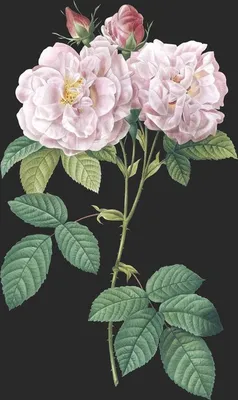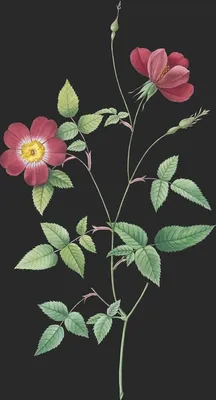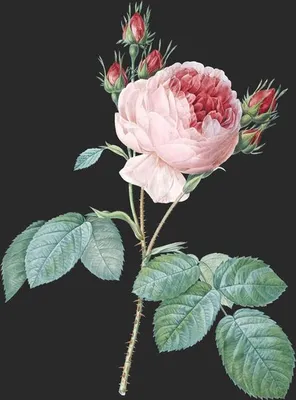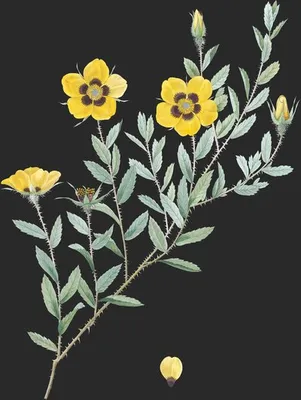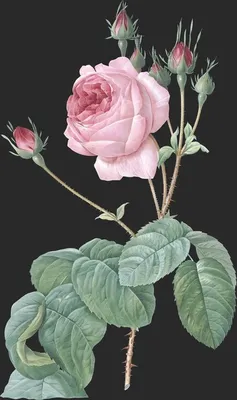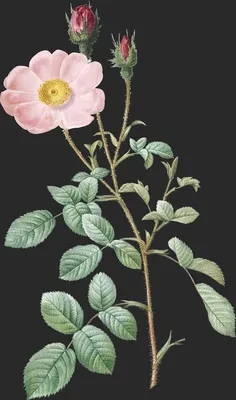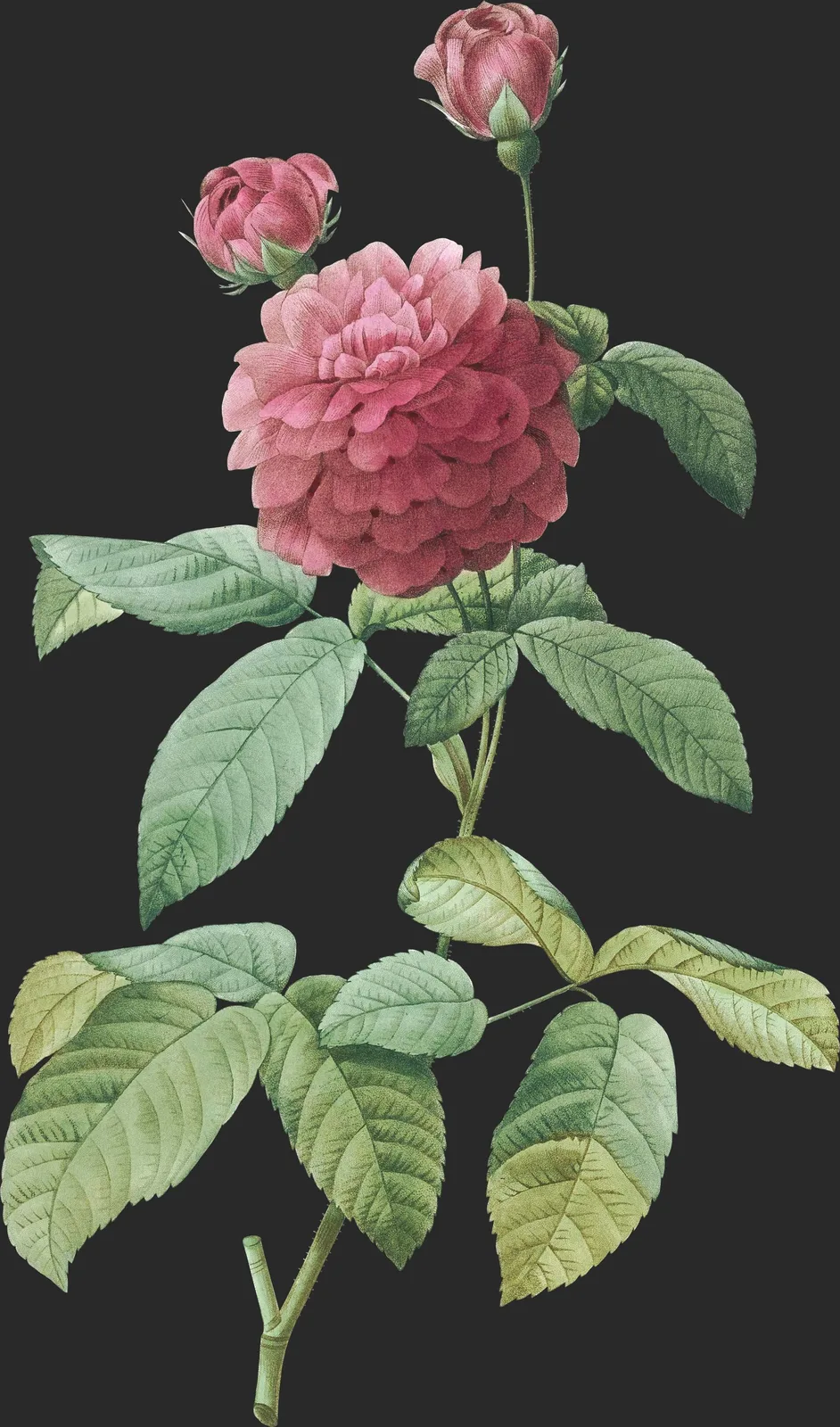
Rosa Gallica Agatha var Delphiniana
L’Énfant de France
L’Énfant de France
Ten ways of seeing
- measured cast red
- upright 1.70 : 1
First Look
搜尽奇峰打草稿。
—— 清·石涛《苦瓜和尚画语录》
Exhaust the strange peaks, and then make the sketch.
The sheet is vertical: the eye climbs and settles in the upper half. Let the plant stand before you look for detail. Then step in close: watch where colour meets line, and whether the line ever breaks. Third, find where the green is deepest: the whole tonal order is measured from that patch.
Name and Thing
Only the genus Rosa is given; species-level names came later. No established Chinese name exists, so it is cited by its binomial alone.
Form and Colour
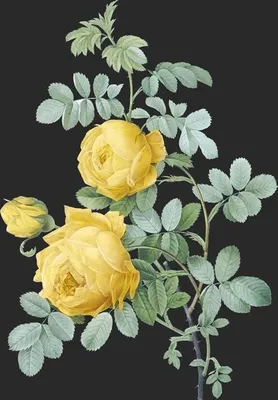
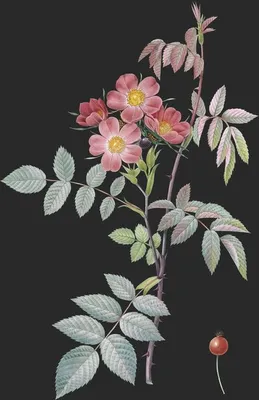
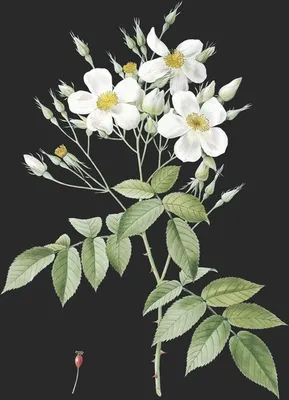
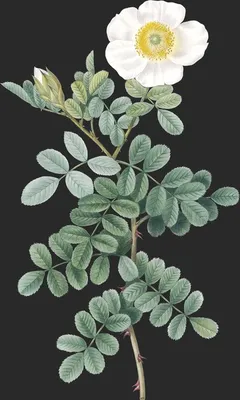
Measured on this plate: flower colour covers 10.3% of the sheet, foliage 16.5%, the cast red with a second note of yellow-green. No other plate shares exactly this measure. Roses are shrubs or scramblers with pinnate leaves of three to seven serrated leaflets; the double flowers open in crumpled, inward-curling layers around a small knot of yellow stamens. a moss green. Read the outline, then the colour layers, then the brush.
Composition
The sheet is tall. No details are appended: a plate for looking, not for keying out. The plant takes about 37% of the sheet, centred near the centre — the easy measure most florists kept to.
Line and Colour
The first half of the nineteenth century moved from copper to steel to lithography; stipple could render the softest transition. Decide first whether it was printed or painted; only then discuss whether it is beautiful. If you mean to copy it: take its skeleton, its margins and the order of its colours; the burin's hatching is the language of copper — suggest it with pencil density, do not imitate it stroke for stroke.
Poetic Resonance
不逐凡花逞艳娇,移根上苑独清高。
—— 唐·楊巽齋《御仙花》
The poem gives the mood first and the picture supplies the form; set the line beside the plate and the green the corolla becomes its resting point.
Symbolism
In Europe the rose means love and secrecy ('sub rosa'); in Chinese verse the rambling rose leans and clings — lingering attachment rather than ardour. Flower language was added later; the flower knows nothing of it, and that innocence is part of its power.
Season and Place
Late spring into early summer, peaking in May — the first flush of the garden year. the ever-blooming modern rose is a nineteenth-century crossing of European and Chinese stock. The year 1824 on the plate is that of publication, not of flowering — the gathering came a year or two earlier. The bud and the ripe fruit on one branch tell the season; the name in the title often tells the journey.
The Book and the Hand
“Les Roses” carries only Pierre-Joseph Redouté's name. The image is public domain; the hand-colouring is still one person's hand.
What to Take Away
If you keep one line, keep Guo Xi's: from afar its momentum, up close its texture. The flower of that year is dust, yet its image on paper has outlived every living cousin.
About this plate
Description
Arbrisseau qui sélève en buisson à la hauteur de trois pieds, ou environ. Ses branches, surtout dans leur partie supérieure, sont garnies d’un grand nombre de petits aiguillons inégaux, presque droits, entremêlés de glandes pédicellées. Les feuilles se composent de cinq folioles d’un vert assez obscur, petites, eu égard à la dimension ordinaire des folioles des autres variétés de la même espèce, ovales-oblongues, arrondies à la base et pointues au sommet, glabres en-dessus, légèrement tomenteuses en-dessous et sur leur bordure. Elles sont supportées par un pétiole glanduleux, muni de quelques petits aiguillons très-courts, ayant à sa base des stipules décurrentes, pointues au sommet, et glanduleuses en leur bord. Les fleurs sont disposées par deux, rarement par trois, à l’extrémité des ra-meaux. Les tubes des calices sont couverts, ainsi que les pédoncules qui les portent, de poils spinuliformes surmontés, en grande partie, de petites glandes rougeâtres. Les divisions du limbe, trois pinnatifides et deux simples, sont glanduleuses à l’extérieur, et couvertes d’un duvet blanchâtre à l’intérieur. La corolle offre un grand nombre de pétales très-rapprochés entre eux, d’un beau rose un peu foncé, renversés les uns sur les autres sous la forme d’un pompon militaire, de sorte que l’on n’aperçoit jamais, dans les fleurs bien faites, les divisions du limbe qui se trouvent entièrement recouvertes. Le fruit est pyriforme et rouge à la maturité.
Observations
Ce Rosier est remarquable par la beauté et en même temps par la singularité de ses fleurs: c’est Du Pont qui l’a communiqué aux amateurs vers l’année 1802. Selon lui, il était connu sous le règne de Louis XV, et les Hollandais lavaient dédié au grand Dauphin, d’où vient le nom d’Enfant de France qui lui a été imposé alors, et qu’il a touiours conservé.
Cette variété du Provins-Agathe se trouve rarement fran-che; en général on ne la rencontre que greffée sur églantier dans les collections. Nous avons pris notre modèle dans le jardin fleuriste du Roi, à Sèvres, où les curieux pourront en voir de très-beaux pieds.
- R. germinibus ovatis pedunculisque glanduloso-hispidulis; caule petiolisque aculeatis; foliolis ovalibus, supra glabris; subtus margineque pubescentibus; Moribus subgeminatis. (N.)