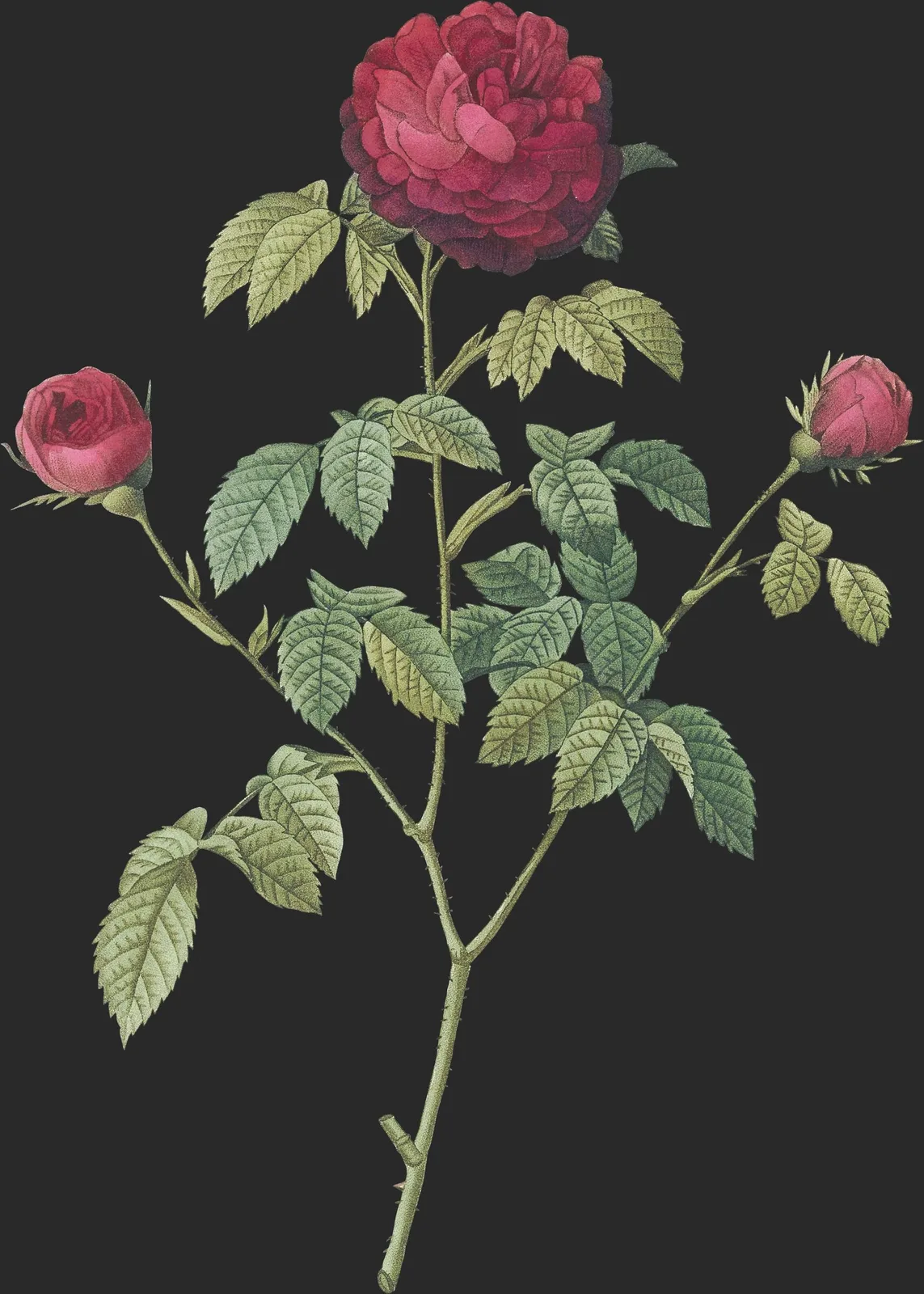
Rosa Gallica Agatha var Parvula Violacea
狗牙蔷薇
Le Rosier de Provins-Agathe
Ten ways of seeing
- measured cast red
- upright 1.40 : 1
First Look
论画以形似,见与儿童邻。
—— 宋·苏轼《书鄢陵王主簿所画折枝》
To judge painting by likeness alone is the view of a child.
The sheet is vertical: the eye climbs and settles in the upper half. Let the plant stand before you look for detail. Then step in close: watch where colour meets line, and whether the line ever breaks. Third, find where the green is deepest: the whole tonal order is measured from that patch.
Name and Thing
Only the genus Rosa is given; species-level names came later. The Chinese name 狗牙蔷薇 is a modern rendering of the Latin, not an old garden name.
Form and Colour
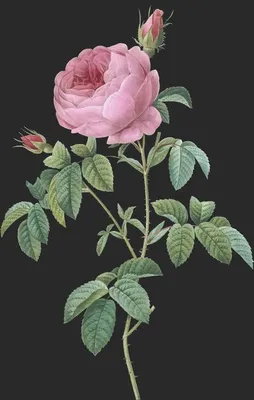
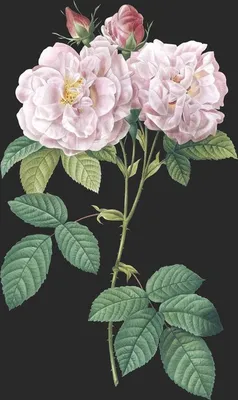
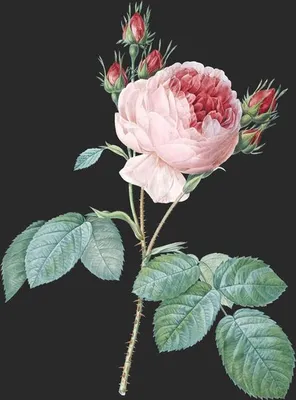
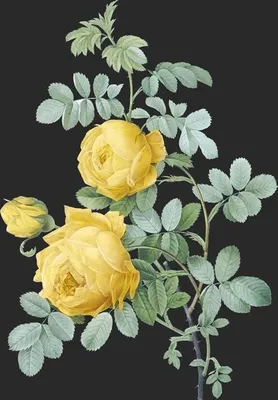
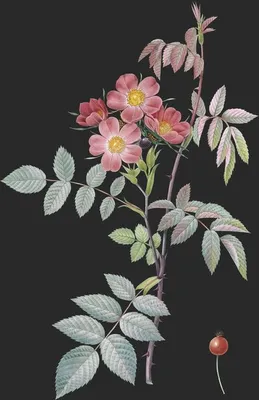
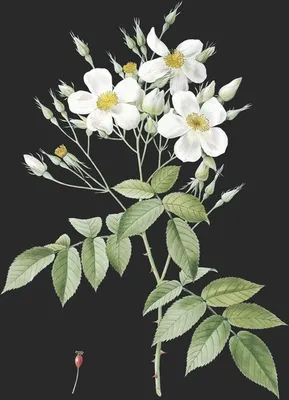
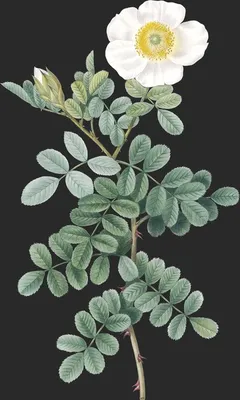
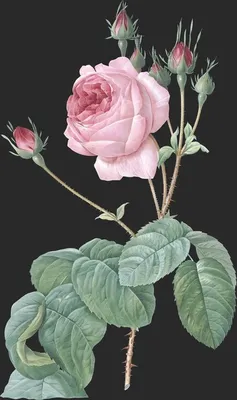
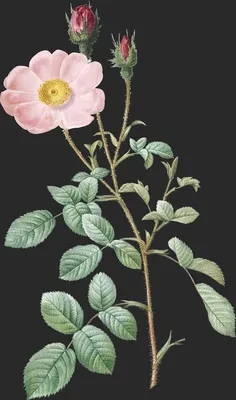
Measured on this plate: flower colour covers 8.9% of the sheet, foliage 7.1%, the cast red with a second note of yellow-green. No other plate shares exactly this measure. Roses are shrubs or scramblers with pinnate leaves of three to seven serrated leaflets; the double flowers open in crumpled, inward-curling layers around a small knot of yellow stamens. a moss green. A single plant, laid out with nothing hidden.
Composition
The sheet is tall. No details are appended: a plate for looking, not for keying out. The plant covers only 23% of the sheet, centred above centre; the emptiness is where the eye rests.
Line and Colour
The first half of the nineteenth century moved from copper to steel to lithography; stipple could render the softest transition. Take a loupe to three places: petal edge, leaf vein, caption. An unbroken line means engraving; colour crossing the outline means a hand. If you mean to copy it: take its skeleton, its margins and the order of its colours; the burin's hatching is the language of copper — suggest it with pencil density, do not imitate it stroke for stroke.
Poetic Resonance
对花何似,似吴宫初教,翠围红阵。
—— 宋·辛弃疾《念奴娇》
The poem gives the mood first and the picture supplies the form; set the line beside the plate and the green the corolla becomes its resting point.
Symbolism
In Europe the rose means love and secrecy ('sub rosa'); in Chinese verse the rambling rose leans and clings — lingering attachment rather than ardour. Flower language was added later; the flower knows nothing of it, and that innocence is part of its power.
Season and Place
Late spring into early summer, peaking in May — the first flush of the garden year. Widespread in the temperate north. Chinese gardeners knew roses since the Han. The year 1824 on the plate is that of publication, not of flowering — the gathering came a year or two earlier. The bud and the ripe fruit on one branch tell the season; the name in the title often tells the journey.
The Book and the Hand
“Les Roses” carries only Pierre-Joseph Redouté's name. The image is public domain; the hand-colouring is still one person's hand.
What to Take Away
Next time you stand before a flowering plant, give it three minutes: leaf arrangement, direction of the flower, the darkest patch. The flower of that year is dust, yet its image on paper has outlived every living cousin.
About this plate
Description
C’est une variété du Rosier de Provins, ou de France, qui entre dans la série de celles qu’on nomme Rosiers Agathes, dont la fleur est très-double, à pétales serrés, roulés et chiffonnés au centre.
L’arbrisseau sélève à peine à un pied et demi. Ses branches, diffuses, sont couvertes; dans leur partie supérieure, d’un grand nombre de poils spinuliformes. La partie inférieure des tiges est garnie d’un petit nombre d’aiguillons épars, inégaux, entremêlés de glandes. Les feuilles, penchées d’une manière assez remarquable, se composent de cinq, parfois de sept folioles de forme ellipsoide, vertes et glabres en-dessus, plus pâles en-dessous, finement et doublement dentées. Le pétiole qui les supporte est muni de poils glanduleux entremêlés de petits aiguillons droits. Les fleurs, latérales et terminales, d’un petit diamètre, sont, le plus souvent solitaires, rarement réunies par deux. Corolle de huit à dix rangs de pétales, d’un pourpre violet-foncé, plus pâles vers l’onglet, rapprochés à-peu-près comme ceux d’une renoncule. Les divisions du limbe sont pinnatifides, courtes, et dépassent à peine la fleur avant l’an-thèse. Fruits pyriformes, rouges ou de couleur d’orange foncée: ils persistent une grande partie de l’hiver.
Observations
Nous avons trouvé, l’été dernier, cette jolie variation du R. Gallica dans la riche collection de M. Le Dru. Les amateurs pourront se la procurer dans la pépinière de M. Vibert, à Chennevières-sur-Marne. Il nous a semblé qu’elle avait quelques rapports avec une Rose obtenue autrefois de semence par M. Descemet, qui nous l’a communiquée sous le nom de Rose Petite violette. Mais celle-ci est un peu plus grande. L’arbrisseau se plaît à l’ombre, et n’exige que la culture ordinaire. M. Le Dru le taille très-court.
- R. germinibus ovatis glabris; petiolis pedunculisque aculeatis; caule superne aculeato, aculeis inequalibus, sparsis; floribus parvulis subsolitaris. (N.)
- R. (Pumila) germinibus pyriformibus, pedunculis petiolisque glanduloso-hispidis; foliolis quinis, rigidis, supra nitidis: serraturis glandulosis. Wahl. Fl. Cauc. p. 150, № 491. (Fl. simpl.)
- R. (Austriaca) germinibus ovatis pedunculisque hispidis, caulibus subunifloris. Poll. Fl. Pal. 2, p. 30, № 484.
- R. sylvestris rubella parvo frutice. J. Bauh. Hist. 2, p. 35.
- R. sylvestris pumila rubens. C. Bauh. Pin. 483.
- La Petite Renoncule violette. Hort.