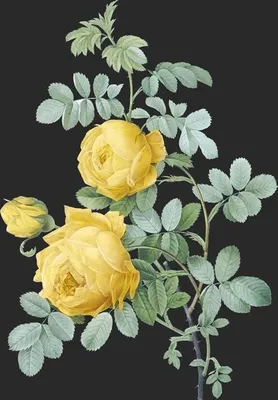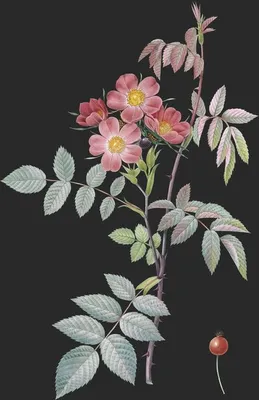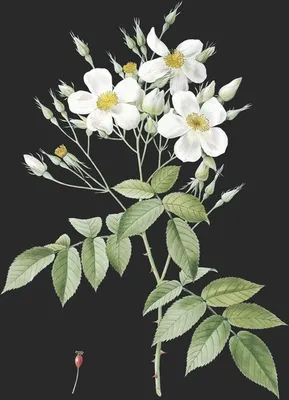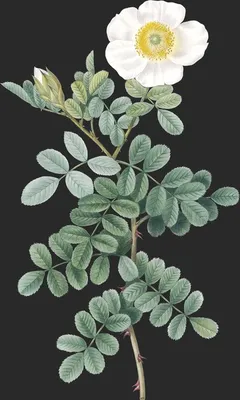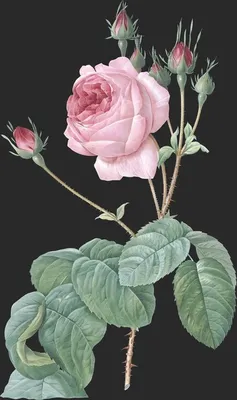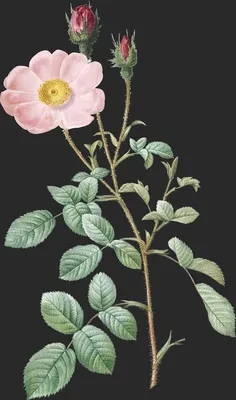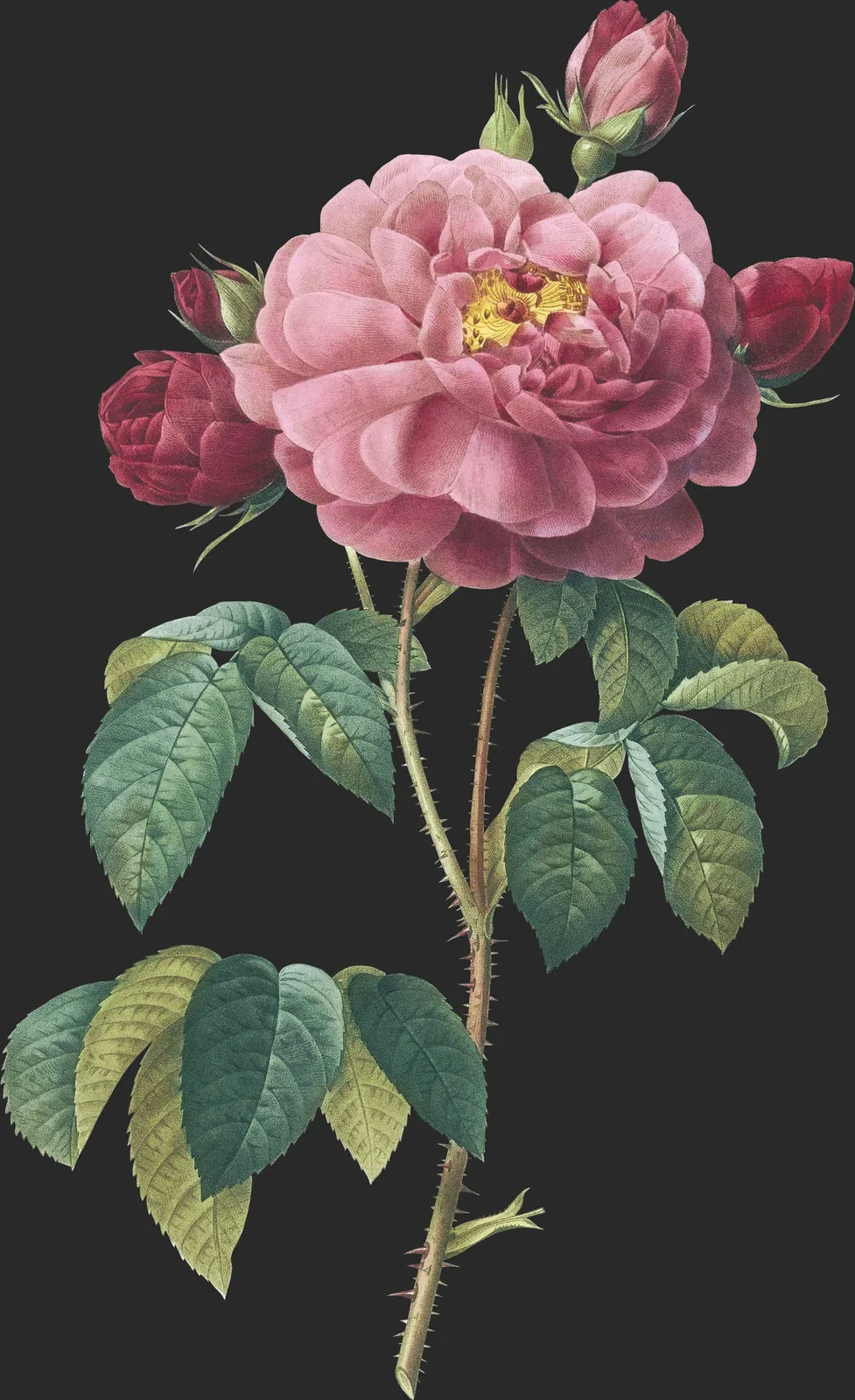
Rosa Gallica Auelianensis
La Duchesse d’Orléans
La Duchesse d’Orléans
Ten ways of seeing
- measured cast red
- upright 1.64 : 1
First Look
凡画山水,意在笔先。
—— 唐·王维《山水论》
In painting, the intention precedes the brush.
The sheet is vertical: the eye climbs and settles in the upper half. Let the plant stand before you look for detail. Then step in close: watch where colour meets line, and whether the line ever breaks. Third, find where the teal is deepest: the whole tonal order is measured from that patch. The pose leans right: the upper half carries 14 points further right than the lower — a living thing, not a diagram.
Name and Thing
Only the genus Rosa is given; species-level names came later. No established Chinese name exists, so it is cited by its binomial alone.
Form and Colour
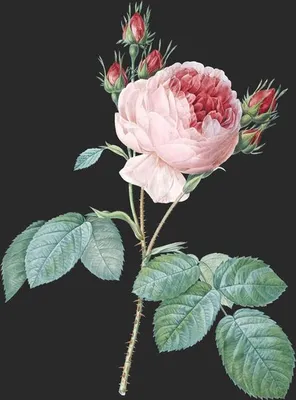
Measured on this plate: flower colour covers 20.6% of the sheet, foliage 10.0%, the cast red with a second note of yellow-green. No other plate shares exactly this measure. Roses are shrubs or scramblers with pinnate leaves of three to seven serrated leaflets; the double flowers open in crumpled, inward-curling layers around a small knot of yellow stamens. a blue-green like distant water. A single plant, laid out with nothing hidden.
Composition
The sheet is tall. No details are appended: a plate for looking, not for keying out. The plant fills 38% of the sheet, centred above centre — the herbarium way, drawn to be read whole.
Line and Colour
The first half of the nineteenth century moved from copper to steel to lithography; stipple could render the softest transition. Take a loupe to three places: petal edge, leaf vein, caption. An unbroken line means engraving; colour crossing the outline means a hand. If you mean to copy it: take its skeleton, its margins and the order of its colours; the burin's hatching is the language of copper — suggest it with pencil density, do not imitate it stroke for stroke.
Poetic Resonance
龙头泻酒客寿杯,主人浅笶红玫瑰。
—— 唐·李商隐《河阳诗》
The poem gives the mood first and the picture supplies the form; set the line beside the plate and the teal the corolla becomes its resting point.
Symbolism
In Europe the rose means love and secrecy ('sub rosa'); in Chinese verse the rambling rose leans and clings — lingering attachment rather than ardour. Meanings change their tune: the same flower can say opposite things within a century.
Season and Place
Late spring into early summer, peaking in May — the first flush of the garden year. Widespread in the temperate north. Chinese gardeners knew roses since the Han. The year 1824 on the plate is that of publication, not of flowering — the gathering came a year or two earlier. Read the locality and the flowering season both with a discount: one is hearsay, the other a ten-day peak.
The Book and the Hand
“Les Roses” carries only Pierre-Joseph Redouté's name. A plate is collective work: drawer, engraver and colourist were different hands, and the unnamed ones decided how good it looks.
What to Take Away
Next time you stand before a flowering plant, give it three minutes: leaf arrangement, direction of the flower, the darkest patch. A flora exists to be consulted; look long enough and you forget to consult — someone in 1824 gave a whole day to a single flower.
About this plate
Description
Cet arbrisseau, l’un des plus beaux du groupe des Rosiers de France, sélève en buisson à la hauteur de trois ou quatre pieds. La partie supérieure des branches est garnie d’un grand nombre de petits aiguillons rougeâtres, inégaux, entremêlés de glandes: leur partie inférieure n’en présente qu’un très-petit nombre qui se détachent promptement. Les feuilles se composent de trois, de cinq, parfois de sept folioles, grandes, fermes au toucher, glabres en-dessus, velues en-dessous, arrondies à la base, pointues au sommet, irrégulièrement den-tées, à dentelure ciliée, et non glanduleuse: elles sont portées par un pétiole muni d’un duvet très-court, et de quelques aiguillons. A sa base sont deux stipules bifides et pointues au sommet. Les fleurs, légèrement odorantes, sont, le plus ordinairement, disposées par trois à l’extrémité des rameaux. Le tube piriforme du calice, et le pédoncule qui le supporte, sont hispides-glanduleux. Les divisions calicinales sont cotonneuses à l’intérieur, et, munies, extérieurement, de petits poils pareils à ceux qui recouvrent les tubes. Corolle de cinq à six rangs de pétales d’un beau rose un peu foncé. Les fruits sont rouges à la maturité.
Observations
Cette belle variété se distingue de toutes celles du même groupe par l’élégance de son port, comme par le volume et la beauté de ses fleurs qui se développent tard, et brillent encore long-temps dans les parterres quand toutes les Roses sont défleuries. L’arbrisseau n’exige aucune culture; mais il demande l’exposition du midi et quelques arrosements. Il est rare dans les collections; cependant les curieux pourront en voir de très-beaux pieds, greffés, dans le jardin fleuriste du Roi, à Sèvres.
Dédié
Respectueusemem
A Son Altesse Royale
Madame la Duchesse d’Orléana
Par P. J. Redouté
XXX Septembre MDCCCXXI
R. germinibus pyriformibus, pedunculisque glanduloso-hispidis; petiolis glandulosis, aculeatis; caule superne aculeatissimo; cyma trifida. (N.)