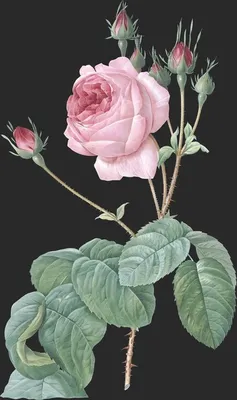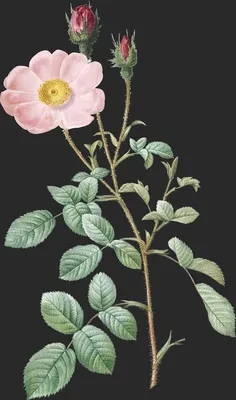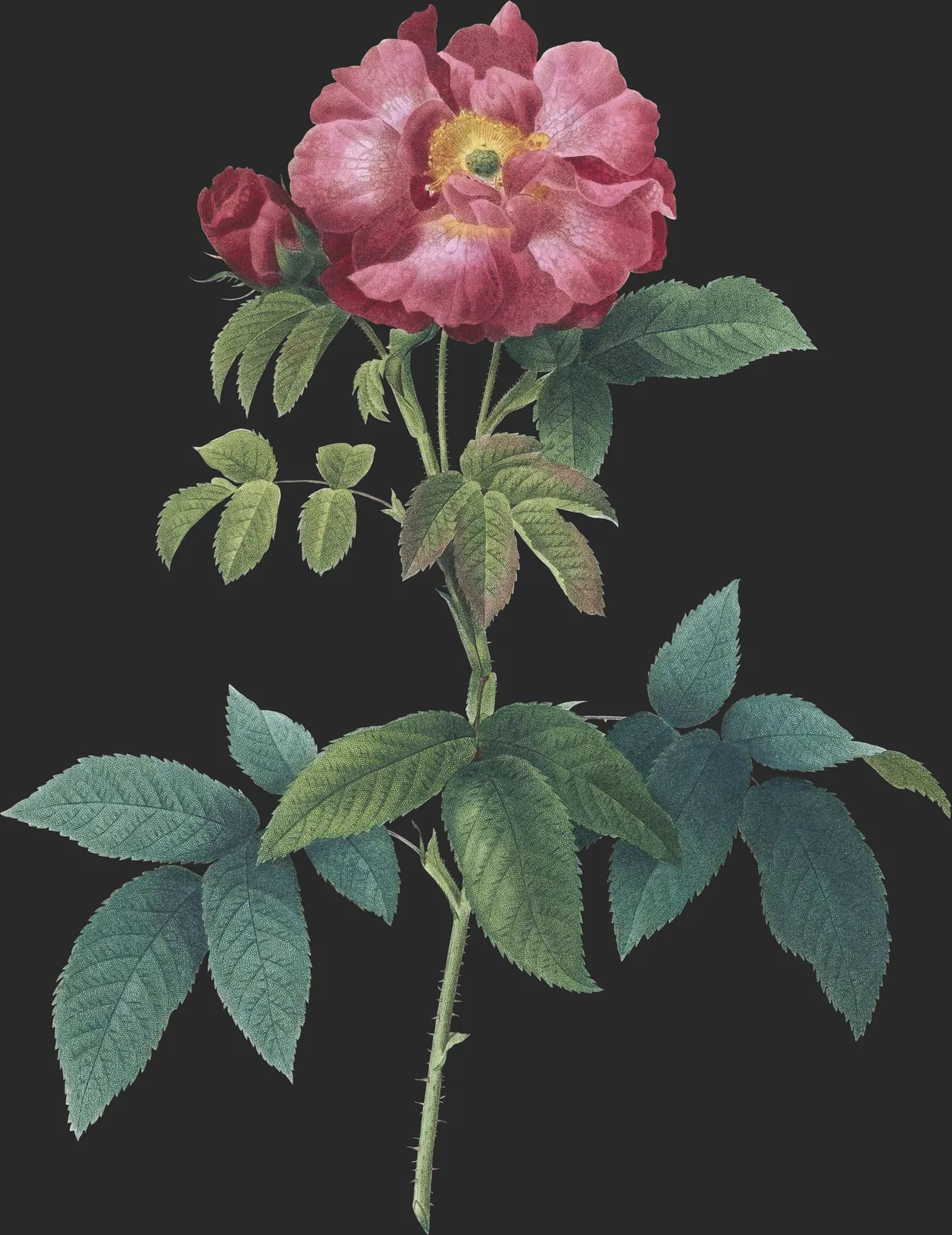
Rosa Gallica var Cœrulea
狗牙蔷薇
Le Rosier de Provins
About this plate
Description
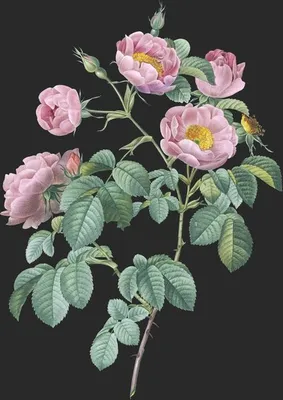
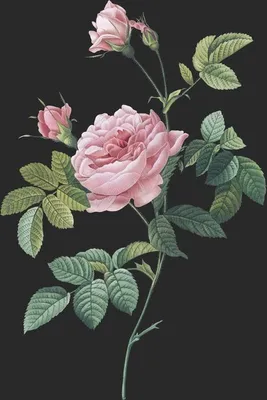
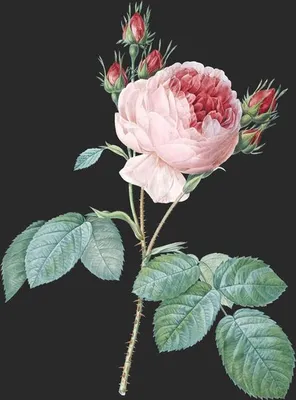
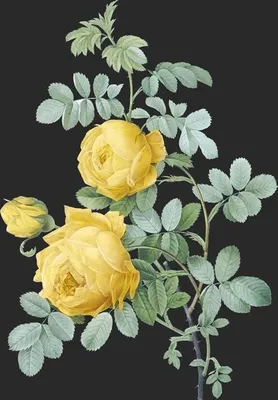
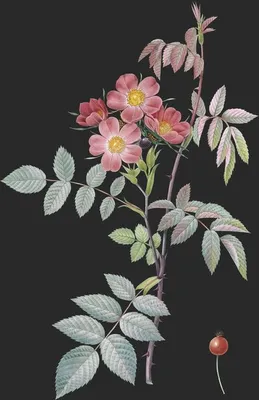
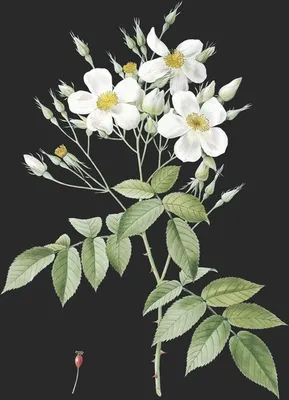
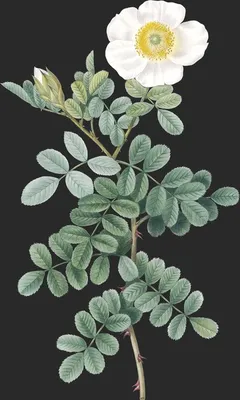
Arbrisseau qui s’élève, en buisson, à la hauteur de deux pieds, ou un peu plus. Ses branches sont armées d’aiguillons inégaux, rougeâtres, et presque droits. Les feuilles se composent de sept folioles oblongues, pointues au sommet, fermes au toucher, finement dentées, d’un vert glauque tirant sur la couleur bleue. Elles sont portées par un pétiole légèrement velu, un peu glanduleux, muni de quelques petits aiguillons jaunâtres, ayant à sa base des stipules bifides glanduleuses en leur bord. Les fleurs sont tantôt solitaires, tantôt disposées par deux ou trois à l’extrémité des rameaux. Le pédoncule qui les supporte, ainsi que le tube presque ovoïde du calice, sont recouverts de petites glandes sessiles. Les divisions du limbe, trois pinnatifides et deux simples, sont cotonneuses à l’inté-rieur, et couvertes, extérieurement, de pareilles glandes. Corolle de sept à huit rangs de pétales, d’un rouge-clair, panaché de plusieurs taches rapprochées et d’une teinte plus foncée. Le surplus de l’arbuste est semblable à tous les Gallica que l’on connaît.
Observations
Cette modification du Rosier de Provins a été obtenue, il y a quelques années, de semences faites dans le jardin du peintre de cet ouvrage, à Fleury. L’arbrisseau est très-romar-quable par ses folioles presque bleues. On le rencontre rarement franc de pied, mais on en trouve de très-beaux individus greffés dans la collection de M. Boursault, à Paris. Nous l’avons aussi vu dans le jardin fleuriste du Roi, à Sèvres: toutefois, il n’est pas commun. On le cultive comme tous les Provins; mais celui-ci demande l’exposition du midi. Ainsi placé, les incidences des rayons du soleil contribuent à faire ressortir encore la couleur bleue de ses folioles.
Twelve ways of seeing
- teal key
- slightly upright 1.30 : 1
- published 1821
- Plate 100
Not a catalogue entry but a way of looking: how to stand, what to notice, how the line was cut, when it flowers, where it came from, who made it — and then the poems and the classics that taught China to see the same flower. Read the twelve in order and the plate opens.
-
First Look
论画以形似,见与儿童邻。
—— 宋·苏轼《书鄢陵王主簿所画折枝》
To judge painting by likeness alone is the view of a child.
Slightly taller than wide; the eye lands above centre. Then step in close: watch where colour meets line, and whether the line ever breaks. Third, find where the teal is deepest: the whole tonal order is measured from that patch.
-
Name and Thing
The binomial is Rosa gallica: the first word is the genus it belongs among, the second the epithet that sets it apart. Here the epithet gallica means “of Gaul” — the name records the feature the namer noticed first. The Chinese name 狗牙蔷薇 is a modern rendering of the Latin, not an old garden name.
-
Form and Colour
Roses are shrubs or scramblers with pinnate leaves of three to seven serrated leaflets; the double flowers open in crumpled, inward-curling layers around a small knot of yellow stamens. Filed under teal — a blue-green like distant water, a colour that comes mostly from leaf and stem. A single plant, laid out with nothing hidden.
-
Composition
Slightly taller than wide, the plant set a little above centre. (about 1.30 : 1) No details are appended: a plate for looking, not for keying out. Cover the margins with your thumb and the plate suffocates; uncover them and the flower breathes again.
-
Line and Colour
The first half of the nineteenth century moved from copper to steel to lithography; stipple could render the softest transition. There is evidence on the back too: the plate mark pressed into the paper, the slight relief of the pigment, lines worn shallow in a later printing.
-
Season
Late spring into early summer, peaking in May — the first flush of the garden year. The year 1821 on the plate is that of publication, not of flowering — the gathering came a year or two earlier. The plate records ten days of peak; the other three hundred are leaf, fruit and rest.
-
Provenance
Widespread in the temperate north. Chinese gardeners knew roses since the Han; the ever-blooming modern rose is a nineteenth-century crossing of European and Chinese stock. The localities on the plate are those of a century ago; plants travel and places change their names.
-
The Book and the Hand
“Les Roses” was drawn by Pierre-Joseph Redouté and published 1817-1824. This plate is Plate 100, book page 100. The image is public domain; the hand-colouring is still one person's hand.
-
Poetic Resonance
春山杜宇唤人归,归见酴醾满架垂。
—— 宋·王十朋《酴醾次賈元節韻》
The poem gives the mood first and the picture supplies the form; set the line beside the plate and the teal the corolla becomes its resting point.
-
The Written Tradition
插花不可太繁,亦不可太瘦。多不过二种三种,高低疏密,如画苑布置方妙。
—— 明·袁宏道《瓶史·宜称》
Flowers should be set neither too crowded nor too sparse — two or three kinds at most, tall and low, dense and open, arranged as a painter would compose.
Tradition places roses in the Han imperial park; Song and Ming manuals named the double forms 'Baoxiang' and 'Ten Sisters', and Qing compendia separated rose, rugosa and monthly rose. You need not parse every word: take the line, and the flower acquires a second face.
-
Symbolism
In Europe the rose means love and secrecy ('sub rosa'); in Chinese verse the rambling rose leans and clings — lingering attachment rather than ardour. Meanings change their tune: the same flower can say opposite things within a century.
-
What to Take Away
Appreciation is not knowledge but habit — one more look each time. A flora exists to be consulted; look long enough and you forget to consult — someone in 1821 gave a whole day to a single flower.