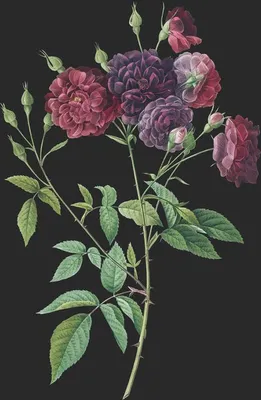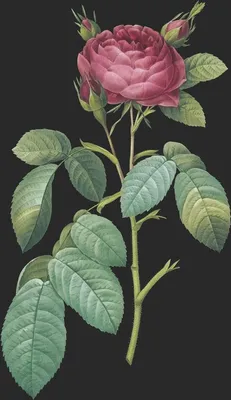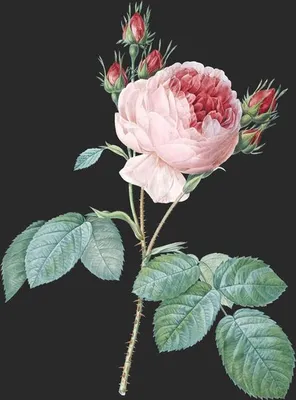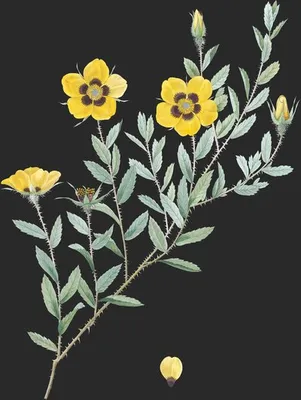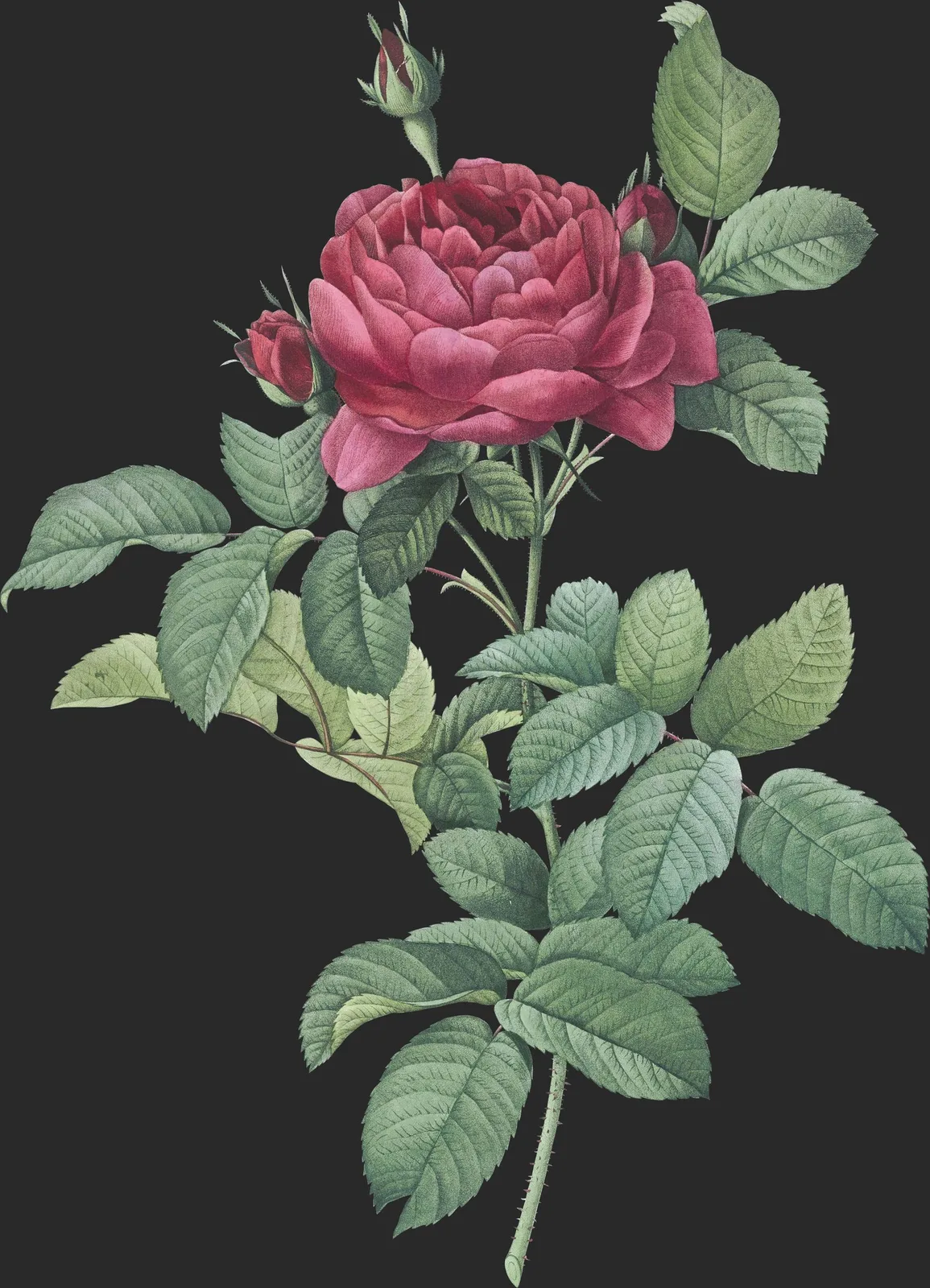
Rosa Gallica var Pontiana
Le Rosier d’André du Pont
Le Rosier d’André du Pont
Ten ways of seeing
- measured cast red
- upright 1.39 : 1
First Look
搜尽奇峰打草稿。
—— 清·石涛《苦瓜和尚画语录》
Exhaust the strange peaks, and then make the sketch.
The sheet is vertical: the eye climbs and settles in the upper half. Let the plant stand before you look for detail. Then step in close: watch where colour meets line, and whether the line ever breaks. Third, find where the green is deepest: the whole tonal order is measured from that patch.
Name and Thing
The binomial is Rosa gallica: the first word is the genus it belongs among, the second the epithet that sets it apart. Here the epithet gallica means “of Gaul” — the name records the feature the namer noticed first. No established Chinese name exists, so it is cited by its binomial alone.
Form and Colour
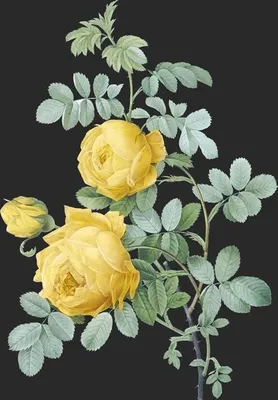
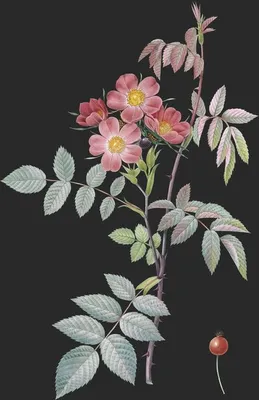
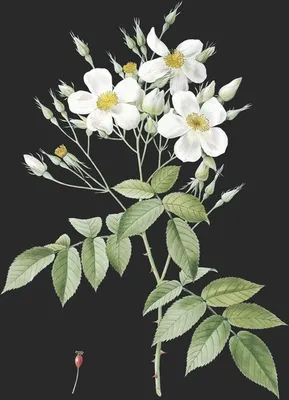
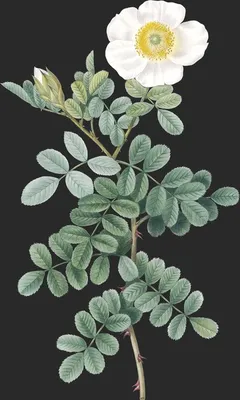
Measured on this plate: flower colour covers 8.1% of the sheet, foliage 9.0%, the cast red. No other plate shares exactly this measure. Roses are shrubs or scramblers with pinnate leaves of three to seven serrated leaflets; the double flowers open in crumpled, inward-curling layers around a small knot of yellow stamens. a moss green. A single plant, laid out with nothing hidden.
Composition
The sheet is tall. No details are appended: a plate for looking, not for keying out. The plant takes about 38% of the sheet, centred a little right of centre — the easy measure most florists kept to.
Line and Colour
The first half of the nineteenth century moved from copper to steel to lithography; stipple could render the softest transition. Decide first whether it was printed or painted; only then discuss whether it is beautiful. If you mean to copy it: take its skeleton, its margins and the order of its colours; the burin's hatching is the language of copper — suggest it with pencil density, do not imitate it stroke for stroke.
Poetic Resonance
小红桃脸花中笑。
—— 宋·刘焘《菩萨蛮》
The poem gives the mood first and the picture supplies the form; set the line beside the plate and the green the corolla becomes its resting point.
Symbolism
In Europe the rose means love and secrecy ('sub rosa'); in Chinese verse the rambling rose leans and clings — lingering attachment rather than ardour. In a flora it is a species first and a symbol second; the order is worth keeping.
Season and Place
Late spring into early summer, peaking in May — the first flush of the garden year. the ever-blooming modern rose is a nineteenth-century crossing of European and Chinese stock. The year 1821 on the plate is that of publication, not of flowering — the gathering came a year or two earlier. The bud and the ripe fruit on one branch tell the season; the name in the title often tells the journey.
The Book and the Hand
“Les Roses” carries only Pierre-Joseph Redouté's name. The image is public domain; the hand-colouring is still one person's hand.
What to Take Away
Next time you stand before a flowering plant, give it three minutes: leaf arrangement, direction of the flower, the darkest patch. The flower of that year is dust, yet its image on paper has outlived every living cousin.
About this plate
Description
Arbrisseau qui s’élève en buisson à la hauteur de trois ou quatre pieds. Ses tiges, d’un vert-obscur, se divisent en rameaux diffus, nombreux, armés d’aiguillons courts, inégaux, rapprochés entre eux. Les feuilles se composent de cinq ou de sept folioles, les unes ovales, les autres arrondies, fermes et cassantes, doublement et finement dentées, glabres en-dessus, velues en-dessous, garnies de quelques glandes en leur bor-dure. Elles sont portées par un pétiole velu, muni de petits aiguillons rares: à sa base, sont deux stipules élargies et den-ticulées. Les fleurs naissent à l’extrémité des rameaux, où elles se réunissent plusieurs ensemble. Les pédoncules qui les soutiennent sont longs et plus ou moins hispides. Les tubes du calice sont en général globuleux; cependant on en rencontre, sur un même arbrisseau, quelques-uns qui présentent une forme ovoïde-allongée. Ces tubes sont hispides-glanduleux, ainsi que les divisions pinnatifides du limbe. Corolle grande, de sept à huit rangs de pétales, d’un rouge-éclatant, et d’une odeur agréable, quoique peu pénétrante.
Observations
Nous avons cru pouvoir supprimer le nom bizarre que l’on donne à cette Rose, dans les pépinières, pour y substituer celui de André Du Pont, qui a cultivé le Rosier avec tant de succès, et qui a répandu dans les jardins la plupart des belles espèces qui en font l’ornement. Cet amateur célèbre, né dans le Palatinat, en 1756, est mort à Paris à la fin de 1817.
- R. gallica Pontii, germinibus subglobosis, pedunculis hispido-glandulosis, caule petiolisque aculeatis, foliolis oblongis acutis. Red. R. vol. 1, p. 75, var. ρ.
- R. gallica Pontiana. Thy. Prod. de la Mon. du genre Rosier, p. go, var. ρ.
- La Rouge formidable. Hortul.