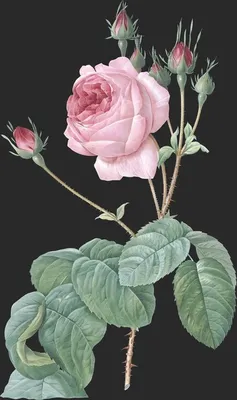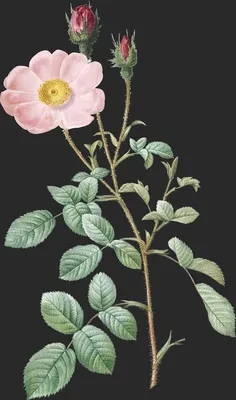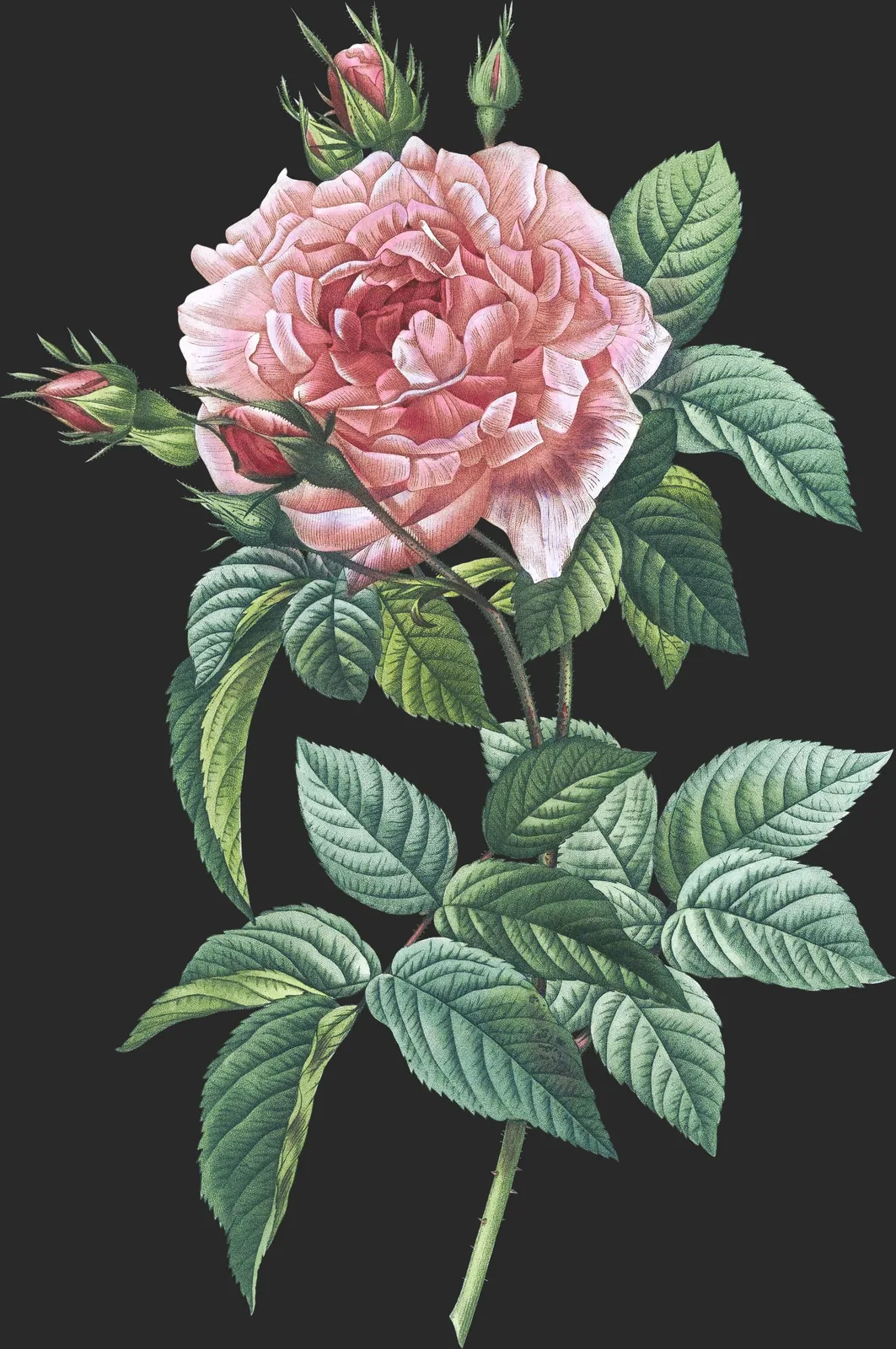
Rosa Gallica var Regalis
狗牙蔷薇
Le Rosier de Provins
About this plate
Description
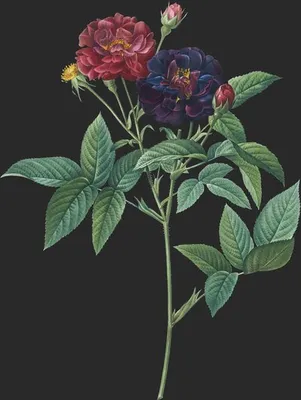
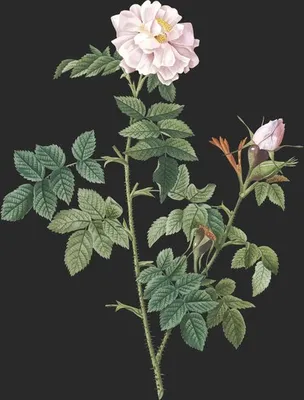
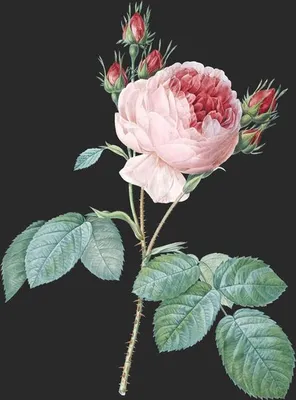
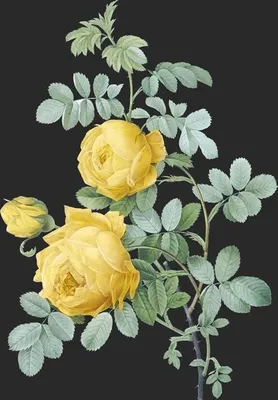
Ce Rosier, connu en Angleterre sous les noms de Provins royal, ou de Provins de la Reine (Royal or Queen’s Province), est très-recherché à cause du prodigieux volume de ses fleurs souvent larges de plus de trois pouces. Il fait partie de cette série d’arbustes que nos jardiniers nomment ordinairement grands Rosiers de Saint-François. On le rencontre, dans les jar-dins, très-souvent greffé, mais rarement en franc-de-pied. Dans ce dernier état, il offre un buisson assez touffu qui s’élève à un pied et demi, ou deux pieds et demi au plus. Les rameaux sont munis d’aiguillons d’inégale longueur et plus ou moins rapprochés entre eux. Les feuilles se composent de cinq folioles ovales, épaisses, ridées, vertes endessus, tomenteuses en-dessous et en leur bord: elles sont portées par un pétiole velu, le plus souvent muni d’aiguillons, ayant à sa base des stipules grandes, bifides, denticulées. Les fleurs, peu odorantes, sont disposées par trois ou quatre à l’extrémité des rameaux. Les pédoncules qui les supportent, ainsi que les tubes des calices sont munis de poils glanduleux. Les divisions du limbe, trois pinnatifides et deux simples, pointues ou spatulées au sommet, sont couvertes de pareils poils extérieurement, et garnies, à l’intérieur, d’un duvet blanchâtre. La corolle, semi-double, est composée de quatre à cinq rangs de pétales d’un rose plus foncé que celui des pétales de la Cent-feuilles ordinaire. On n’aperçoit au centre de la fleur qu’un petit nombre d’étamines dont quelques-unes se sont métamorphosées en pétales irréguliers et chiffonnés. Les styles sont longs, rapprochés et presque réunis en un seul faisceau.
Observations
Ce Rosier a beaucoup de rapports avec l’arbuste que les pépiniéristes fournissent sous le nom de Grand Monarque; mais les fleurs de celui-ci ont moins de volume. Les Anglais ont obtenu une sous-variété, à fleurs aussi grandes que celles de notre Rosier, qu’ils ont appelée R. Provincialis multiplex, et vulgairement the cabbage Province (la Rose-chou de Provins). Elle est figurée dans Andrews, qui dit que son odeur agréable, jointe à l’abondance de ses fleurs, la font cultiver comme utile aux distillateurs auxquels elle fournit plus d’essence que toute autre espèce.
Le Rosier Grandeur royale doit être cultivé à l’ombre, car lorsqu’il est exposé au soleil il est sujet à se couvrir d’une poussière, que les agriculteurs nomment le blanc ou le meúnier, qu’on suppose être une végétation parasite, laquelle s’opposerait à son accrois-sement, et le ferait périr si l’on n’avait le soin de supprimer les bourgeons, les feuilles, même les branches qui en sont attaquées.
- R. (Provincialis) germinibus subglobosis: pedunculis et petrolis hispide-glandulosis: foliolis pinnatis: folis ovatis, acutis, subtus villosis: Moribus semi-duplicibus, incarnatis magnis. And. R. cum Tabula.
- R. Gallica (à fleur tres-large). Du P. Gymnasium Rosarum, in Thory R. Candolleana, p. 17, sect. 20, № 41.1
- Rosa Candolleana, seu descriptio nova speciei generis Rosa Dicata Pyr.-Aug. De Candolle, a CI.-Ant. Thory, in prima Parisiorum civitatis circumscriptione adili vicario; addito Catalogo inedito Rosarum quas Andreas Du Pont, in Horto suo studiose colebat anno 1813. Parisiis, Herissant Le Doux, 1819 in-8°, (19 pages), cum tabula.
Twelve ways of seeing
- measured cast red
- upright 1.51 : 1
- published 1821
- Plate 64
Not a catalogue entry but a way of looking: how to stand, what to notice, how the line was cut, when it flowers, where it came from, who made it — and then the poems and the classics that taught China to see the same flower. Read the twelve in order and the plate opens.
-
First Look
真山水之川谷,远望之以取其势,近看之以取其质。
—— 宋·郭熙《林泉高致·山水训》
Mountains and valleys: from afar take their momentum, up close take their texture — the two distances from which any picture is read.
The sheet is vertical: the eye climbs and settles in the upper half. Let the plant stand before you look for detail. Then step in close: watch where colour meets line, and whether the line ever breaks. Third, find where the green is deepest: the whole tonal order is measured from that patch.
-
Name and Thing
The binomial is Rosa gallica: the first word is the genus it belongs among, the second the epithet that sets it apart. Here the epithet gallica means “of Gaul” — the name records the feature the namer noticed first. The Chinese name 狗牙蔷薇 is a modern rendering of the Latin, not an old garden name.
-
Form and Colour
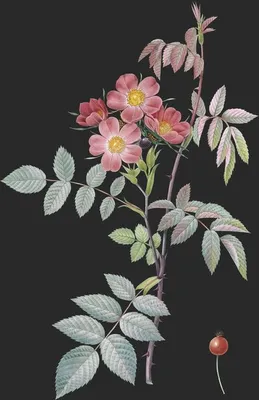
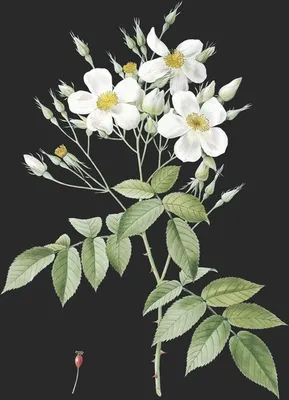
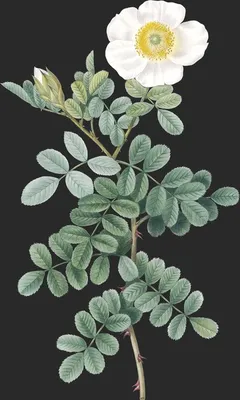
Measured on this plate: flower colour covers 8.1% of the sheet, foliage 14.9%, the cast red. No other plate shares exactly this measure. Roses are shrubs or scramblers with pinnate leaves of three to seven serrated leaflets; the double flowers open in crumpled, inward-curling layers around a small knot of yellow stamens. Filed under green — a moss green, a colour that comes mostly from leaf and stem. A single plant, laid out with nothing hidden.
-
Composition
Tall and narrow, the plant rising in one movement with generous margins — the upright format of most floras. (about 1.51 : 1) No details are appended: a plate for looking, not for keying out. The plant fills 40% of the sheet, centred near the centre — the herbarium way, drawn to be read whole. Cover the margins with your thumb and the plate suffocates; uncover them and the flower breathes again.
-
Line and Colour
The first half of the nineteenth century moved from copper to steel to lithography; stipple could render the softest transition. Take a loupe to three places: petal edge, leaf vein, caption. An unbroken line means engraving; colour crossing the outline means a hand.
-
Season
Late spring into early summer, peaking in May — the first flush of the garden year. The year 1821 on the plate is that of publication, not of flowering — the gathering came a year or two earlier. The best time to read such a plate is its flowering season: three minutes under the tree explains what no text can.
-
Provenance
Widespread in the temperate north. Chinese gardeners knew roses since the Han; the ever-blooming modern rose is a nineteenth-century crossing of European and Chinese stock. In the same volume the kin are shelved together; set several plates side by side.
-
The Book and the Hand
“Les Roses” was drawn by Pierre-Joseph Redouté and published 1817-1824. This plate is Plate 64, book page 64. The image is public domain; the hand-colouring is still one person's hand.
-
Poetic Resonance
苍翠浓阴满院,莺对语,蝶交飞,戏蔷薇。
—— 《定西番·苍翠浓阴满院》
The poem gives the mood first and the picture supplies the form; set the line beside the plate and the green the corolla becomes its resting point.
-
The Written Tradition
庭下如积水空明,水中藻荇交横,盖竹柏影也。
—— 宋·苏轼《记承天寺夜游》
The courtyard seemed flooded with clear water, weeds crossing in it — in fact the shadows of bamboo and cypress.
Tradition places roses in the Han imperial park; Song and Ming manuals named the double forms 'Baoxiang' and 'Ten Sisters', and Qing compendia separated rose, rugosa and monthly rose. The difference is not of quality but of question: Europe asks what it is, China asks whom it resembles.
-
Symbolism
In Europe the rose means love and secrecy ('sub rosa'); in Chinese verse the rambling rose leans and clings — lingering attachment rather than ardour. In a flora it is a species first and a symbol second; the order is worth keeping.
-
What to Take Away
If you keep one line, keep Guo Xi's: from afar its momentum, up close its texture. A flora exists to be consulted; look long enough and you forget to consult — someone in 1821 gave a whole day to a single flower.