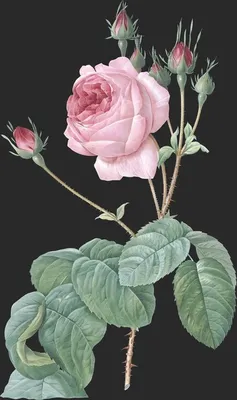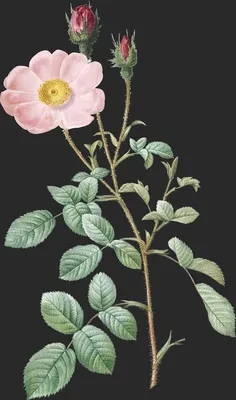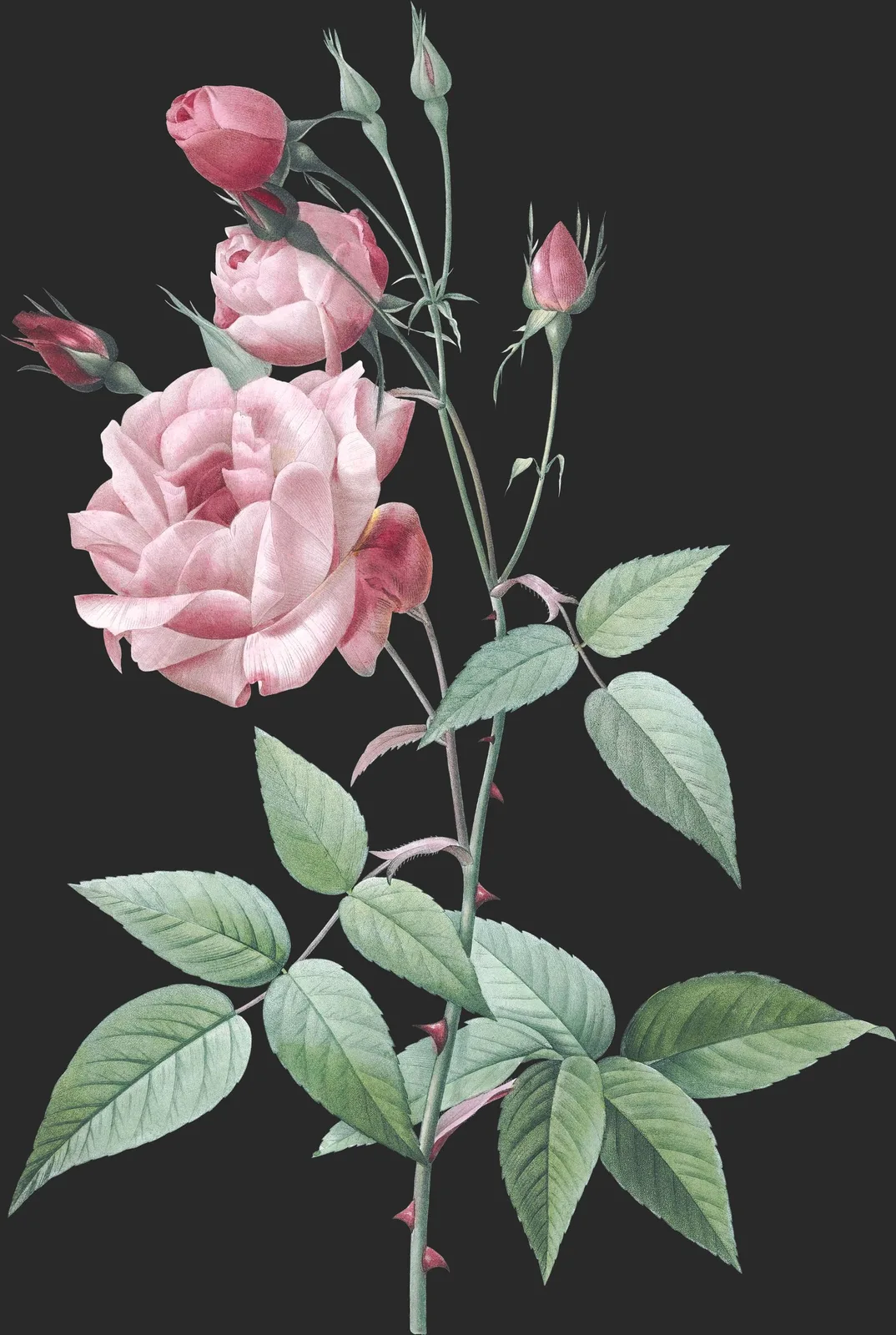
Rosa Indica Vulgaris
狗牙蔷薇
Le Rosier des Indes
Ten ways of seeing
- measured cast red
- upright 1.49 : 1
First Look
搜尽奇峰打草稿。
—— 清·石涛《苦瓜和尚画语录》
Exhaust the strange peaks, and then make the sketch.
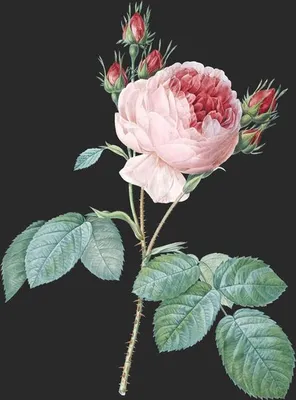
The sheet is vertical: the eye climbs and settles in the upper half. Let the plant stand before you look for detail. Then step in close: watch where colour meets line, and whether the line ever breaks. Third, find where the magenta is deepest: the whole tonal order is measured from that patch. The pose leans left: the upper half carries 15 points further left than the lower — a living thing, not a diagram.
Name and Thing
Only the genus Rosa is given; species-level names came later. The Chinese name 狗牙蔷薇 is a modern rendering of the Latin, not an old garden name.
Form and Colour
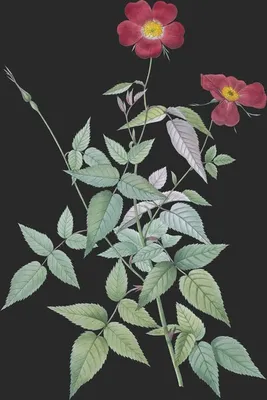
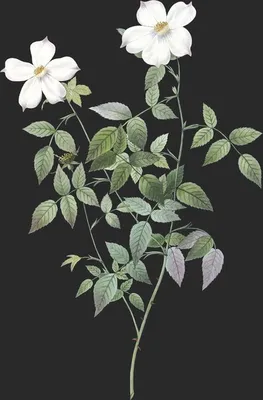
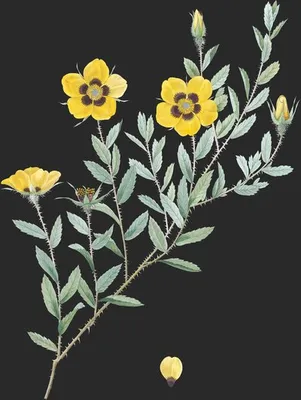
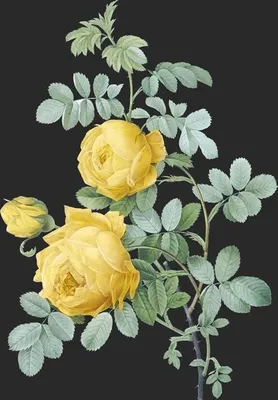
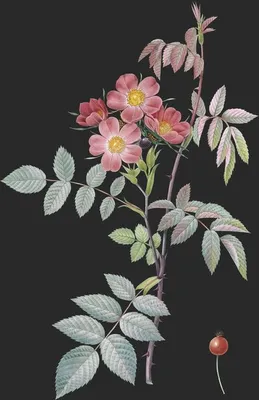
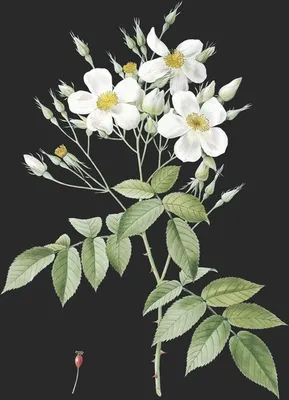
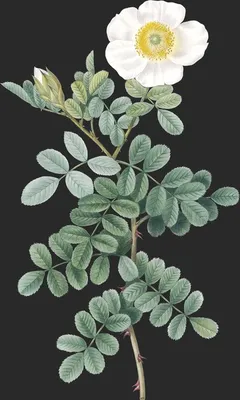
Measured on this plate: flower colour covers 4.6% of the sheet, foliage 3.7%, the cast red. No other plate shares exactly this measure. Roses are shrubs or scramblers with pinnate leaves of three to seven serrated leaflets; the double flowers open in crumpled, inward-curling layers around a small knot of yellow stamens. Filed under magenta — a crimson-magenta, built in washes from a pale ground. Read the outline, then the colour layers, then the brush.
Composition
The sheet is tall. No details are appended: a plate for looking, not for keying out. The plant takes about 31% of the sheet, centred a little left of centre — the easy measure most florists kept to.
Line and Colour
The first half of the nineteenth century moved from copper to steel to lithography; stipple could render the softest transition. Take a loupe to three places: petal edge, leaf vein, caption. An unbroken line means engraving; colour crossing the outline means a hand. If you mean to copy it: take its skeleton, its margins and the order of its colours; the burin's hatching is the language of copper — suggest it with pencil density, do not imitate it stroke for stroke.
Poetic Resonance
红蜡枝头双燕小。
—— 宋·欧阳修《蝶恋花》
The poem gives the mood first and the picture supplies the form; set the line beside the plate and the magenta the corolla becomes its resting point.
Symbolism
In Europe the rose means love and secrecy ('sub rosa'); in Chinese verse the rambling rose leans and clings — lingering attachment rather than ardour. This plate leans magenta, which in flower language adds one more degree of feeling. Meanings change their tune: the same flower can say opposite things within a century.
Season and Place
Late spring into early summer, peaking in May — the first flush of the garden year. the ever-blooming modern rose is a nineteenth-century crossing of European and Chinese stock. The year 1817 on the plate is that of publication, not of flowering — the gathering came a year or two earlier. The bud and the ripe fruit on one branch tell the season; the name in the title often tells the journey.
The Book and the Hand
“Les Roses” carries only Pierre-Joseph Redouté's name. From drawing to plate the sheet passed through several hands — the engraver aimed at accuracy, the colourist at speed, and between them lies each plate's unevenness.
What to Take Away
If you keep one line, keep Guo Xi's: from afar its momentum, up close its texture. A flora exists to be consulted; look long enough and you forget to consult — someone in 1817 gave a whole day to a single flower.
About this plate
Description
On distingue cette variété à ses tiges vertes et lisses, qui partent de la base, et s’élèvent à quatre ou six pieds. Elles sont armées d’aiguillons forts, recourbés et rougeâtres. Les feuilles de trois ou cinq folioles vertes, luisantes, glabres, simplement dentées, sont portées par des pétioles ciliés et munis de petits aiguillons crochus. Les fleurs semi-doubles, d’un rose tendre, naissent quelquefois solitaires, mais plus souvent plusieurs ensemble à l’extrémité des rameaux, et forment, par leur réunion, une espèce de panicule. Les tubes ovales du calice, à divisions presque toujours munies de quelques pinnules, sont légèrement hispides, ainsi que les pédoncules qui les supportent.
Ce Rosier est figuré dans le Curtis mag., on le trouve encore dans la Monographie des Roses d’Andrews, mais ce dernier l’a donné sans aiguillons.
Observations
Ce Rosier, qu’on appelle communément Rosier du Bengale, est aujourd’hui devenu populaire dans l’Europe entière. Il est le plus répandu des arbustes de ce genre. On le cultive dans tous les jardins: on le rencontre dans les palais et dans les chaumières. Il a été introduit en Europe par les Anglais, qui l’ont rapporté de l’Inde, et il a fleuri, pour la première fois, en Angleterre, vers l’année 1793, dans le jardin de M. Parson de Rickmansworth, dans le Hertfordshire. Il est connu dans les pépinières de Londres sous le nom de Pale China Rose (Rose pâle de la Chine). Ses fleurs, d’une grande fraîcheur, sont légèrement odorantes, sur-tout au moment de l’épa-nouissement. On le multiplie très-aisément de boutures qui, lorsqu’elles sont faites au mois de février, donnent souvent des fleurs dans la même année. On l’a traité long-temps comme une plante d’orangerie, mais aujourd’hui on le cultive en pleine terre, et il a bravé, jusqu’à-présent, les hivers les plus rigoureux.
- R. Germinibus ovatis pedunculisque glanduloso-hispidis; caule petiolisque aculeatis; foribus subpaniculatis. Semperflorens. (N).
- R. (Semperflorens), caule aculeato folis subternis pedunculisque subunifloris, aculeatis, hispidis, calycis foliolis subintegris. Curtis. mag. 284.
- R. Indica. Andrews, Roses.
- R. Semperflorens. Nouv. Duham. 7, p. 24. var. 2.