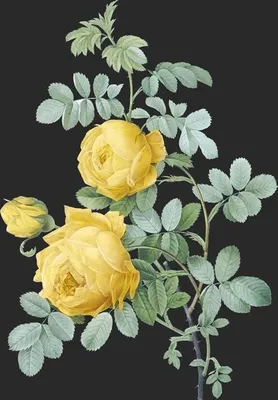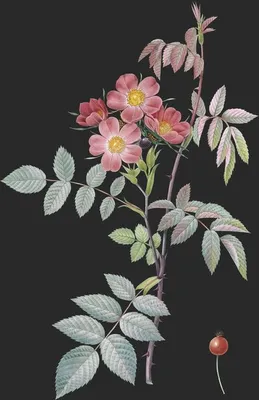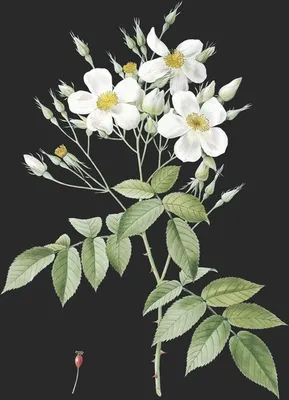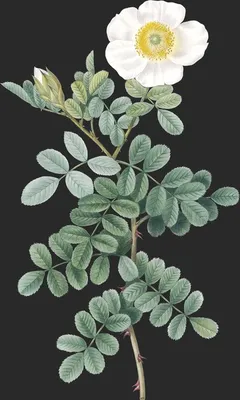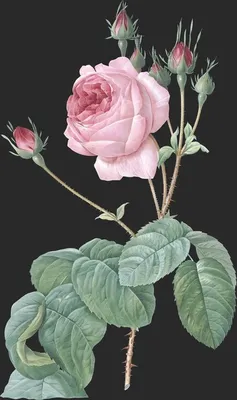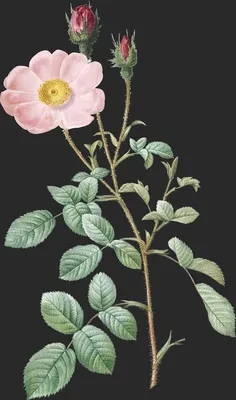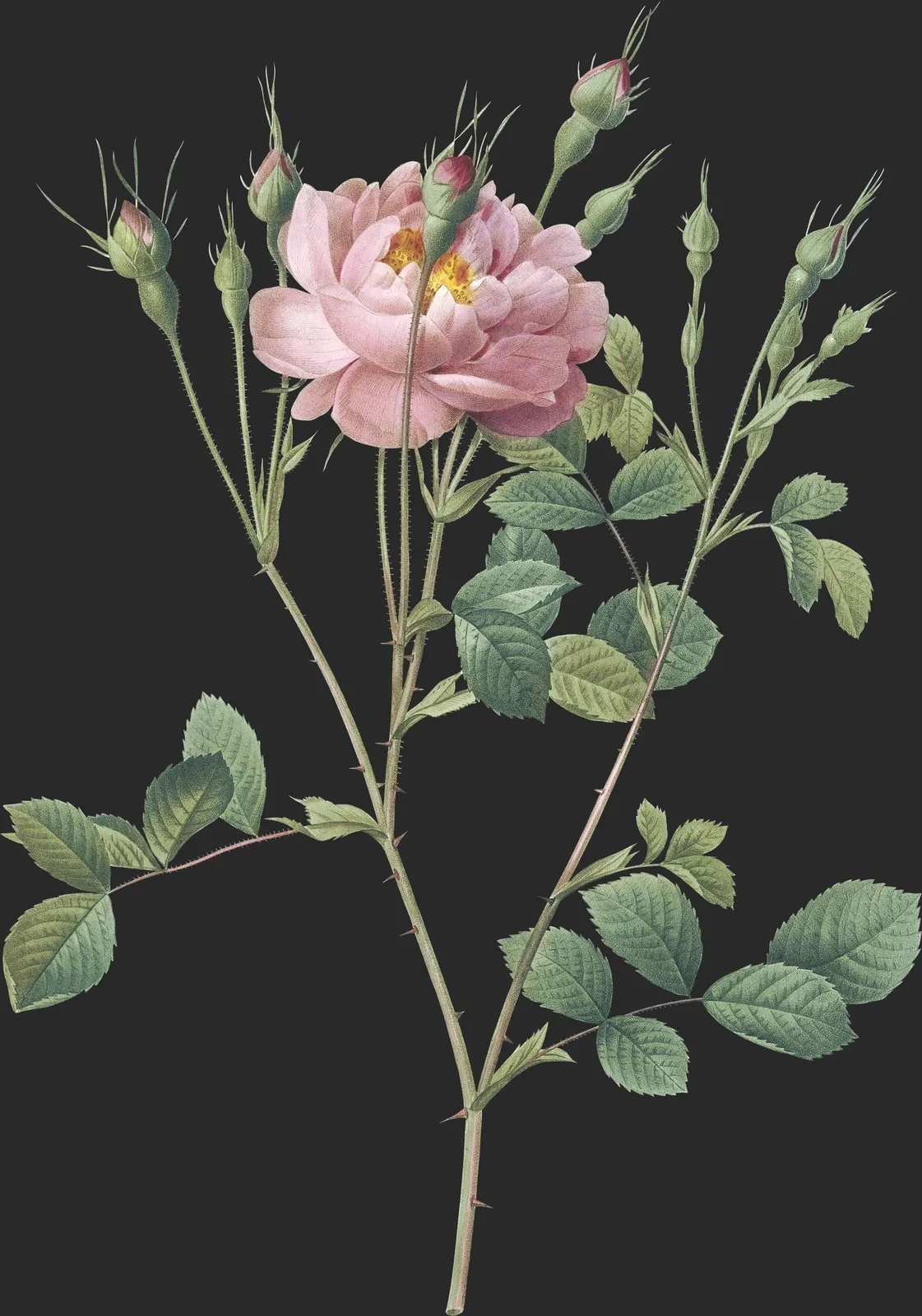
Rosa Rubiginosa var Anemone-Flora
Le Rosier Rouillé
Le Rosier Rouillé
About this plate
Description
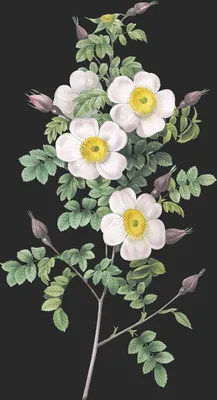
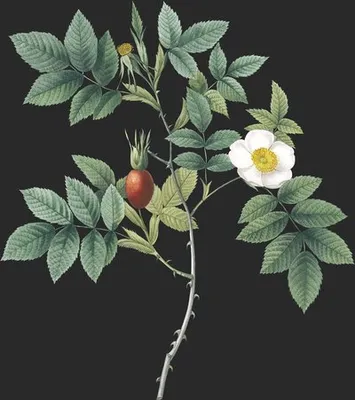
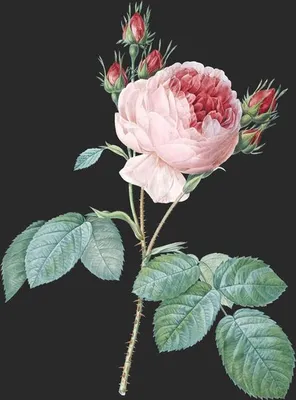
Cet arbrisseau s’élève en buisson à la hauteur de deux ou trois pieds. Les tiges et les rameaux adultes sont garnis d’aiguillons inégaux stipulaires, écartés: ceux des ramuscules de l’année sont en grand nombre, très-rapprochés entre eux. Les feuilles se composent de cinq ou de sept folioles, un peu arrondies, vertes, presque glabres en-dessus, glanduleuses en-dessous et sur leur bordure, doublement dentées, d’une odeur vineuse. Le pétiole qui les supporte, velu, glanduleux, un peu aiguillonné, est muni à sa base de stipules bifides denticulées en leur bord. Les fleurs naissent trois, quatre, et quelquefois plus, à l’extrémité des rameaux, où elles se réunissent en une espèce de corymbe: elles sont portées par des pédoncules hispides-glanduleux. Les tubes des calices sont ovoïdes et presque glabres. Les divisions du limbe, longues et appendi-culées, sont tomenteuses à l’intérieur, et couvertes, extérieure-ment, d’une multitude de glandes sessiles: elles se détachent avant la maturité du fruit. La corolle présente à-peu-près quatre rangs de pétales, échancrés en cour au sommet, d’une couleur pourpre tirant un peu sur le violet, les intérieurs plus courts, concaves, se renversant sur les étamines, comme dans la Rose Cent-feuilles-Anémone. Le fruit est hispide et rouge à la maturité; les fraîcheurs de l’automne lui communiquent une teinte noirâtre.
Observations
Ce Rosier n’est qu’une modification du R. Rubiginosa triflora de Willd. Il a encore beaucoup de rapport avec le Rubiginosa β de l’Enumeratio Rosarum, de Rav. Il n’en diffère que dans ses proportions qui sont un peu plus grandes, et ses fleurs semi-doubles dont les pétales sont réfléchis comme dans l’anémone. Nous l’avons observé, pour la première fois, en 1819, greffé dans le jardin de M. Catel; depuis nous l’avons revu franc, dans d’autres collections. L’arbrisseau fournit de très-belles têtes; nous conseillons de le greffer sur le Rubiginosa vulgaris de nos forêts; alors, ainsi que l’expérience nous l’a appris, la Rose prendra plus de volume, et une teinte plus foncée. Ne point tailler: se contenter d’ôter le bois mort.
- R. germinibus ovatis subglabris; pedunculis glanduloso-hispidis; foliolis subrotundis supra subpubescentibus, subtus glandulosis villosulisque; caule petiolisque aculeatis; foribus 2–5 corymbosis; petalis incarnatis, involutis. (N.)
- R. Rubiginosa anemone-flora. Thy. Prod. groupe XX, spec. 40, var. ζ.
Ten ways of seeing
- measured cast red
- upright 1.43 : 1
- published 1824
- Plate 126
First Look
搜尽奇峰打草稿。
—— 清·石涛《苦瓜和尚画语录》
Exhaust the strange peaks, and then make the sketch.
The sheet is vertical: the eye climbs and settles in the upper half. Let the plant stand before you look for detail. Then step in close: watch where colour meets line, and whether the line ever breaks. Third, find where the green is deepest: the whole tonal order is measured from that patch.
Name and Thing
The binomial is Rosa rubiginosa: the first word is the genus it belongs among, the second the epithet that sets it apart. The genus name Rosa: Rosa is simply the Latin for rose, from Greek rhodon. No established Chinese name exists, so it is cited by its binomial alone.
Form and Colour
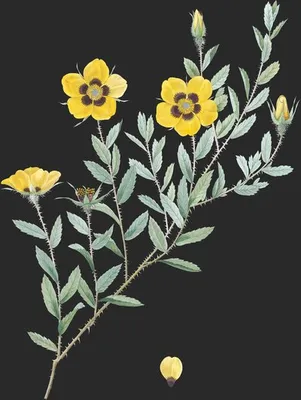
Measured on this plate: flower colour covers 3.9% of the sheet, foliage 6.4%, the cast red with a second note of yellow-green. No other plate shares exactly this measure. Roses are shrubs or scramblers with pinnate leaves of three to seven serrated leaflets; the double flowers open in crumpled, inward-curling layers around a small knot of yellow stamens. Filed under green — a moss green, a colour that comes mostly from leaf and stem. Three things fix the habit: leaf arrangement, tepal count, and how the flower is borne.
Composition
Tall and narrow, the plant rising in one movement with generous margins — the upright format of most floras. (about 1.43 : 1) No details are appended: a plate for looking, not for keying out. The plant covers only 25% of the sheet, centred above centre; the emptiness is where the eye rests. Cover the margins with your thumb and the plate suffocates; uncover them and the flower breathes again.
Line and Colour
The first half of the nineteenth century moved from copper to steel to lithography; stipple could render the softest transition. Take a loupe to three places: petal edge, leaf vein, caption. An unbroken line means engraving; colour crossing the outline means a hand. If you mean to copy it: take its skeleton, its margins and the order of its colours; the burin's hatching is the language of copper — suggest it with pencil density, do not imitate it stroke for stroke.
Poetic Resonance
不种自红仍自白,野酴醾压野蔷薇。
—— 唐·杨万里《入城》
The poem gives the mood first and the picture supplies the form; set the line beside the plate and the green the corolla becomes its resting point.
Symbolism
In Europe the rose means love and secrecy ('sub rosa'); in Chinese verse the rambling rose leans and clings — lingering attachment rather than ardour. Meanings change their tune: the same flower can say opposite things within a century.
Season and Place
Late spring into early summer, peaking in May — the first flush of the garden year. Widespread in the temperate north. Chinese gardeners knew roses since the Han. The year 1824 on the plate is that of publication, not of flowering — the gathering came a year or two earlier. Read the locality and the flowering season both with a discount: one is hearsay, the other a ten-day peak.
The Book and the Hand
“Les Roses” was drawn by Pierre-Joseph Redouté and published 1817-1824. This plate is Plate 126, book page 126. The image is public domain; the hand-colouring is still one person's hand.
What to Take Away
Next time you stand before a flowering plant, give it three minutes: leaf arrangement, direction of the flower, the darkest patch. Two centuries on, the plant may still flower in some garden; the one on this sheet stopped in the season of 1824.