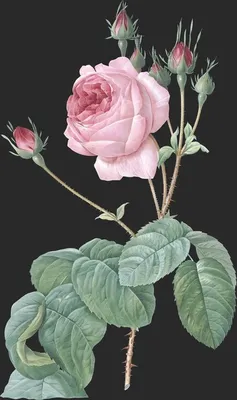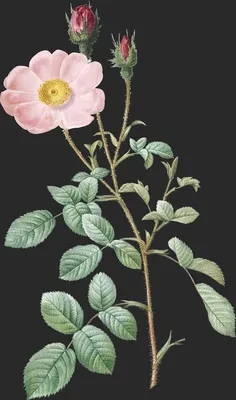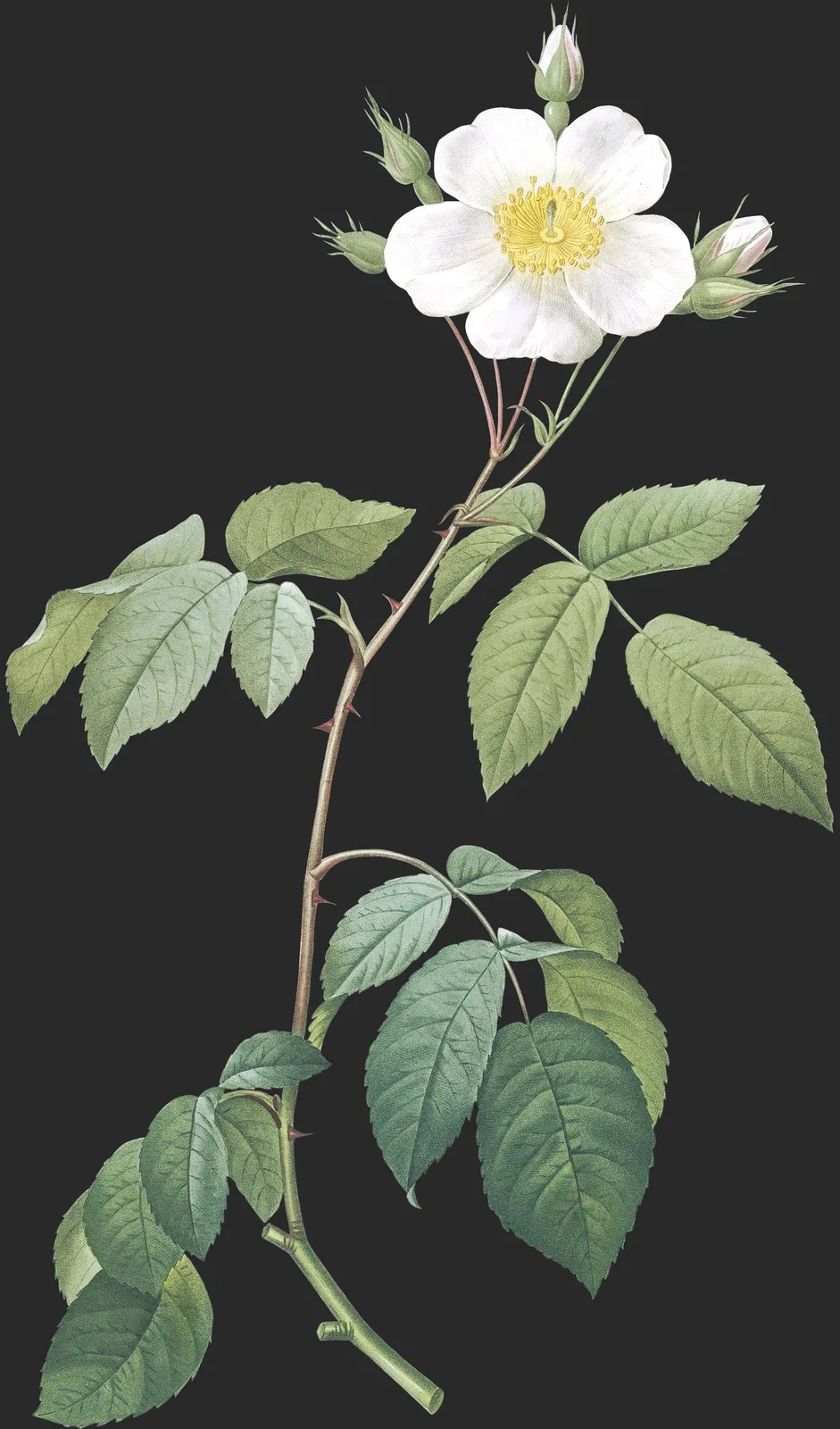
Rosa Sempervirens var Latifolia
Rosa Sempervirens var Latifolia
Le Rosier Grimpant
About this plate
Description
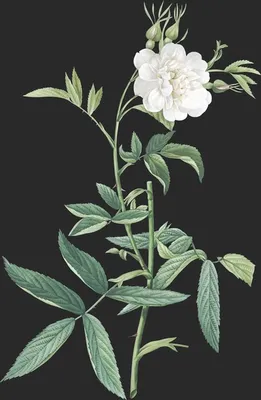
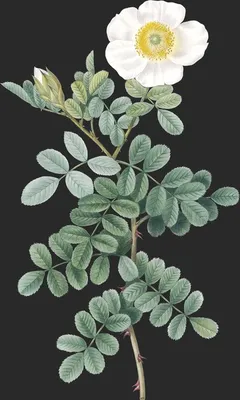
Cet arbuste peut atteindre à une très-grande hauteur comme tous ceux de ce groupe: celui qui existait chez Du Pont avait trente pieds d’élévation. Ses tiges sont armées d’aiguillons épars, les uns droits, les autres recourbés. Les feuilles se composent de cinq folioles, quatre ou six fois plus grandes que celles du Sempervirens de nos forêts, glabres et luisantes, surtout en-dessus, arrondies à la base, pointues au sommet, simplement et assez finement dentées. Elles sont portées par un pétiole muni de poils et de glandes, ainsi que de plusieurs petits aiguillons recourbés, ayant à sa base deux stipules dé-currentes, bifides, pointues au sommet, denticulées et glanduleuses en leur bord. Les fleurs, d’une odeur agréable, naissent par trois, six, et plus encore, à l’extrémité des rameaux qui croissent le long des branches principales, et forment, par leur réunion, une espèce d’ombelle. De longs pédoncules hispides glanduleux les supportent avec grace: chacun d’eux, excepté celui du milieu, est muni de deux petites bractées qui lui sont propres. A la base du pédoncule commun sont deux autres bractées plus grandes, quelquefois foliacées. Les tubes ovoïdes des calices sont, le plus souvent, glabres. Les divisions du limbe, trois pinnatifides et deux simples, sont velues extérieurement, et couvertes de duvet à l’intérieur et sur les bords. La corolle est composée de cinq pétales blancs dans l’intérieur, et par-fois parés, à l’extérieur, de quelques fascies longitudinales de couleur rose. Les styles, dans cette variété, sont très-remarquables: soudés, velus (sur-tout auprès des stigmates, longs de cinq à six lignes, ils présentent une forme qu’on pourrait appeler Phalloïde; c’est par ce motif que M. Du Pont, qui n’avait pas su rattacher ce Rosier à son type, le nommait Rosa Phalloidea. Les fruits viennent difficilement à maturité dans le climat de Paris.
Observations
Ce Rosier, très-rare en France, conserve ses feuilles l’hiver, ainsi que tous les individus de cette série. Nous sommes autorisés à croire qu’il croit spontanément dans l’ltalie, car nous l’avons trouvé parmi plusieurs Rosiers sauvages desséchés qui nous ont été envoyés de Florence. Nous le cultivons depuis long-temps, et c’est Du Pont qui nous l’a communiqué. L’individu qui appartenait à ce célèbre cultivateur a passé, avec sa collection, dans le carré des Roses, au Luxembourg, où nous l’avons vu, pendant long-temps, végéter avec une grande vigueur, et étendre ses longs rameaux horizontalement, parce qu’on avait négligé de lui donner un tuteur; mais nous ne l’avons plus revu cette année.
L’arbuste est de pleine terre et ne donne ses fleurs qu’à l’exposition du midi: toutefois, pour en obtenir, il faut éviter de le tailler. Tous les sempervirens sont dans le même cas: l’espèce qu’on cultive dans l’école de botanique, au Jardin du Roi, à Paris, ne fleurit que dans le haut, parce que cette partie du Rosier est la seule qui, en raison de son élévation, échappe au ciseau et à la serpette.
Twelve ways of seeing
- measured cast yellow-green
- upright 1.70 : 1
- published 1821
- Plate 79
Not a catalogue entry but a way of looking: how to stand, what to notice, how the line was cut, when it flowers, where it came from, who made it — and then the poems and the classics that taught China to see the same flower. Read the twelve in order and the plate opens.
-
First Look
竖划三寸,当千仞之高;横墨数尺,体百里之迥。
—— 南朝宋·宗炳《画山水序》
A vertical stroke of three inches stands for a cliff of a thousand fathoms; a few feet of ink holds a hundred li.
The sheet is vertical: the eye climbs and settles in the upper half. Let the plant stand before you look for detail. Then step in close: watch where colour meets line, and whether the line ever breaks. Third, find where the green is deepest: the whole tonal order is measured from that patch. The pose leans right: the upper half carries 8 points further right than the lower — a living thing, not a diagram.
-
Name and Thing
The binomial is Rosa sempervirens: the first word is the genus it belongs among, the second the epithet that sets it apart. The genus name Rosa: Rosa is simply the Latin for rose, from Greek rhodon. No established Chinese name exists, so it is cited by its binomial alone.
-
Form and Colour
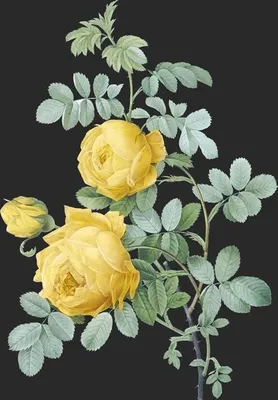
Measured on this plate: flower colour is sparing, 1.1% of the sheet against 14.5% of foliage, the cast tending yellow-green — as with pale or white blooms, outline and tone do the talking. Roses are shrubs or scramblers with pinnate leaves of three to seven serrated leaflets; the double flowers open in crumpled, inward-curling layers around a small knot of yellow stamens. Filed under green — a moss green, a colour that comes mostly from leaf and stem. Three things fix the habit: leaf arrangement, tepal count, and how the flower is borne.
-
Composition
Tall and narrow, the plant rising in one movement with generous margins — the upright format of most floras. (about 1.70 : 1) No details are appended: a plate for looking, not for keying out. The plant takes about 30% of the sheet, centred near the centre — the easy measure most florists kept to. Blank paper is not unfinished work: it is where the eye rests.
-
Line and Colour
The first half of the nineteenth century moved from copper to steel to lithography; stipple could render the softest transition. Take a loupe to three places: petal edge, leaf vein, caption. An unbroken line means engraving; colour crossing the outline means a hand.
-
Season
Late spring into early summer, peaking in May — the first flush of the garden year. The year 1821 on the plate is that of publication, not of flowering — the gathering came a year or two earlier. Note the season. Phenology is the most practical tool of appreciation.
-
Provenance
Widespread in the temperate north. Chinese gardeners knew roses since the Han; the ever-blooming modern rose is a nineteenth-century crossing of European and Chinese stock. The volume was made in 1817-1824, when most of this knowledge came from living plants under glass.
-
The Book and the Hand
“Les Roses” was drawn by Pierre-Joseph Redouté and published 1817-1824. This plate is Plate 79, book page 79. The image is public domain; the hand-colouring is still one person's hand.
-
Poetic Resonance
有情芍药含春泪,无力蔷薇卧晓枝。
—— 宋·秦观《春日》
The peony, feeling, holds spring tears; the rose, strengthless, lies across the morning branch.
The poem gives the mood first and the picture supplies the form; set the line beside the plate and the green the corolla becomes its resting point.
-
The Written Tradition
插花不可太繁,亦不可太瘦。多不过二种三种,高低疏密,如画苑布置方妙。
—— 明·袁宏道《瓶史·宜称》
Flowers should be set neither too crowded nor too sparse — two or three kinds at most, tall and low, dense and open, arranged as a painter would compose.
Tradition places roses in the Han imperial park; Song and Ming manuals named the double forms 'Baoxiang' and 'Ten Sisters', and Qing compendia separated rose, rugosa and monthly rose. You need not parse every word: take the line, and the flower acquires a second face.
-
Symbolism
In Europe the rose means love and secrecy ('sub rosa'); in Chinese verse the rambling rose leans and clings — lingering attachment rather than ardour. Flower language was added later; the flower knows nothing of it, and that innocence is part of its power.
-
What to Take Away
Next time you stand before a flowering plant, give it three minutes: leaf arrangement, direction of the flower, the darkest patch. The flower of that year is dust, yet its image on paper has outlived every living cousin.