Rosa Sepium var Rosea
狗牙蔷薇
Le Rosier des Haies
About this plate
Description
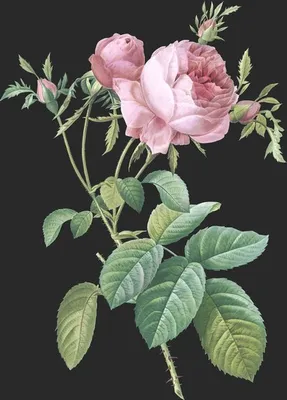
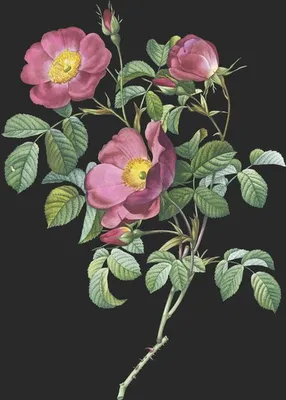
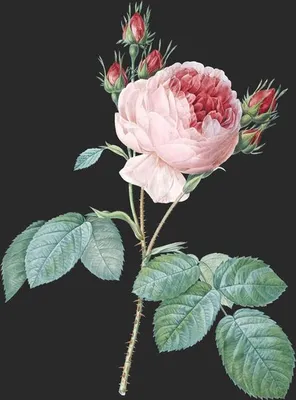
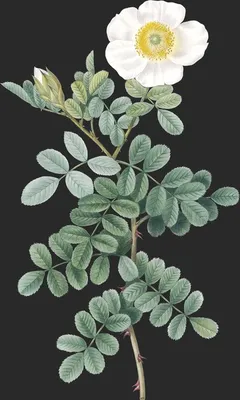
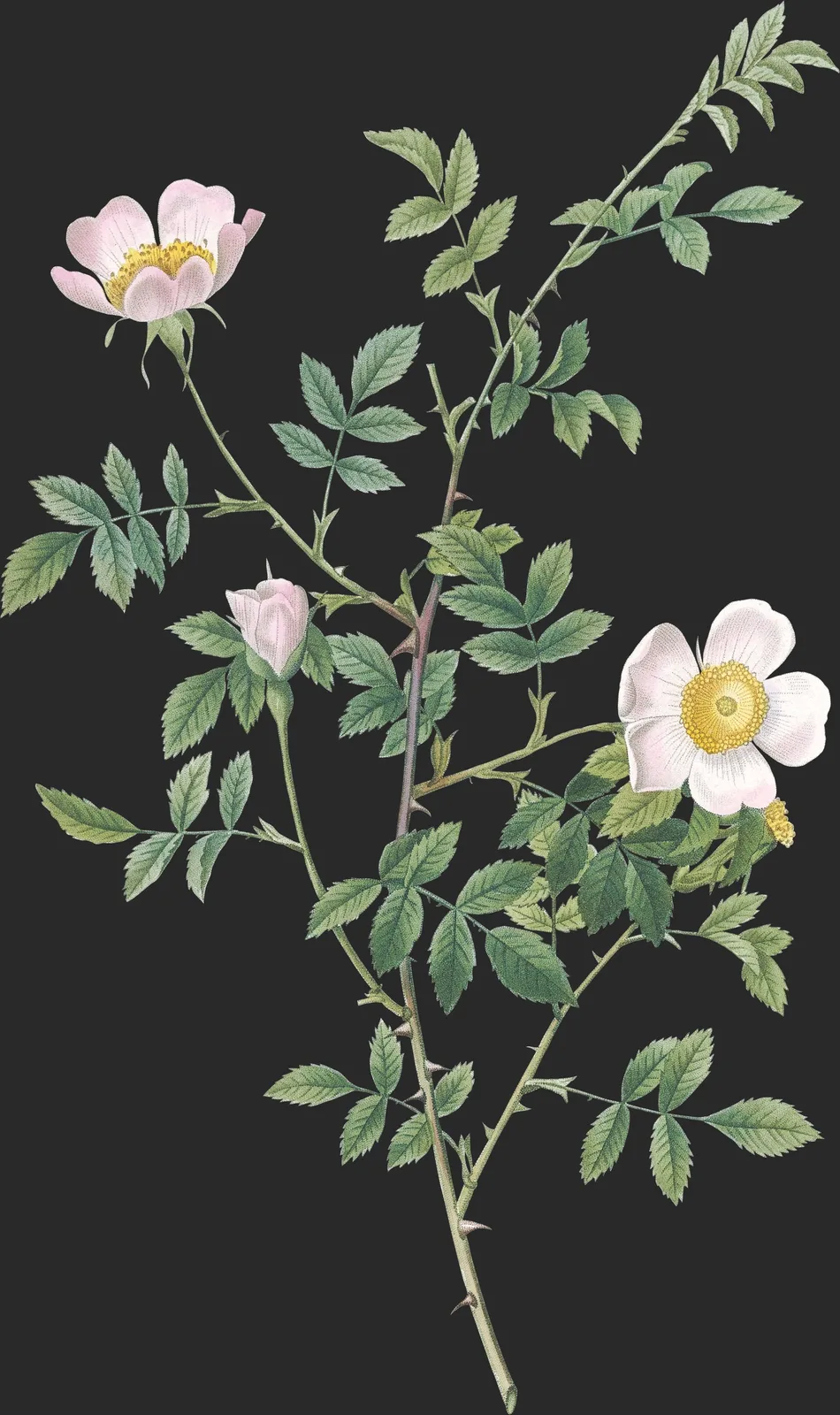
Arbrisseau élevé et très-rameux. Ses branches sont armées d’aiguillons nombreux, blanchâtres et recourbés. Ses feuilles se composent de cing ou de sept folioles, le plus souvent très-petites, chaque paire écartée l’une de l’autre, pointues au sommet et à la base, glabres en-dessus, glanduleuses en-dessous, à dents serraturées, aussi glanduleuses. Elles sont supportées par un long pétiole couvert de glandes, aiguillonné, et muni à sa base de deux stipules bifides. Les fleurs, souvent solitaires, quelquefois réunies deux ou trois ensemble, croissent à l’extré mité des ramuscules qui garnissent les branches principales. Le pédoncule est glabre ainsi que le tube ovoide du calice. Les divisions du limbe sont pinnatifides. La Corolle présente cinq pétales d’abord d’un rose-tendre, mais qui se décolore et blanchit en peu d’heures, sur-tout à l’exposition du soleil. Fruits ovoïdes.
Nomenclature des variétés du Rosier des haies
Rosa germinibus oblongo-ovatis, pedunculisque glabris; foliolis sublanceolatis, cuspidatis, supra glabris, subtus margineque glandulosis; petiolis aculeolatis, undique glandulis minimis proditis; ramulis ramosissimis, aculeatis. (N.)
-
- R. Sepium rosea. Desv. Journ. Bot. septembre 1813, p. r16, var. β.
- R. Sepium. Th. fl. de Paris, éd. 2, p. 262. DC. syn. 333; idem. Fl. franç. éd. 3, vol. 6, p. 538. Nouv. Duhamel, vol. 7, p. 47, et Tab. 11, fig. 2. Non Rau Enum. Ros. p. 90.
- R. (Canina) var. β. DC. Fl. franc. 3716. Poir. Ency. 6, 288, var. β. Vulg. Rosier des haies à fl. roses. Sous-variété à fleurs semi-doubles.
- R. Sepium parviflora. Bast. Suppl. p. 31. Petit arbrisseau qui ne s’élève guères qu’à un pied et demi. Environs d’Angers. Vulg. Rosier des haies à petites fleurs.
-
- R. Sepium alba. Desv. l. c. p. 116, var. α.
- R. (Agrestis.) Gm. Bad. 2, p. 416. Savi, Fl. Pis. 1, p. 475. Les folioles sont plus arrondies que dans les autres variétés. Vulg. Rosier des haies à fl. blanches.
-
- R. Sepium myrtifolia. (N.)
- R. (Myrtifolia.) Haller Fil. R. (Canina myrtifolia.) Du P. Gymn. Ros. 1, № 6, in Thy. R. Cand., P. 13. Folioles petites, elliptiques très-luisantes en-dessus, assez semblables aux feuilles du myrte. Fleurs d’un blanc-lavé-de-rose, souvent solitaires. Vulg. Rosier des haies à feuilles de myrte.
-
- R. Sepium olei-carpa. (N.)
- R. Olei-carpa. Th. inédit. Trouvée atix environs de Paris par M. Thuillier, qui a bien voulu nous la communiquer. C’est une variété remarquable par les nervures très-saillantes des folioles, et ses fruits qui offrent la forme exacte d’une olive moyenne. Vulg. Rosier des haies à fruits d’Olivier.
- R. Sepium ambigua. Desv. l. c. p. 116. Les pédoncules sont quelquefois un peu hispides dans cette variété. Vulg. Rosier des haies équivoque.
-
R. Sepium latifolia, foliolis magnis, remotis, grandi-dentatis, basi acutis, apice subrotundis; floribus exalbo-roseis; crma trifida. (N.)
Folioles, trois ou quatre fois plus grandes que dans la précédente; chaque paire, très-écartée l’une de l’autre, se développe sur un pétiole souvent long de quatre pouces. Cette variété nous a été envoyée par M. Le Grand, qui l’a découverte sur la lisière de la forêt de Chantilly, à Saint-Firmin, aux environs de l’habitation de M. Lecont. Vulg. Rosier des haies à grandes feuilles.
Les Rosiers de cette série sont communs dans toute la France. Quelques auteurs ont prétendu que le Rosa Sepium n’était qu’une modification du Rosa Rubiginosa; cependant celui-ci s’en éloigne par ses tiges moins élancées, par ses folioles presque rondes, un peu pubescentes en-dessus, et couvertes en-dessous, comme sur les bordures de glandes vis-queuses, entremêlées de poils, souvent, couleur de rouille; mais, surtout, par la forte odeur de pomme de reinette que donnent ces mêmes folioles froissées dans les doigts, caractère propre à tous les Rosiers du groupe des Rubiginosæ, et qu’on ne trouve pas dans celui des Sepienses.
Twelve ways of seeing
- measured cast yellow-green
- upright 1.69 : 1
- published 1821
- Plate 85
Not a catalogue entry but a way of looking: how to stand, what to notice, how the line was cut, when it flowers, where it came from, who made it — and then the poems and the classics that taught China to see the same flower. Read the twelve in order and the plate opens.
-
First Look
竖划三寸,当千仞之高;横墨数尺,体百里之迥。
—— 南朝宋·宗炳《画山水序》
A vertical stroke of three inches stands for a cliff of a thousand fathoms; a few feet of ink holds a hundred li.
The sheet is vertical: the eye climbs and settles in the upper half. Let the plant stand before you look for detail. Then step in close: watch where colour meets line, and whether the line ever breaks. Third, find where the green is deepest: the whole tonal order is measured from that patch. The pose leans left: the upper half carries 14 points further left than the lower — a living thing, not a diagram.
-
Name and Thing
The binomial is Rosa sepium: the first word is the genus it belongs among, the second the epithet that sets it apart. The genus name Rosa: Rosa is simply the Latin for rose, from Greek rhodon. The Chinese name 狗牙蔷薇 is a modern rendering of the Latin, not an old garden name.
-
Form and Colour
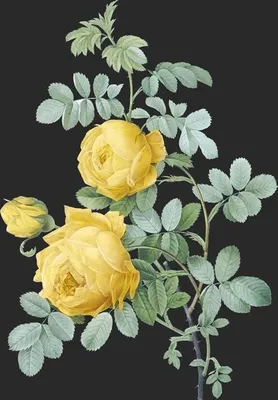
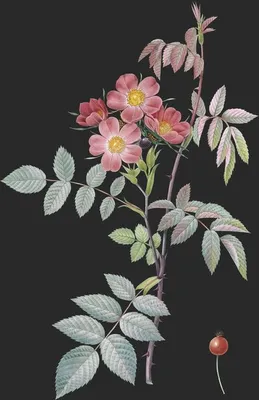
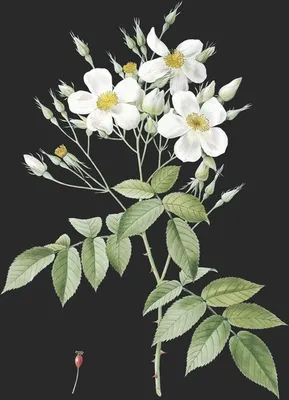
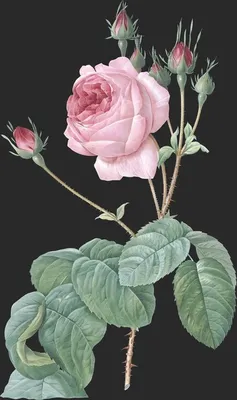
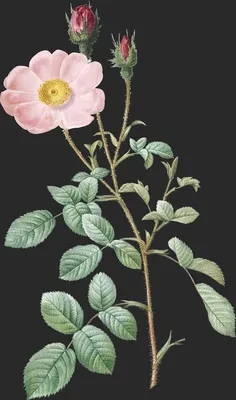
Measured on this plate: flower colour is sparing, 1.1% of the sheet against 9.2% of foliage, the cast tending yellow-green — as with pale or white blooms, outline and tone do the talking. Roses are shrubs or scramblers with pinnate leaves of three to seven serrated leaflets; the double flowers open in crumpled, inward-curling layers around a small knot of yellow stamens. Filed under green — a moss green, a colour that comes mostly from leaf and stem. Read the outline, then the colour layers, then the brush.
-
Composition
Tall and narrow, the plant rising in one movement with generous margins — the upright format of most floras. (about 1.69 : 1) No details are appended: a plate for looking, not for keying out. The plant covers only 24% of the sheet, centred near the centre; the emptiness is where the eye rests. Cover the margins with your thumb and the plate suffocates; uncover them and the flower breathes again.
-
Line and Colour
The first half of the nineteenth century moved from copper to steel to lithography; stipple could render the softest transition. Craft leaves franker evidence than inscriptions.
-
Season
Late spring into early summer, peaking in May — the first flush of the garden year. The year 1821 on the plate is that of publication, not of flowering — the gathering came a year or two earlier. Note the season. Phenology is the most practical tool of appreciation.
-
Provenance
Widespread in the temperate north. Chinese gardeners knew roses since the Han; the ever-blooming modern rose is a nineteenth-century crossing of European and Chinese stock. The localities on the plate are those of a century ago; plants travel and places change their names.
-
The Book and the Hand
“Les Roses” was drawn by Pierre-Joseph Redouté and published 1817-1824. This plate is Plate 85, book page 85. The image is public domain; the hand-colouring is still one person's hand.
-
Poetic Resonance
水晶帘动微风起,满架蔷薇一院香。
—— 唐·高骈《山亭夏日》
The crystal blind stirs as a breeze rises; a trellis of roses perfumes the whole courtyard.
The poem gives the mood first and the picture supplies the form; set the line beside the plate and the green the corolla becomes its resting point.
-
The Written Tradition
插花不可太繁,亦不可太瘦。多不过二种三种,高低疏密,如画苑布置方妙。
—— 明·袁宏道《瓶史·宜称》
Flowers should be set neither too crowded nor too sparse — two or three kinds at most, tall and low, dense and open, arranged as a painter would compose.
Tradition places roses in the Han imperial park; Song and Ming manuals named the double forms 'Baoxiang' and 'Ten Sisters', and Qing compendia separated rose, rugosa and monthly rose. Keep the line; it will surface the next time you meet the same plant.
-
Symbolism
In Europe the rose means love and secrecy ('sub rosa'); in Chinese verse the rambling rose leans and clings — lingering attachment rather than ardour. Meanings change their tune: the same flower can say opposite things within a century.
-
What to Take Away
Next time you stand before a flowering plant, give it three minutes: leaf arrangement, direction of the flower, the darkest patch. Two centuries on, the plant may still flower in some garden; the one on this sheet stopped in the season of 1821.