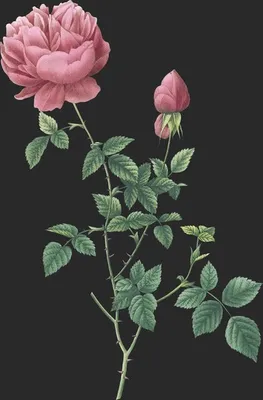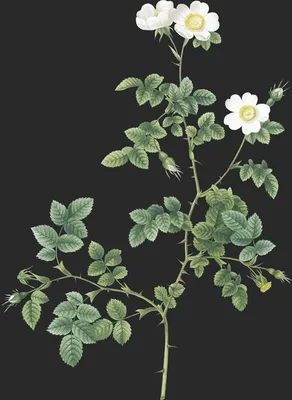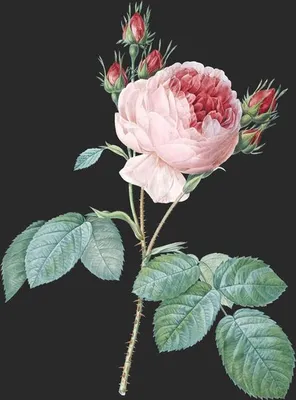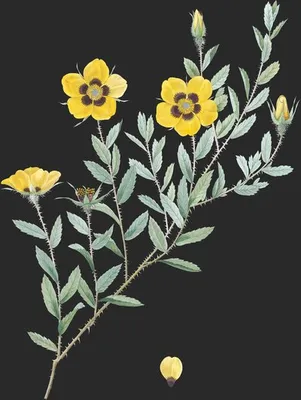
Rosa Villosa Evrathiana
Le Rosier d’Evrath
Le Rosier d’Evrath
Ten ways of seeing
- measured cast red
- upright 1.45 : 1
First Look
真山水之川谷,远望之以取其势,近看之以取其质。
—— 宋·郭熙《林泉高致·山水训》
Mountains and valleys: from afar take their momentum, up close take their texture — the two distances from which any picture is read.
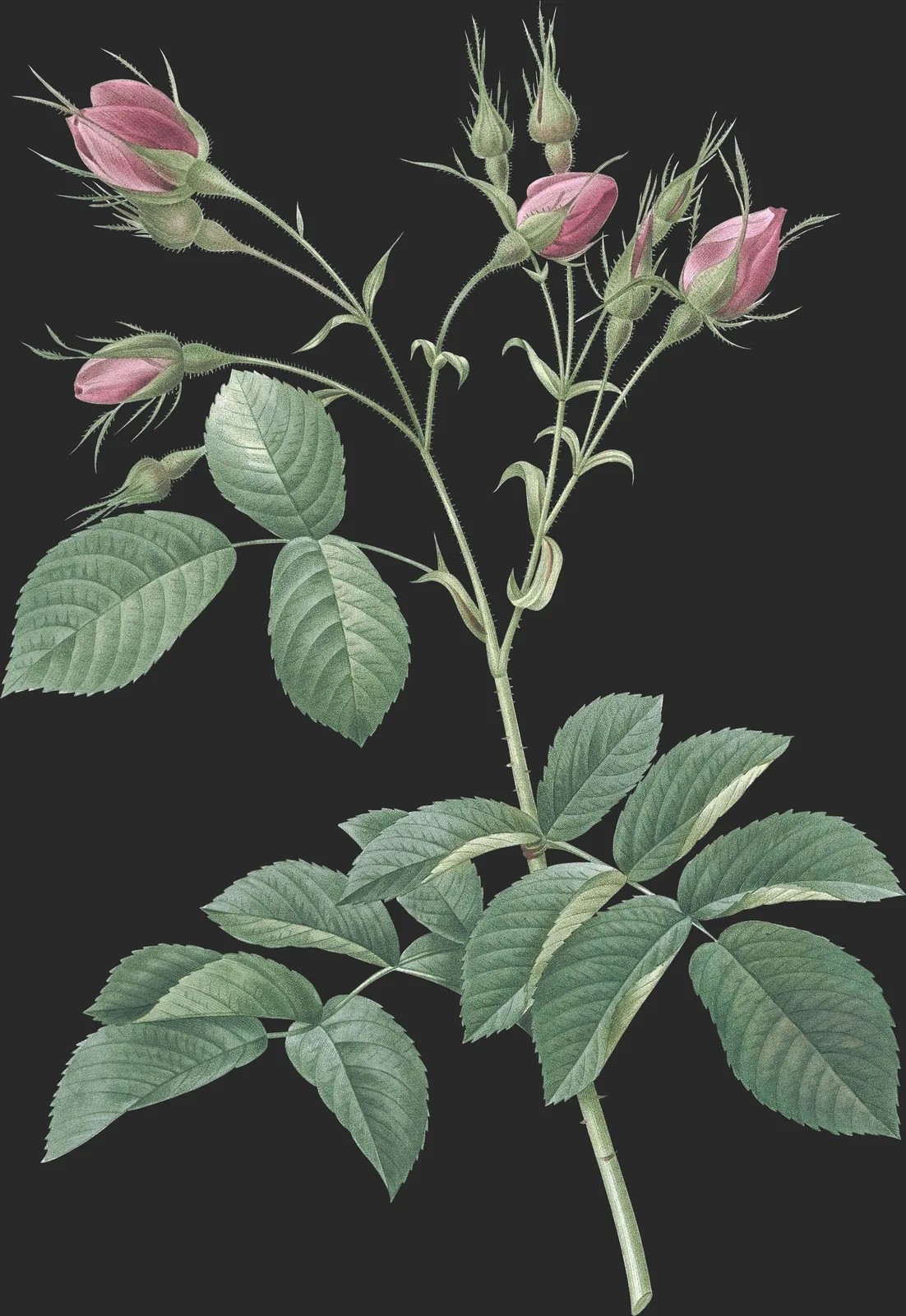
The sheet is vertical: the eye climbs and settles in the upper half. Let the plant stand before you look for detail. Then step in close: watch where colour meets line, and whether the line ever breaks. Third, find where the green is deepest: the whole tonal order is measured from that patch. The pose leans left: the upper half carries 18 points further left than the lower — a living thing, not a diagram.
Name and Thing
Only the genus Rosa is given; species-level names came later. No established Chinese name exists, so it is cited by its binomial alone.
Form and Colour
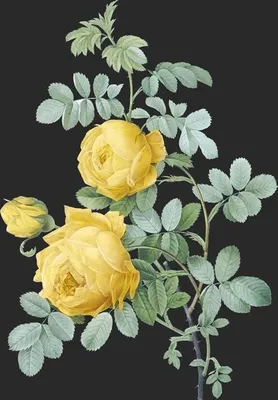
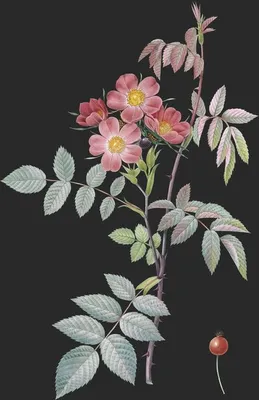
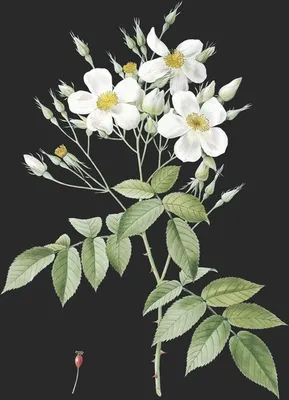
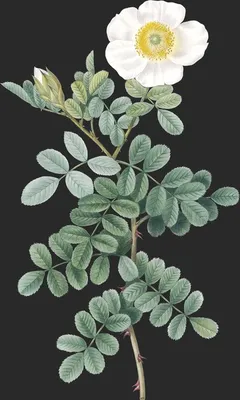
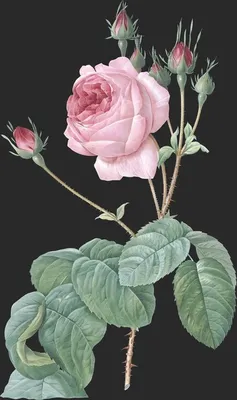
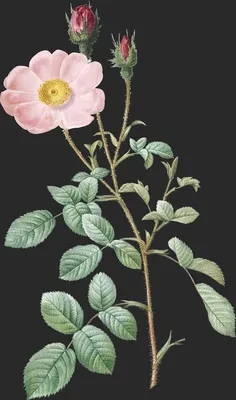
Measured on this plate: flower colour covers 1.6% of the sheet, foliage 5.5%, the cast red. No other plate shares exactly this measure. Roses are shrubs or scramblers with pinnate leaves of three to seven serrated leaflets; the double flowers open in crumpled, inward-curling layers around a small knot of yellow stamens. a moss green. Three things fix the habit: leaf arrangement, tepal count, and how the flower is borne.
Composition
The sheet is tall. No details are appended: a plate for looking, not for keying out. The plant takes about 30% of the sheet, centred near the centre — the easy measure most florists kept to.
Line and Colour
The first half of the nineteenth century moved from copper to steel to lithography; stipple could render the softest transition. Craft leaves franker evidence than inscriptions. If you mean to copy it: take its skeleton, its margins and the order of its colours; the burin's hatching is the language of copper — suggest it with pencil density, do not imitate it stroke for stroke.
Poetic Resonance
粉融香雪透轻纱。
—— 宋·晏殊《浣溪沙》
The poem gives the mood first and the picture supplies the form; set the line beside the plate and the green the corolla becomes its resting point.
Symbolism
In Europe the rose means love and secrecy ('sub rosa'); in Chinese verse the rambling rose leans and clings — lingering attachment rather than ardour. In a flora it is a species first and a symbol second; the order is worth keeping.
Season and Place
Late spring into early summer, peaking in May — the first flush of the garden year. Widespread in the temperate north. Chinese gardeners knew roses since the Han. The year 1824 on the plate is that of publication, not of flowering — the gathering came a year or two earlier. Read the locality and the flowering season both with a discount: one is hearsay, the other a ten-day peak.
The Book and the Hand
“Les Roses” carries only Pierre-Joseph Redouté's name. A plate is collective work: drawer, engraver and colourist were different hands, and the unnamed ones decided how good it looks.
What to Take Away
If you keep one line, keep Guo Xi's: from afar its momentum, up close its texture. Two centuries on, the plant may still flower in some garden; the one on this sheet stopped in the season of 1824.
About this plate
Description
C’est un arbrisseau très-vigoureux qui s’élève en buisson jusqu’à la hauteur de dix pieds. Ses tiges ne présentent, en général, qu’un très-petit nombre d’aiguillons; quelques indivi-dus, même, en sont entièrement dépourvus. Les feuilles se composent rarement de trois, le plus souvent de cing à sept folioles très-grandes, glabres et d’un vert-foncé en-dessus, plus pâles et légèrement velues en-dessous; elles sont portées par un pétiole presque glabre et un peu glanduleux. Les fleurs, latérales et terminales, sont disposées en panicule pendant: les pédoncules qui les supportent sont, ainsi que les tubes ovoïdes-allongés des calices, recouverts d’un grand nombre de poils fermes, surmontés de glandes. Les divisions du limbe sont ap-pendiculées, très-longues et glanduleuses. Les boutons des fleurs de ce Rosier s’épanouissent assez rarement. Celles des fleurs qui parviennent à se développer présentent sept à huit rangs de pétales d’un rose-tendre, et sont assez odorantes.
Observations
Ce Rosier a été dédié par M. Bosc à M. Evrath, amateur distingué, auquel il a été envoyé des pépinières de Hollande, sous le nom de Muscade noire. Il participe du R. Alba, par la forme des tubes des calices; du Villosa, par ses folioles velues en-dessous, ses pédoncules, ses pédicelles et ses tubes recouverts de poils glanduleux; enfin du R. Turbinata, par l’extrême difficulté qu’éprouve l’épanouissement des boutons. On ne peut donc le considérer que comme un mulet végétal. Toutefois, Du Pont a cru apercevoir que le Rosier Evrath participait plus du Rosier velu que des autres, c’est pourquoi il l’a placé dans le groupe des Villosæ; opinion que nous avons adoptée.
MM. Poiret et Lindlet disent que ce Rosier est maturel au sol de la Caroline; on peut douter de ce fait, et à l’appui de notre opinion nous dirons que l’arbrisseau ne se trouve pas dans la nomenclature des Rosiers indigènes de ces contrées que nous a donnée M. Nuttall, en 1818.
Selon M. Bosc, cet arbrisseau, en raison de sa vigueur, peut avantageusement servir à recevoir la greffe, et à remplacer les églantiers qui commencent à devenir rares.
- R. Evratina. Bosc, Nouv. Cours, vol. 11, p. 256. Desf. Cat. Hort. p. 273. Lind. Mon. p. 236.
- R. (Evratina) germinibus ovatis hispidissimis; ramis petiolisque subinermibus; foliolis quinatis ternatisve; pedunculis hispidis, fasciculato-subumbellatis, terminalibus. Poir. Ency. supp. au vol. 4, 2e part. p. 714.
- R. Villosa Evratina. Du P. Gymn. Ros. p. 14, spec. 5, № 7. Thy. Prod. groupe XI, p. 65, var. ε.