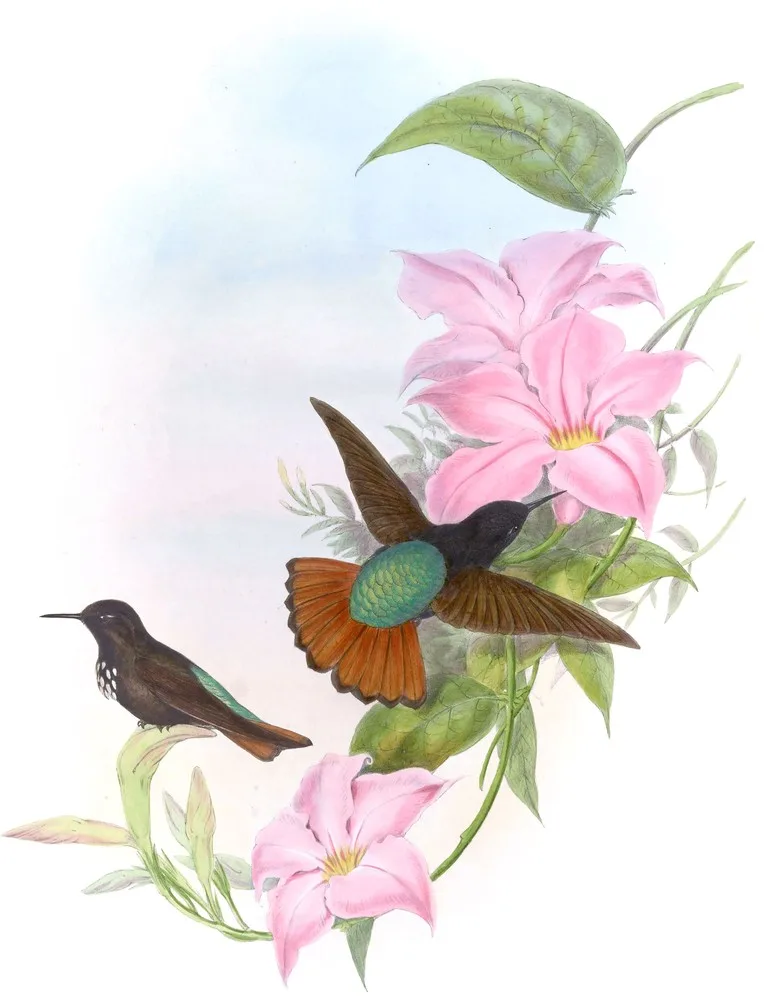
Aglæactis Pamela
Aglæactis Pamela
Pamela’s Sun-beam
- 合集
- 古尔德蜂鸟图谱
- 绘者
- John Gould(约翰·古尔德)
- 年代
- 1852
- 图版号
- Pl. 181, Vol. III
- 原书页码
- p.181
- 授权
- CC0 1.0 Universal (Public domain)
关于本图版
本图选自约翰·古尔德的《古尔德蜂鸟图谱》(Gould's Hummingbirds),原书 1849—1887 年间出版。原书题作“Aglæactis Pamela”,在分类体系中列于蜂鸟科(Trochilidae)。
该合集全编共 421 幅图版,此图为其中之一,图版编号 Pl. 181, Vol. III,对应原书第 181 页,版式为纵幅。图为公有领域原件的修复扫描,构图与设色未经改动。
原书文字(英文 / 法文)
Bolivia
As far as is yet known, this magnificent species is exclusively confined to Bolivia.
It was first discovered by M. D’Orbigny, and a figure and description of it will be found in his “Voyage dans Amérique.” In the extent of the lustre of the upper surface it far exceeds all the other members of the genus, the entire back being covered with glittering metallic-green feathers, as if encased in a coat of mail; it is also rendered very conspicuous by the tuft of feathers which springs from the chest.
Fortunate indeed may be considered those travellers who have seen this fine bird in a state of nature. M. D’Orbigny states that he only saw two examples, but Mr. Bridges procured numerous specimens during his travels into the interior of Bolivia; and it was from this gentleman that I procured the fine series which grace, and may be considered the gems of, my collection. Hardy in its constitution, this species braves with impunity the fierce blasts of the bleak mountain-ranges among which it dwells, at an elevation more than double the height of the loftiest mountain of the British Islands. Here, amid alpine plants, and with the uninterrupted rays of the sun imparting additional lustre to the glittering feathers of its back, it must form a truly gorgeous object. Like the A. cupripennis, the back feathers of this bird receive the rays of light in an opposite direction to that required to show the beauty of nearly all other birds, it being only from behind that they appear brilliant.
I have much pleasure in adding the following short notes on this species from the work of M. D’Orbigny above referred to, and the pen of Mr. Bridges:—
“We met with this species,” says M. D’Orbigny, “in the 17th degree of south latitude, at the upper limit of ligneous vegetation, near Tajesi, in the province of Yungas, on the eastern side of the Cordillera of La Paz, in Bolivia; we also met with it on the summit of the mountains in the province of Ayupaya, near PalcaGrande; and we believe that it is confined to those mountainous regions, at an altitude of about 3500 metres above the level of the sea. As yet we have only seen two specimens, which renders it probable that it is very rare; but it must be mentioned, that it is impossible to remain for any length of time in the localities it inhabits.”
Mr. Bridges states that it “is found at Unduave, and in the Yungas of Cochabamba; far up the mountains, near the limit of vegetation, at an altitude of 10,000 feet. It procures its food from the flowers of a species of Alstrœmeria.”
As is the case with A. cupripennis, the female is not so fine as the male; the general colouring of her body not being so deep, the back having only a slight trace of the brilliant green, and the breast-tufts being shorter.
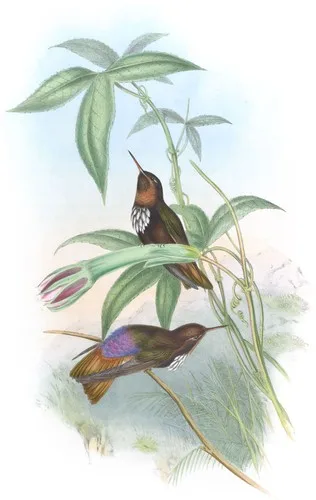
The male has the head, neck, upper part of the back, upper and under wing-coverts, and all the under surface, dark velvety brownish black; on the centre of the chest a tuft of long pendent black feathers tipped with white; wings bronzy purplish brown; lower part of the back, rump, and upper tail-coverts velvety brown when viewed in front, and of glittering metallic grass-green when viewed from behind; tail dark chestnut, each feather narrowly edged externally and more broadly tipped with bronzy brown; bea blackish brown.
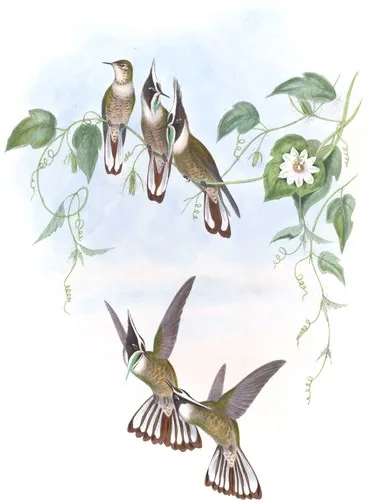
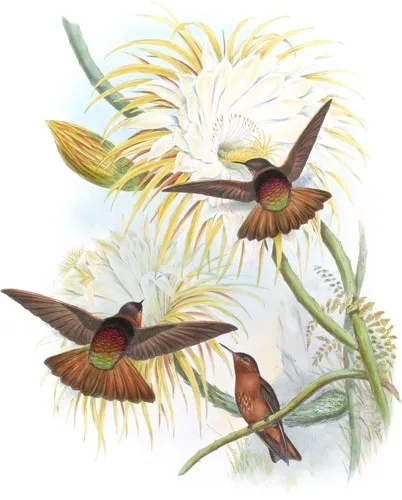
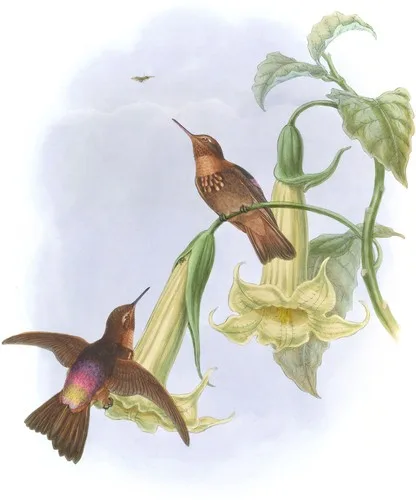
The Plate represents both sexes of the natural size. The plant is the Depladenia acuminata.
References
- Orthorhynchus Pamela, D’Orb. et Lafres. Syn., p. 29. no. 14.—D’Orb. Voy. dans l'Amér. Mérid., Ois., tom. iv. p. 375. pl. 60. fig. 1.
- Hylocharis Pamela, Gray and Mitch. Gen. of Birds, vol. 1. p. 114, Hylocharis, sp. 13.
- Agleactis pamela, Bonap. Consp. Gen. Av., p. 73, Aglæactis, sp. 2.—Ib. Rev. et Mag. de Zool. 1854, p. 253.—Reichenb. Aufz. der Colibris, p. 9.
- Helianthea Pamela, Reichenb. Troch. enumer., p. 6. pl. dccxxxiii. figs. 4691, 4692.
十二观
- 略纵 1.28∶1
- 1852 年刊
- 图版 181, Vol. III
这不是词条,是一条看画的次序:先站定看整体,再看名字与形色、构图与刀工,然后问它几时开、从哪里来、经了谁的手;最后是中国诗文——同一朵花,中国古人是怎么看的。十二观读完,这幅图就打开了。
-
第一眼
搜尽奇峰打草稿。
—— 清·石涛《苦瓜和尚画语录》
走遍山川,才有资格落笔。博物画的画家也一样:先在温室与山野里看够了活的花,纸上那一朵才不虚。这一幅略高于宽,落点在中央偏上那只鸟的头部。第二步凑近一寸:看线与色的交界,色有没有压住线,线有没有断。第三步,把视线放到最深的那一小块:整幅的用色秩序,都是从那里排开的。
-
名与实
此幅未见可靠的学名,只能以原书题名相称——早期图谱里这种情形并不少见。此幅既无通行中文名,学名也不可靠,只能以原书题名相称——图谱里总有几幅这样的图,只能靠画面本身说话。
-
形与色
蜂鸟为美洲最小之鸟,喙细长如针,舌分叉成管,可伸入花心吸蜜;翼小而振频极高,能悬停、能倒飞。此幅未作色相归档,只能就形制论。看形制不必求全:记住喙形、翼式与栖姿,这一类的骨架就立住了。
-
构图与呼吸
画幅略高于宽,鸟身居中偏上,视线落在头部与喙。(高宽比约 1.28∶1)全幅只画一只,不作解剖附图——这类图更近于“观赏”,而非“鉴定”。空白不是没画完,是给眼睛留的落脚处:一张图若四边都塞满,花反而会闷。
-
一刀一色
十九世纪后半叶,石版与彩色石印渐成主流:颜色可以直接印出,不再依赖手工,线条反倒退居其次。图像的“准确”提高了,手性却淡了。拿放大镜(或手机微距)看三处:喙缘、覆羽、题名。线若连续不断,是刻的;色若越过轮廓半毫米,是手涂的。
-
时序
热带美洲几乎全年可见,花期即其季节;温带种类的蜂鸟则随花北迁,一年往返数千公里。图上所记的 1852 年是刊行之年,不是采到那只鸟的年份;真正的观察记录通常比出版早一两年。记下这一季:物候是最好用的鉴赏工具,见过一次活的花,再看图就不会只看颜色。
-
故土
仅产美洲,自阿拉斯加南部至火地岛,以安第斯山最为繁盛。中土无蜂鸟,汉籍不载,晚清海外游记始见其名。产地写在图上的,往往是“据说来自”;真正的野外记录,要等采集人回来才敢落笔。
-
书与人
《古尔德蜂鸟图谱》(Gould's Hummingbirds)由约翰·古尔德绘,成于1849-1887。此幅为其中图版 181, Vol. III,见原书第 181 页。一本书的“作者”常常是主编;真正决定这幅图好不好看的,是没留下名字的刻工与上色人。
-
诗境
夫列子御风而行,泠然善也,旬有五日而后反。
—— 《庄子·逍遥游》
蜂鸟悬停于空,不落不飞,最近于“御风”。庄子说的是一种自由的姿态,蜂鸟把它做成了生理事实。把这一句放回画面:画面就是诗句的落点——诗先写气,画后写形,两者在此处接上了。
-
文心
竖划三寸,当千仞之高;横墨数尺,体百里之迥。
—— 南朝宋·宗炳《画山水序》
三寸的竖线可当千仞高山,几尺横墨能容百里之远。一只蜂鸟只有拇指大,画家却要在几厘米里放下整片花丛——尺度从来不是障碍。古尔德《蜂鸟图谱》(1849—1887)以石版手工上色,金箔衬底,使羽色在纸上仍有金属光;这套图册本身就是十九世纪印刷与收藏狂热合流的产物。中外的分别不在谁高明,而在问的问题不同:欧洲问它是什么,中国问它像谁。两个问题都答了,一幅图才算读完。
-
花语
阿兹特克以蜂鸟为战神与太阳的化身;欧洲维多利亚时代则以蜂鸟为收藏与装饰的极致,百万只羽毛被做成胸饰。中国旧籍无此鸟,故无象征——这空白本身,就是一部博物学交流史。象征多半来自形状与气味:像杯的、像泪的、香的、臭的——先有形状,后有意义。
-
带走一双眼睛
如果只能记一句,就记郭熙那八个字:远望取其势,近看取其质。看图、看花、看人,都一样。1852 年的那只鸟早已化作尘土,它留在纸上的样子,却比任何一只活着的同类都长寿。