Bourcieria torquata
Bourcieria torquata
Collared Inca
- 学名
- Bourcieria torquata
- 合集
- 古尔德蜂鸟图谱
- 绘者
- John Gould(约翰·古尔德)
- 年代
- 1854
- 图版号
- Pl. 251, Vol. IV
- 原书页码
- p.251
- 授权
- CC0 1.0 Universal (Public domain)
关于本图版
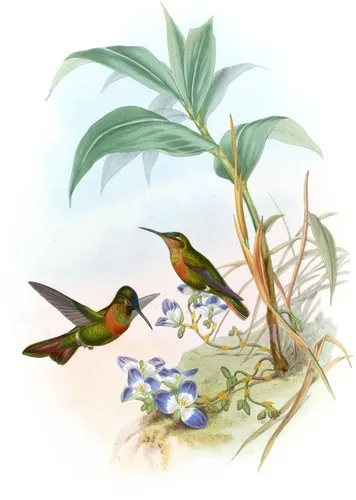
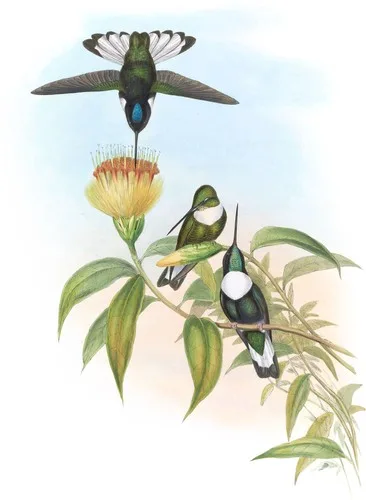
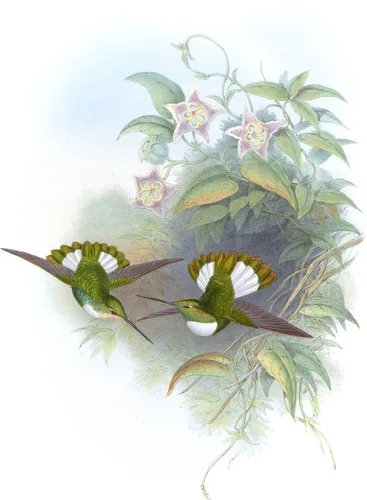
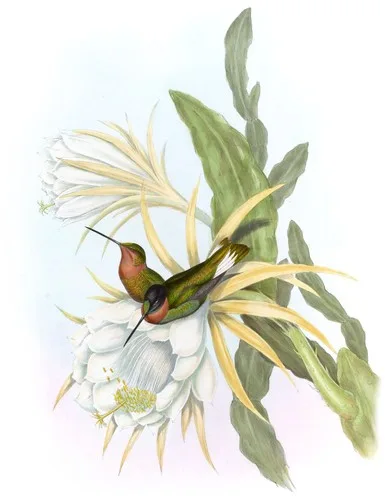
本图选自约翰·古尔德的《古尔德蜂鸟图谱》(Gould's Hummingbirds),原书 1849—1887 年间出版。画面主体为 Bourcieria torquata,在分类体系中列于蜂鸟科(Trochilidae)。
该合集全编共 421 幅图版,此图为其中之一,图版编号 Pl. 251, Vol. IV,对应原书第 251 页,版式为纵幅。图像由公有领域原件扫描修复而来,细节在放大视图中仍清晰可辨。
原书文字(英文 / 法文)
Columbia. Common in the temperate regions round Bogota.
The present is one of the best-known species of the well-defined Andean genus of Humming Birds, to which the Prince Charles Lucien Bonaparte has given the appellation of Bourcieria, in order to assist in perpetuating the name of a gentleman familiar to every naturalist, as the possessor of one of the finest collections of the Trochilidæ in Europe, and who, by his personal researches in South America, has added largely to our knowledge of this charming group.
Speaking in a wide sense, the high lands of the great country of Columbia is the native habitat of this fine species. Most of the collections from Bogota and Popayan contain examples. Mr. Mark tells me that it frequents the Paramos or upland grassy districts, and that it extracts its food from the blossoms of the shrubby plants common to such localities, the wild Guava being always resorted to when in flower.
Judging from the large size of its wings and its general contour, we may conclude that, like its allies, its powers of flight are very great.
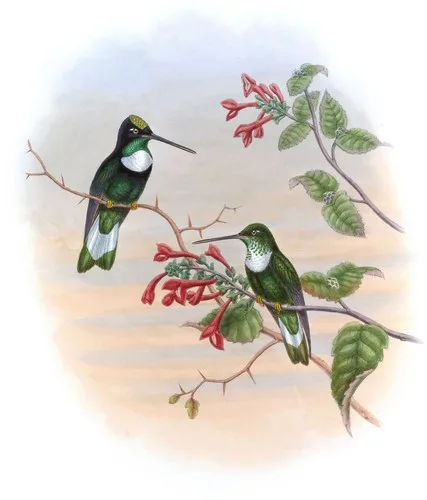
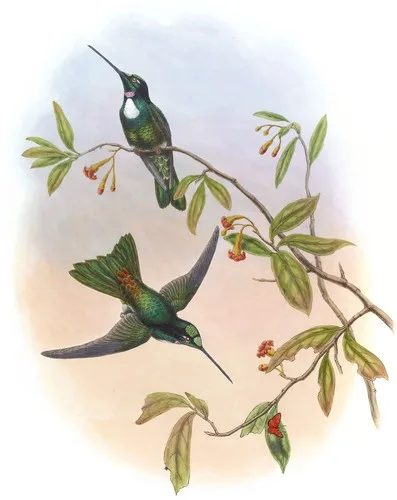
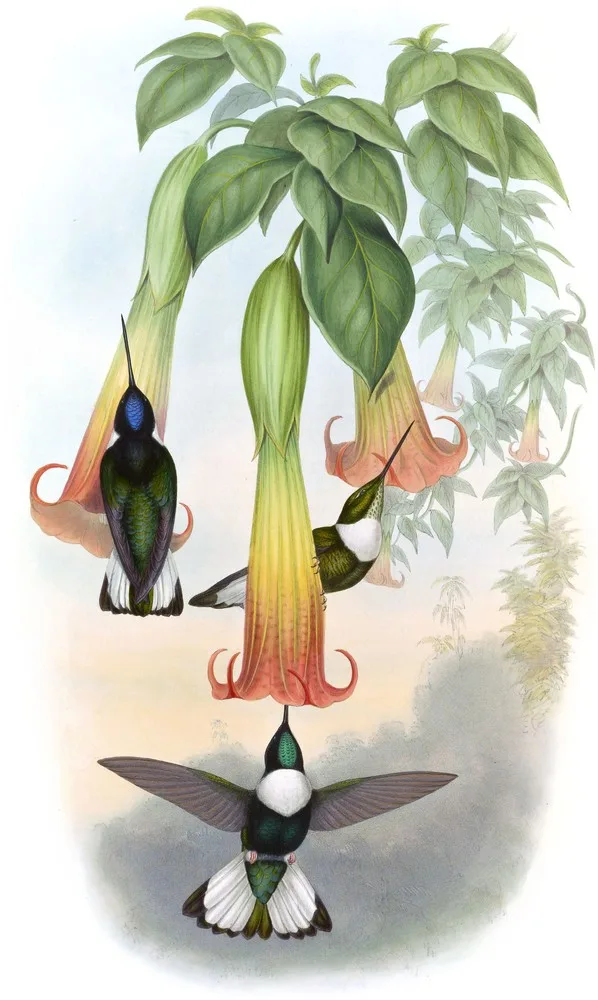
It will be seen that the colours of the male are very decided, the white breast of the fully adult birds offering a striking contrast to the jet-black of the surrounding plumage. The female is much smaller than the male, and although dressed in a somewhat similar style of plumage, the markings are never so well defined, the blue crown is absent, the white gorget is less pure, and the surrounding plumage obscure green instead of black.
The male has the forehead, back of the neck, mantle, ear-coverts, and sides of the face, black with green reflexions; on the centre of the crown a nearly triangular mark of blue; shoulders, spurious wing, the three innermost secondaries, back and upper tail-coverts deep grass-green; chin and throat black, each feather tipped with greenish blue; on the breast a broad gorget of pure white; abdomen black, with reflexions of green on the tips of the feathers; thighs black; tarsi white; toes yellowish rose-colour; wings purplish brown; two centre tail-feathers dark olive-green, the remainder pure white tipped with dark olivegreen, and extending down the external margin of the outer feather for three-fourths of its length; bill black.
The female has the head and upper surface bronzy grass-green; no blue on the crown; wings and tail as in the male; the throat white speckled with green, and the white gorget dull and clouded.
The figures are of the natural size; the plant is a species of Brugmansia, common in the country frequented by the birds.
References
- Ornismia torquata, Boiss. Rey. Zool. 1840, p. 6.
- Mellisuga torquata, Gray and Mitch. Gen. of Birds, vol. i. p. 112, Mellisuga, sp. 12.
- Bourcieria torquatus, Bonap. Consp. Gen. Av., p. 73, Bourcieria, sp. 2.
- Bourcieria torquata, Bonap. Consp. Troch. in Rev. et Mag. de Zool. 1854, p. 251.
十二观
- 纵幅 1.67∶1
- 1854 年刊
- 图版 251, Vol. IV
这不是词条,是一条看画的次序:先站定看整体,再看名字与形色、构图与刀工,然后问它几时开、从哪里来、经了谁的手;最后是中国诗文——同一朵花,中国古人是怎么看的。十二观读完,这幅图就打开了。
-
第一眼
真山水之川谷,远望之以取其势,近看之以取其质。
—— 宋·郭熙《林泉高致·山水训》
远看取其气势,近看取其质地。八个字,就是看画的两步:先退后看整体,再凑近看笔与色。看花鸟图版一样管用。这一幅是竖的:眼睛从下往上走,落点在中段那只鸟身上。先别急着看羽毛,让姿态先立起来。第二步凑近一寸:看线与色的交界,色有没有压住线,线有没有断。第三步,把视线放到最深的那一小块:整幅的用色秩序,都是从那里排开的。
-
名与实
学名 Bourcieria torquata:前一词是属,管它归在哪一类;后一词是种加词,管它在这一类里凭什么与众不同。名字是通行证,也是懒办法——记住两个词,就抓住了一整个物种。此幅尚无通行中文名,姑以学名相称;在没有本地名字的地方,学名就是它唯一的身份证。
-
形与色
翼小而振频极高,能悬停、能倒飞;羽色非颜料所致,是羽枝结构折射的光,随角度而变。此幅未作色相归档,只能就形制论。颜色不是平涂的:最浅处近乎纸色,最深处在花瓣重叠的缝里。把这两处找到,画面的呼吸就出来了。
-
构图与呼吸
画幅高而窄,鸟栖在枝的中段,上下留白多——十九世纪鸟谱的标准版式,留给它飞走的余地。(高宽比约 1.67∶1)全幅只画一只,不作解剖附图——这类图更近于“观赏”,而非“鉴定”。老图谱爱把主株摆在偏中线的位置,左右留得不一样多:这一点偏心,正是画面活起来的原因。
-
一刀一色
十九世纪后半叶,石版与彩色石印渐成主流:颜色可以直接印出,不再依赖手工,线条反倒退居其次。图像的“准确”提高了,手性却淡了。拿放大镜(或手机微距)看三处:喙缘、覆羽、题名。线若连续不断,是刻的;色若越过轮廓半毫米,是手涂的。
-
时序
热带美洲几乎全年可见,花期即其季节;温带种类的蜂鸟则随花北迁,一年往返数千公里。图上所记的 1854 年是刊行之年,不是采到那只鸟的年份;真正的观察记录通常比出版早一两年。图谱记的是十余日的盛况;剩下的三百多天,植物在长叶、结果、休眠——图只截了它最像自己的一刻。
-
故土
仅产美洲,自阿拉斯加南部至火地岛,以安第斯山最为繁盛。中土无蜂鸟,汉籍不载,晚清海外游记始见其名。产地写在图上的,往往是“据说来自”;真正的野外记录,要等采集人回来才敢落笔。
-
书与人
《古尔德蜂鸟图谱》(Gould's Hummingbirds)由约翰·古尔德绘,成于1849-1887。此幅为其中图版 251, Vol. IV,见原书第 251 页。一本书的“作者”常常是主编;真正决定这幅图好不好看的,是没留下名字的刻工与上色人。
-
诗境
夫列子御风而行,泠然善也,旬有五日而后反。
—— 《庄子·逍遥游》
蜂鸟悬停于空,不落不飞,最近于“御风”。庄子说的是一种自由的姿态,蜂鸟把它做成了生理事实。诗以气行,画以形立;两种“看”叠在一起,才是看画的意思。
-
文心
论画以形似,见与儿童邻。
—— 宋·苏轼《书鄢陵王主簿所画折枝》
只求画得像,是小孩的眼光。苏轼不是不要形似,是说形似之后还有一层:神。古尔德《蜂鸟图谱》(1849—1887)以石版手工上色,金箔衬底,使羽色在纸上仍有金属光;这套图册本身就是十九世纪印刷与收藏狂热合流的产物。记住这一句,下次在别处见到同类,它会自己浮上来——鉴赏力就是这样一句一句攒出来的。
-
花语
阿兹特克以蜂鸟为战神与太阳的化身;欧洲维多利亚时代则以蜂鸟为收藏与装饰的极致,百万只羽毛被做成胸饰。中国旧籍无此鸟,故无象征——这空白本身,就是一部博物学交流史。花语是给人与人的关系用的;植物自己只关心有没有传粉的虫。这两套语言,可以并行不悖。
-
带走一双眼睛
下次看鸟,别急着认名:先看它停的姿态,再看羽色在哪一段最深,最后才翻图鉴——顺序一换,看鸟就从“对答案”变成了“看画”。1854 年的那只鸟早已化作尘土,它留在纸上的样子,却比任何一只活着的同类都长寿。