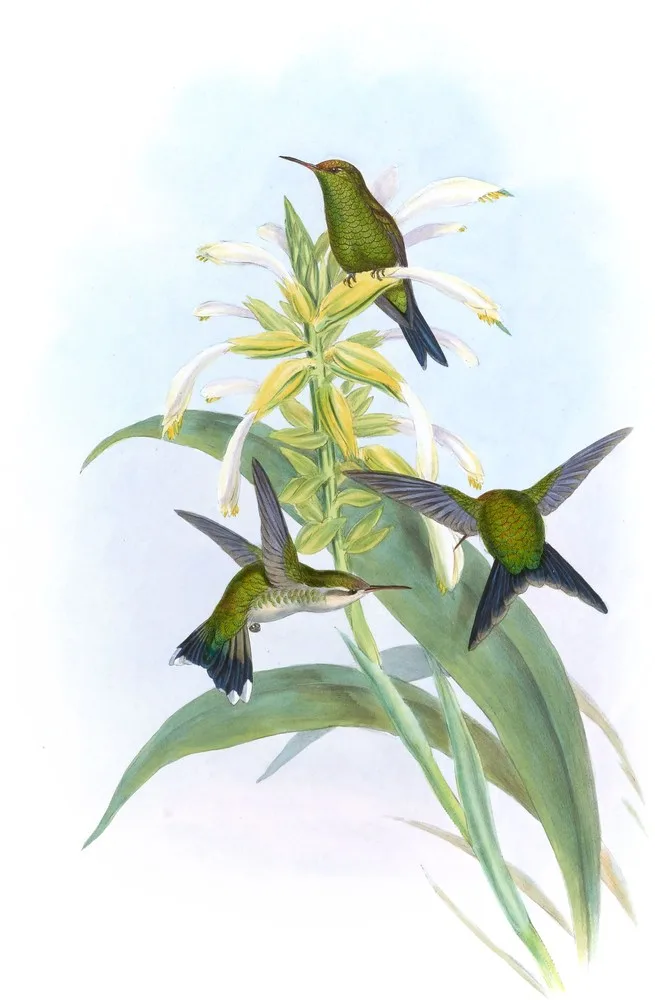
翠蜂鸟属·Chlorostilbon Caniveti
Chlorostilbon Caniveti
Chlorostilbon Caniveti
Canivet’s Emerald
- 中文名
- 翠蜂鸟属·Chlorostilbon Caniveti
- 学名
- Chlorostilbon Caniveti
- 合集
- 古尔德蜂鸟图谱
- 绘者
- John Gould(约翰·古尔德)
- 年代
- 1861
- 图版号
- Pl. 351, Vol. V
- 原书页码
- p.351
- 授权
- CC0 1.0 Universal (Public domain)
十观
- 纵幅 1.53∶1
第一眼
真山水之川谷,远望之以取其势,近看之以取其质。
—— 宋·郭熙《林泉高致·山水训》
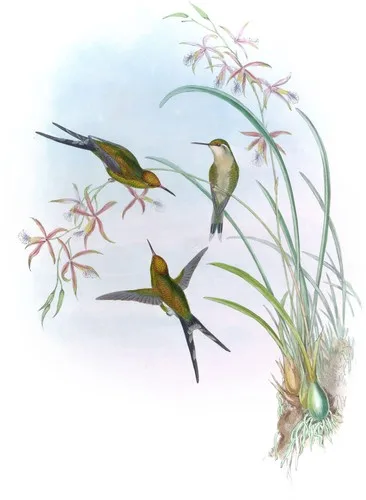
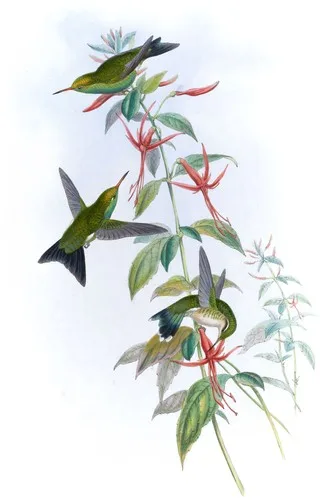
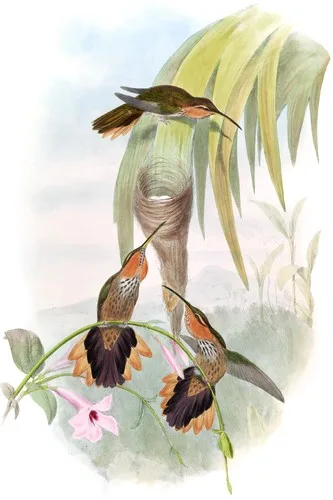
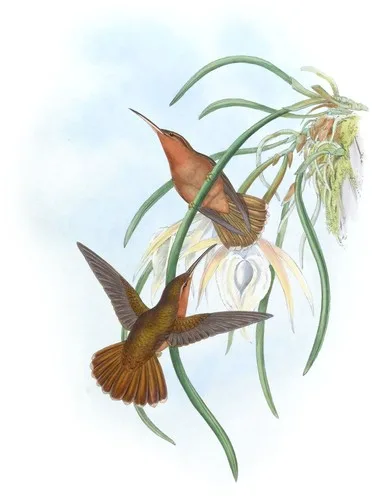
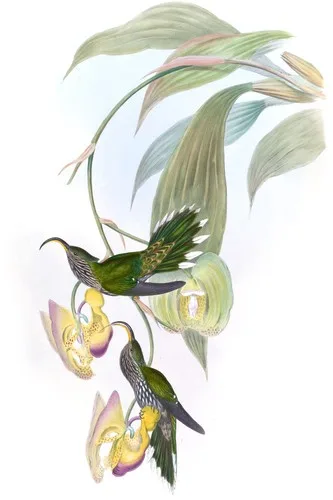
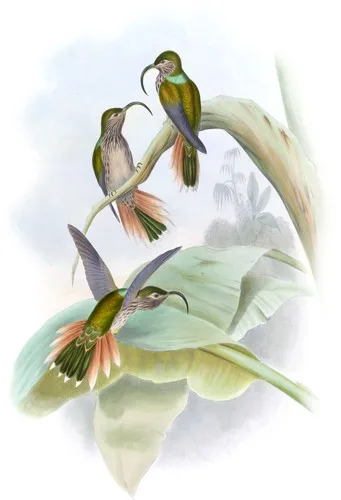
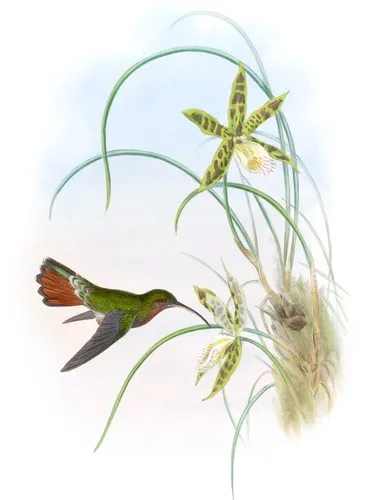
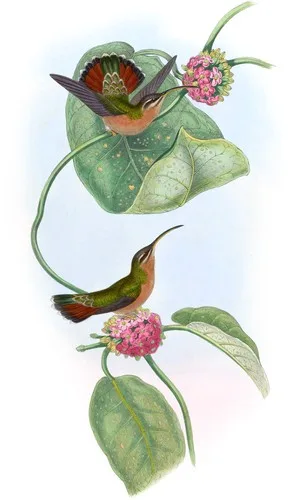
远看取其气势,近看取其质地。八个字,就是看画的两步:先退后看整体,再凑近看笔与色。看花鸟图版一样管用。这一幅是竖的:眼睛从下往上走,落点在中段那只鸟身上。先别急着看羽毛,让姿态先立起来。第二步凑近一寸:看线与色的交界,色有没有压住线,线有没有断。第三步,把视线放到最深的那一小块:整幅的用色秩序,都是从那里排开的。
名与实
学名 Chlorostilbon caniveti:前一词是属,管它归在哪一类;后一词是种加词,管它在这一类里凭什么与众不同。一百多年前的命名者,把一种植物的来历压进了两个词。此幅尚无通行中文名,姑以学名相称;在没有本地名字的地方,学名就是它唯一的身份证。
形与色
蜂鸟为美洲最小之鸟,喙细长如针,舌分叉成管,可伸入花心吸蜜;翼小而振频极高,能悬停、能倒飞。此幅未作色相归档,只能就形制论。没有解剖图,就靠主株一处一处看过去:叶怎么排,花怎么着生,果在哪里。
构图与呼吸
画幅高而窄,鸟栖在枝的中段,上下留白多——十九世纪鸟谱的标准版式,留给它飞走的余地。全幅只画一只,不作解剖附图——这类图更近于“观赏”,而非“鉴定”。老图谱爱把主株摆在偏中线的位置,左右留得不一样多:这一点偏心,正是画面活起来的原因。
一刀一色
十九世纪后半叶,石版与彩色石印渐成主流:颜色可以直接印出,不再依赖手工,线条反倒退居其次。图像的“准确”提高了,手性却淡了。还有一种证据在纸背:铜版压进纸里的那道痕、上色处微微凸起的颜料、再版时磨浅的线。扫描件里也能看出七分。想动笔临它的人记住一句:先铺大块的形与色,干后再收细部;石印的柔和层次来自薄涂与网点,水彩分两三遍淡铺即可逼近。
诗境
夫列子御风而行,泠然善也,旬有五日而后反。
—— 《庄子·逍遥游》
蜂鸟悬停于空,不落不飞,最近于“御风”。庄子说的是一种自由的姿态,蜂鸟把它做成了生理事实。把这一句放回画面:画面就是诗句的落点——诗先写气,画后写形,两者在此处接上了。
花语
阿兹特克以蜂鸟为战神与太阳的化身;欧洲维多利亚时代则以蜂鸟为收藏与装饰的极致,百万只羽毛被做成胸饰。中国旧籍无此鸟,故无象征——这空白本身,就是一部博物学交流史。花语是后人添上去的,花本身并不知道;但这层“不知道”,正是它最动人的地方。
时与地
热带美洲几乎全年可见,花期即其季节。仅产美洲,自阿拉斯加南部至火地岛,以安第斯山最为繁盛。中土无蜂鸟,汉籍不载,晚清海外游记始见其名。图上所记的 1861 年是刊行之年,不是采到那只鸟的年份;真正的观察记录通常比出版早一两年。图上的产地常是“据说来自”,图上的花期常是“盛开那十日”——两处都要打个折扣读。
书与人
《古尔德蜂鸟图谱》只署了约翰·古尔德一个人的名字。版画是集体工程:绘图、刻版、上色各有其人,真正决定这幅图好不好看的,常是没留下名字的刻工与上色师。
带走一双眼睛
如果只能记一句,就记郭熙那八个字:远望取其势,近看取其质。看图、看花、看人,都一样。1861 年的那只鸟早已化作尘土,它留在纸上的样子,却比任何一只活着的同类都长寿。
关于本图版
《古尔德蜂鸟图谱》(Gould's Hummingbirds)由约翰·古尔德绘制,1849—1887 年间印行,本图即其中一幅。图中描绘的是翠蜂鸟,在分类体系中列于蜂鸟科(Trochilidae)。
该合集全编共 421 幅图版,此图为其中之一,图版编号 Pl. 351, Vol. V,对应原书第 351 页,版式为纵幅。图为公有领域原件的修复扫描,构图与设色未经改动。
原书文字(英文 / 法文)
Southern Mexico and Guatemala?
In no instance does false information as to locality more frequently occur than among the members of the great group of Humming-Birds, and thus the Chlorostilbon Caniveti, the bird here represented, has been described as an inhabitant of a country in which it has never existed.
The bird figured by Lesson on the 38th plate of his ‘Supplément’ has usually been considered by more recent naturalists to be, as M. Lesson states, the young of this species; but I observe that Dr. Reichenbach considers it to be not only a new and distinct bird, but as belonging to a very different genus, and that, entertaining this impression, he has assigned it a new name, that of Chlorestes Haeberlinii. Now from this view I must dissent, at least in part: it is just possible that the plate in question may not represent the young of the present species, but it certainly does represent the young of a Chlorostilbon,—of what species, however, neither Dr. Reichenbach nor any living Trochilidist can determine unless he had an opportunity of examining the typical specimen from which the figure was taken; consequently the grounds for naming it as distinct are very slight indeed, and I have therefore placed Dr. Reichenbach’s name among the synonyms to C. Caniveti, giving him the benefit of the doubt which exists in my mind as to his having come to a right conclusion. Enough, I am sure, has now been said upon this part of the history of the bird, which, after all, cannot be of interest to any one but the compiler of names and lists of species. It is time to say of what country it really is a native, and something about its habits and economy. Speaking of its habitat in a wide sense, it may be said to extend over Mexico, Guatemala, Honduras, and Costa Rica, as it is found in all, but I believe it is confined to the eastern parts of those countries; in Western Guatemala its place is supplied by the nearly-allied species which I have named C. Osberti—a bird which differs in its much smaller size rather than in any variation in its colouring. The country of Cordova, in Mexico, would appear to be a favourite locality of the C. Caniveti; indeed it would seem to be very common there, if we may judge by the numerous examples, together with their nests and eggs, which were brought from thence by M. Salle. M. Lesson must have become aware of his having made a mistake in giving Brazil as the habitat of this bird, for in the ‘Revue Zoologique’ for 1839 he states that M. De Lattre had killed it at Kakamoakho in Mexico, but that it was rare in the neighbourhood of Jalapa. M. De Lattre informed him that it ‘leads a solitary life, either in the forests or by the borders of the little foot-paths, choosing one spot and wandering but little from it.”
In its general contour this is a very elegant bird, its body, bill, wings and tail being all well-proportioned; the last-mentioned organ is ample and considerably forked, and has nearly all the feathers tipped with silvery grey, offering a contrast to the colours of the surrounding feathers; its crown, breast, and under surface are brilliant in the extreme, so much so as to nearly rival the same parts in C. auriceps, to which species it is more closely allied than to any other, but from which it may at all times be distinguished by its shorter and broader outer tail-feathers.
The male has the crown of the head rich golden; all the upper surface, wing- and tail-coverts rich wings pale purplish brown; tail deep purplish black, the central feathers tipped with grey, lessening in extent as they approach the external ones, which in some specimens are destitute of this mark; throat and under surface glittering grass-green, washed with a golden hue on the flanks and under tail-coverts; thighs white; bill coral-red at the base, darker at the tip.
The female has the crown golden brown; all the upper surface and flanks green; wings purplish brown; two centre tail-feathers green; the three next on each side are green at the base, the remainder of their length being purplish black, with a narrow edging of grey at the tip; the outer feather on each side is grey, crossed by a broad band of purplish black; behind the eye a patch of white; throat and under surface greyish white.
The young male I possess grey at the tip of the outer feathers of the tail.
The Plate represents two males and a female of the size of life. The plant is similar to, but much less brilliant than the adult, and has a small spot of ant is the Pitcairnia macrocalyx.
References
- Ornismya Canivetii, Less. Suppl. des Ois.-Mou., p. 174, 177, pls. 37, 38.—Ib. Ind. Gen. et Syn. des Ois. du Gen. Trochilus, p: xxin.—Ib. Rev. Zool. 1839, p. 15.
- Thaumatias Caniveti Bonap. Consp. Gen. Av., p. 78, Thawmatias, sp. 9.
- Riccordia Canivetii, Reichenb. Auf. der Col., p. 8.
- Sporadinus caniveti, Bonap. Rey. et Mag. de Zool. 1854, p. 255.—Selat. in Proc. of Zool. Soe., part xxiv. p. 287.
- Hylocharis Caniveti, Gray and Mitch. Gen. of Birds, vol. i. p. 114, Hylocharis, sp. 19.
- Chlorestes Haeberlinii, Reichenb. Auf. der Col., p. 7?
- Chlorostilbon caneveti, Sclat. and Salv. in Ibis, vol. i. p. 130.