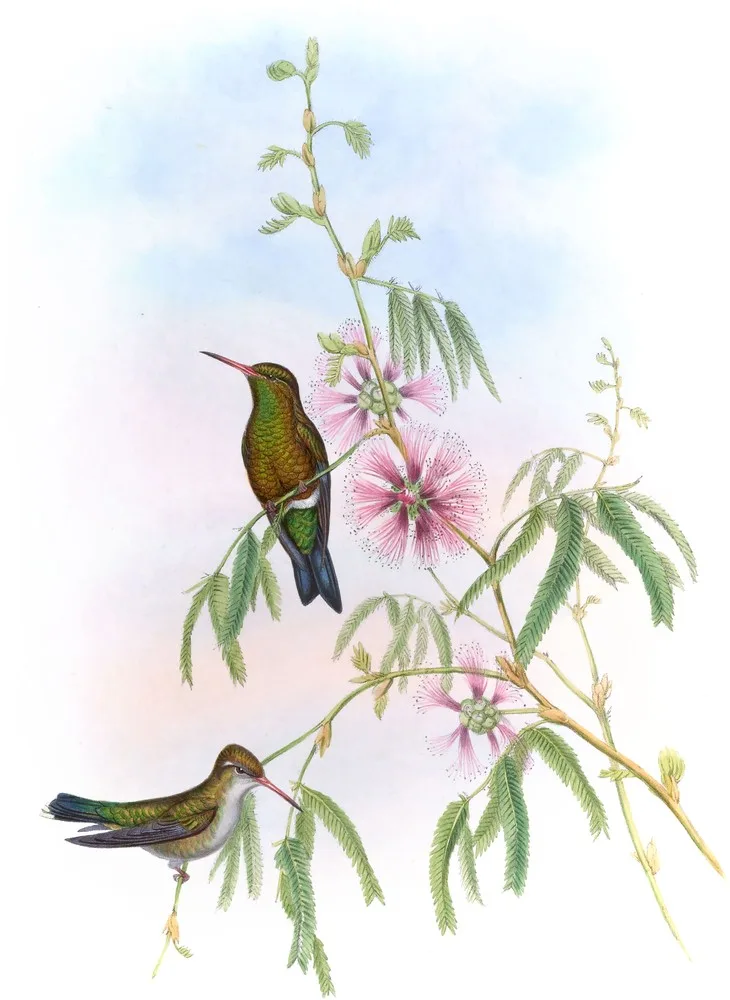
Chlorostilbon Phaëthon
Chlorostilbon Phaëthon
Glittering Emerald
- 合集
- 古尔德蜂鸟图谱
- 绘者
- John Gould(约翰·古尔德)
- 年代
- 1861
- 图版号
- Pl. 354, Vol. V
- 原书页码
- p.354
- 授权
- CC0 1.0 Universal (Public domain)
关于本图版
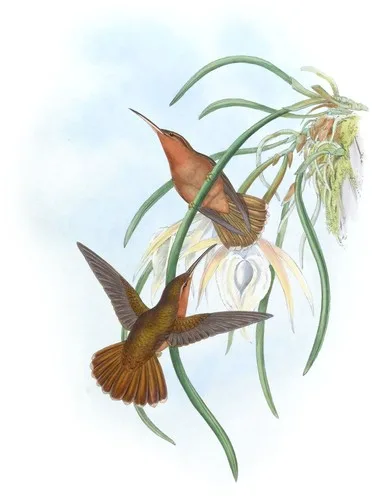
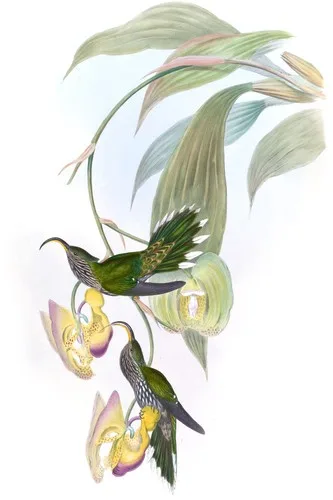
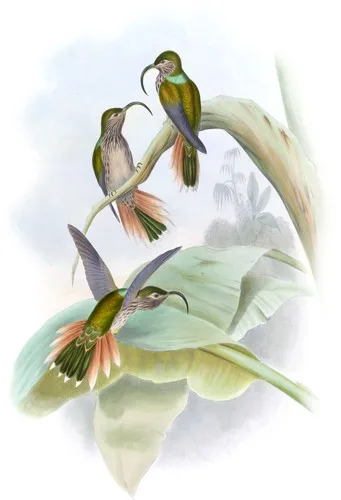
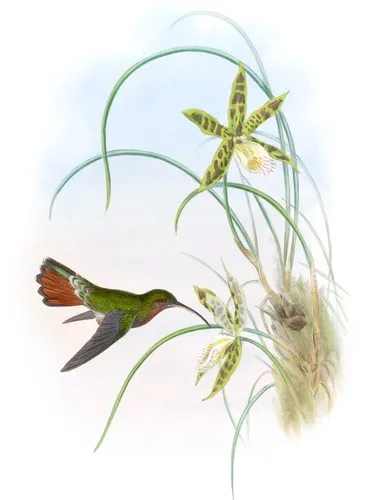
本图选自约翰·古尔德的《古尔德蜂鸟图谱》(Gould's Hummingbirds),原书 1849—1887 年间出版。原书题作“Chlorostilbon Phaëthon”,在分类体系中列于蜂鸟科(Trochilidae)。
该合集全编共 421 幅图版,此图为其中之一,图版编号 Pl. 354, Vol. V,对应原书第 354 页,版式为纵幅。图像由公有领域原件扫描修复而来,细节在放大视图中仍清晰可辨。
原书文字(英文 / 法文)
Bolivia, Southern Brazil, and La Plata
If we consider the metallic-plumaged Humming-Birds of Bolivia, Peru, and La Plata to be one and the same species, then this bird enjoys a range extending across the continent of South America from east to west.
It is true that the specimens from the three localities above mentioned have received distinct specific appellations, but, except in size, they offer no marked difference. The bird frequenting the high lands of Bolivia was named aureiventris by MM. D’Orbigny and La Fresnaye; the Peruvian bird so common at Chuquesaca had the name Phaëthon assigned to it by M. Bourcier, and the one from La Plata that of flavifrons, by myself.
The typical specimen from which M. Bourcier took his description of Phaëthon is now before me; it is evidently the Chuquesacan bird, and is by far the largest in size when compared with the examples from the other localities mentioned; those from Monte Video, where specimens were procured by Mr. Darwin, are the next in size, and the aureiventris is the least; all are precisely alike in form and colour, their only difference being, as already mentioned, in their admeasurements.
My figures, which represent both sexes of the size of life, were taken from Chuquesacan birds. Time, and the acquisition of a greater number of specimens from every locality, can alone determine whether we are warranted in considering these birds as one or three species: what is the Trochilis similis of M. Bourcier?
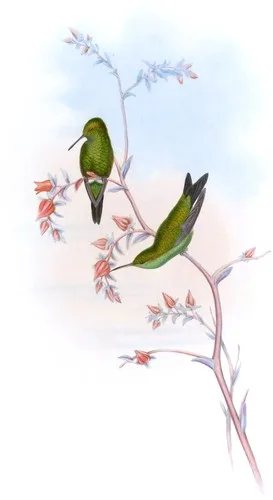
The male has the head, all the upper surface and wing-coverts rich golden bronze, but inclining to green on the upper tail-coverts; wings purplish brown; tail black, glossed with deep green; throat and breast glittering emerald-green, merging into the glittering coppery bronze of the sides of the neck and abdomen; under tail-coverts green; bill apparently fleshy red at the base, with a darker tip.
The female is bronzy green above and grey beneath, washed with bronze on the flanks; wings purplish brown; tail bluish black, the two lateral feathers tipped with greyish white.
The Plate represents the two sexes of the natural size. The plant is the Calliandra Tweediei.
References
- Trochilus phaëthon, Bourc. Rev. Zool. 1848, p. 274.
- Trochilus phæton, Gray and Mitch. Gen. of Birds, vol. ui. App. p. 300, App. to p. 103.
- Chlorestes Phaëthon, Reich. Auf. der Col., p. 7.—Ib. Troch. Enum., p. 4.
- Hylocharis phaëton, Bonap. Rev. et Mag. de Zool. 1854, p. 255.
- Hylocharis aureiventris, Bonap. Rev. et Mag. de Zool. 1854, p. 255.
- Hylocharis similis, Bonap. Consp. Gen. Av., tom. i. p. 74, Hylocharis, sp. 4?
- Chlorolampis phaëthon, Cab. Mus. Hein., Theil ii. p. 48, note.
- Trochilus flavifrons, Gould, Zool. of Beagle, part mi. Birds, p. 110.
- Trochilus metallicus, Gould, MS.
- Ornismya aureiventris, D’Orb. and La Fresn. Syn. Av., p. 28.
- Trochilis similis, Bourc.?