Eriocnemis Alinæ
Eriocnemis Alinæ
Metallic Puff-leg
- 合集
- 古尔德蜂鸟图谱
- 绘者
- John Gould(约翰·古尔德)
- 年代
- 1854
- 图版号
- Pl. 280, Vol. IV
- 原书页码
- p.280
- 授权
- CC0 1.0 Universal (Public domain)
关于本图版
这幅图版出自《古尔德蜂鸟图谱》(Gould's Hummingbirds),由约翰·古尔德绘制,1849—1887 年间出版。原书题作“Eriocnemis Alinæ”,归入蜂鸟科(Trochilidae)。
全编共收录 421 幅图版,本图是其中一幅,原书将其列为 Pl. 280, Vol. IV,见第 280 页,版式为纵幅。图像由公有领域原件扫描修复而来,细节在放大视图中仍清晰可辨。
原书文字(英文 / 法文)
The hilly parts of New Granada
No one species of the well-defined genus Eriocnemis is more beautifully plumaged than the fully adult male of this little Bird, neither is there any one of them that has the peculiar puff-like decoration of the legs carried to so great an extent; no Bee ever hurried towards its hive with legs more loaded, or Beetle ever turned a more glittering breast towards the light, the entire under surface being one mass of green metallic colour.
Having so beautiful an object to name, it is not surprising that the great French Trochilidist, M. Bourcier, when introducing it to the notice of the scientific world, should have given it that of Aline, in honour of his wife; and it gives me great pleasure to assist in perpetuating the name of a lady to whom such an act of courtesy has been rendered.
Thus much having been said about the beauty of the bird and its name, my next duty would be, were it possible, to give some account of its habits and economy; but on these points nothing is known, and I am merely able to state that it is a native of the rich district in the neighbourhood of Santa Fé de Bogota, whence nearly all the: specimens sent to Europe have been forwarded. Although by no means a scarce bird, it is far less common than the E. cupreiventris and E. vestitus. There seems to be less difference in the colouring of the sexes of this species than in either of the others; but I observe that there is considerable diversity in the amount of the metallic colouring in individuals of the same sex, and I think it not unlikely ‘that the bird attains a considerable age, and a high state of health and vigour, before it acquires the excessively glittering metallic hues seen in some specimens. It is somewhat singular that some of these very fine males exhibit a white or broken appearance in the centre of the chest, a mark which I believe to be perfectly natural; again, this bird, when fully adult, independently of its glittering breast, has a narrow welldefined band of the same colour across the forehead, immediately behind the bill, in which respect it differs from all the other members of its genus, and which probably induced Dr. Reichenbach to propose for it a new generic name—a name, however, I have not found it desirable to adopt, believing as I do that the feature indicated does not amount to more than specific importance.
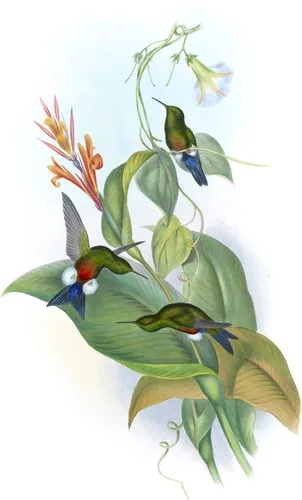
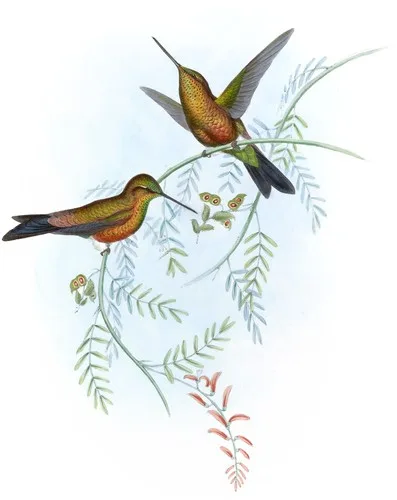
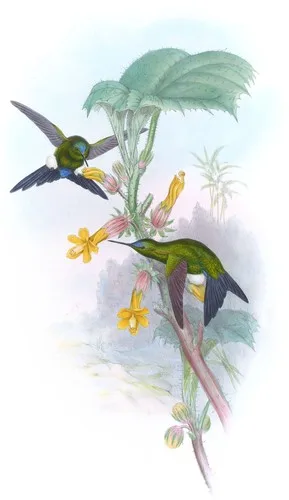
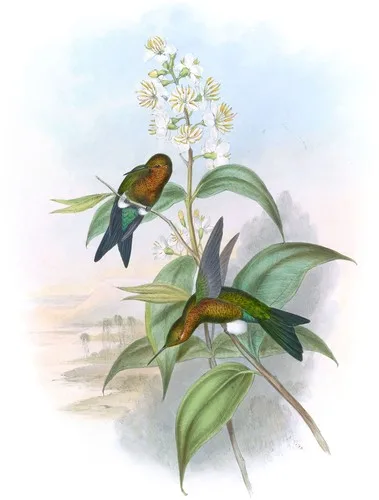
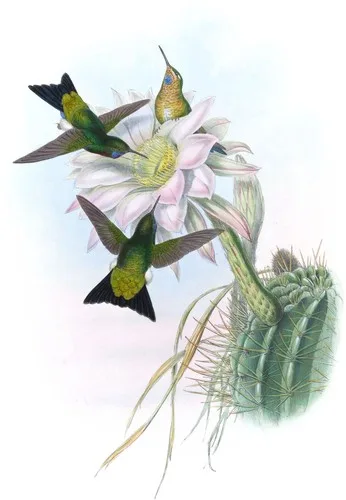
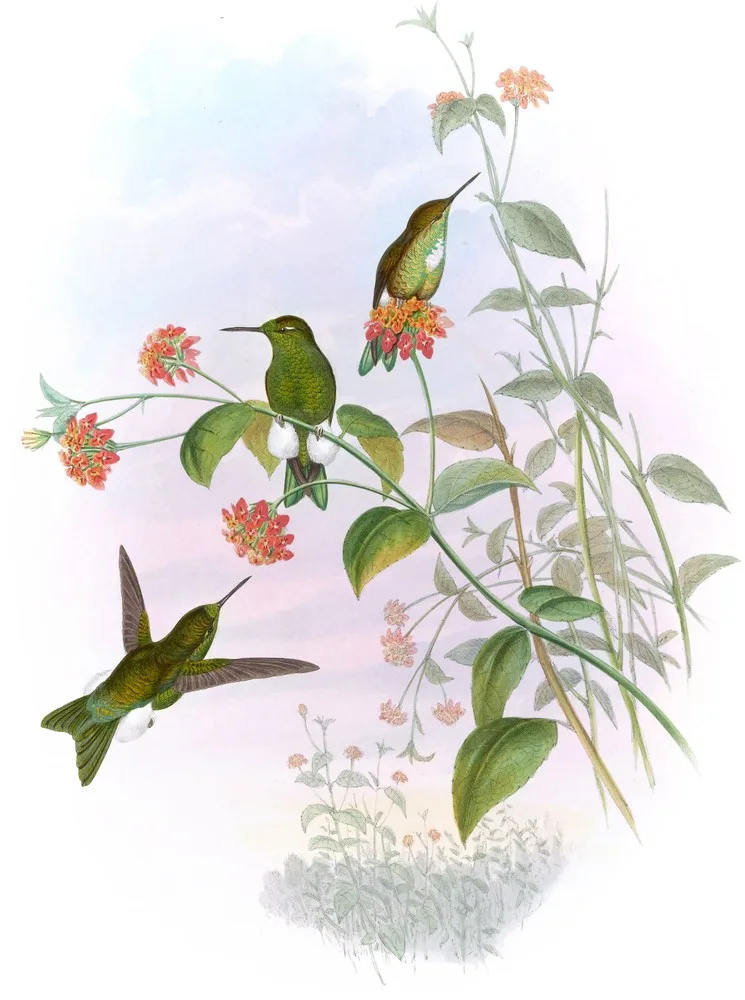
Head, all the upper surface, wing-coverts and tail deep green, the upper tail-coverts and tail being somewhat brighter than the other parts; wings dark purplish brown; line across the forehead, and all the under surface, including the under tail-coverts, rich metallic glittering green; legs thickly clothed with downy white feathers; bill black; legs brown.
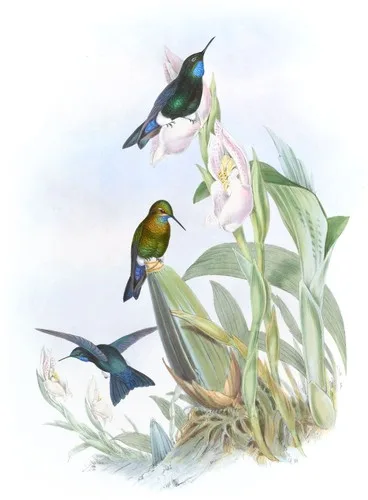
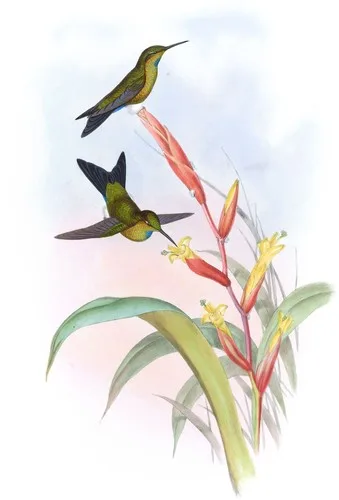
The Plate represents two males and a female of the natural size.
References
- Ornismyia Aline, Boure. Rev. Zool. 1842, p. 373.
- Ornismya Alinæ, Ib. Ann. Sci. Phys. &c. de Lyon, 1842, p. 344. pl. 19.
- Hylocharis Aline, Gray and Mitch. Gen. of Birds, vol. i. p. 114, Hylocharis, sp. 6.
- Eriopus aline, Bonap. Consp. Gen. Av., p. 80, Eriopus, sp. 6.
- Engyete Aline, Reich. Auf. der Col., p. 9.
- Eriocnemys alina, Bonap. Rey. Zool. 1854, p. 252.