Eulampis chlorolæmus
Eulampis chlorolæmus
Grass-green-breasted Carib
- 合集
- 古尔德蜂鸟图谱
- 绘者
- John Gould(约翰·古尔德)
- 年代
- 1850
- 图版号
- Pl. 84, Vol. II
- 原书页码
- p.84
- 授权
- CC0 1.0 Universal (Public domain)
十观
- 略纵 1.26∶1
第一眼
真山水之川谷,远望之以取其势,近看之以取其质。
—— 宋·郭熙《林泉高致·山水训》
远看取其气势,近看取其质地。八个字,就是看画的两步:先退后看整体,再凑近看笔与色。看花鸟图版一样管用。这一幅略高于宽,落点在中央偏上那只鸟的头部。第二步凑近一寸:看线与色的交界,色有没有压住线,线有没有断。第三步,把视线放到最深的那一小块:整幅的用色秩序,都是从那里排开的。
名与实
图上只标属名 Eulampis,未定种;这一时期的图谱常以一属数种合绘,种名要等后来的专著补齐。此幅尚无通行中文名,姑以学名相称;在没有本地名字的地方,学名就是它唯一的身份证。
形与色
翼小而振频极高,能悬停、能倒飞;羽色非颜料所致,是羽枝结构折射的光,随角度而变。此幅未作色相归档,只能就形制论。别只看花:叶脉的走向、萼片的长短、甚至茎上的毛,都是画家用来区分物种的证据。
构图与呼吸
画幅略高于宽,鸟身居中偏上,视线落在头部与喙。全幅只画一只,不作解剖附图——这类图更近于“观赏”,而非“鉴定”。空白不是没画完,是给眼睛留的落脚处:一张图若四边都塞满,花反而会闷。
一刀一色
十九世纪后半叶,石版与彩色石印渐成主流:颜色可以直接印出,不再依赖手工,线条反倒退居其次。图像的“准确”提高了,手性却淡了。还有一种证据在纸背:铜版压进纸里的那道痕、上色处微微凸起的颜料、再版时磨浅的线。扫描件里也能看出七分。想动笔临它的人记住一句:先铺大块的形与色,干后再收细部;石印的柔和层次来自薄涂与网点,水彩分两三遍淡铺即可逼近。
诗境
穿花蛱蝶深深见,点水蜻蜓款款飞。
—— 唐·杜甫《曲江二首》
中土无蜂鸟,然“穿花”之态,杜甫早已写过:贴着花心走,是采蜜者的共同姿态。把这一句放回画面:画面就是诗句的落点——诗先写气,画后写形,两者在此处接上了。
花语
阿兹特克以蜂鸟为战神与太阳的化身;欧洲维多利亚时代则以蜂鸟为收藏与装饰的极致,百万只羽毛被做成胸饰。中国旧籍无此鸟,故无象征——这空白本身,就是一部博物学交流史。象征多半来自形状与气味:像杯的、像泪的、香的、臭的——先有形状,后有意义。
时与地
温带种类的蜂鸟则随花北迁,一年往返数千公里。仅产美洲,自阿拉斯加南部至火地岛,以安第斯山最为繁盛。中土无蜂鸟,汉籍不载,晚清海外游记始见其名。图上所记的 1850 年是刊行之年,不是采到那只鸟的年份;真正的观察记录通常比出版早一两年。图上的产地常是“据说来自”,图上的花期常是“盛开那十日”——两处都要打个折扣读。
书与人
《古尔德蜂鸟图谱》只署了约翰·古尔德一个人的名字。从画稿到成图要过好几双手:转刻的人求准,上色的人求快——快与准之间,就是各幅之间深浅不一的来历。
带走一双眼睛
如果只能记一句,就记郭熙那八个字:远望取其势,近看取其质。看图、看花、看人,都一样。1850 年的那只鸟早已化作尘土,它留在纸上的样子,却比任何一只活着的同类都长寿。
关于本图版
《古尔德蜂鸟图谱》(Gould's Hummingbirds)由约翰·古尔德绘制,1849—1887 年间印行,本图即其中一幅。画面主体为 Eulampis chlorolæmus,在分类体系中列于蜂鸟科(Trochilidae)。
该合集全编共 421 幅图版,此图为其中之一,图版编号 Pl. 84, Vol. II,对应原书第 84 页,版式为纵幅。图像由公有领域原件扫描修复而来,细节在放大视图中仍清晰可辨。
原书文字(英文 / 法文)
The Islands of St. Thomas and St. Croix
Some Trochilidists might be inclined to doubt the specific value of this Caribbean Humming-bird, and to regard it as a mere variety of the Eulampis holosericeus, but had they as many specimens as I have to examine and form an opinion from, I believe they would come to the same conclusion as myself, and consider it to be distinct.
The principal difference between the E. chlorolæmus and E. holosericeus consists in the former “having a deeper and less luminous green throat, and the blue patch on the breast dilated into a band of blue extending across the chest; the former is also a larger and stouter bird than the latter. These differences are much more apparent in the mounted specimens in my collection, where at least six of each kind are placed side by side in one of the cases.
Like the E. holosericeus, the present: bird is an inhabitant of the Caribbean Islands, but of which, and how many of them, no certain information has been received, further than that a specimen, now in the British Museum, was collected in the island of Nevis, by T. J. Cottle, Esq., who informs me that it inhabits the low grounds of the island, and that it builds a round compact nest, and lays the usual two white eggs.
I have not failed to remark, while mounting my specimens of the genus, that their skins are particularly thick and strong, even approaching the toughness and substance of leather in the E. jugularis.
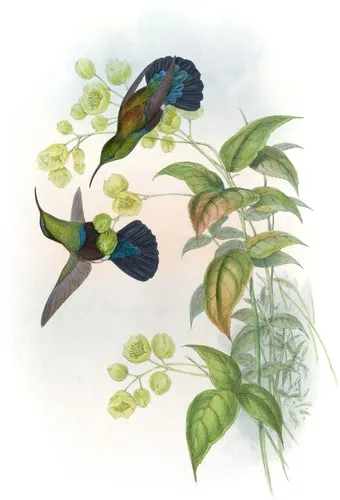
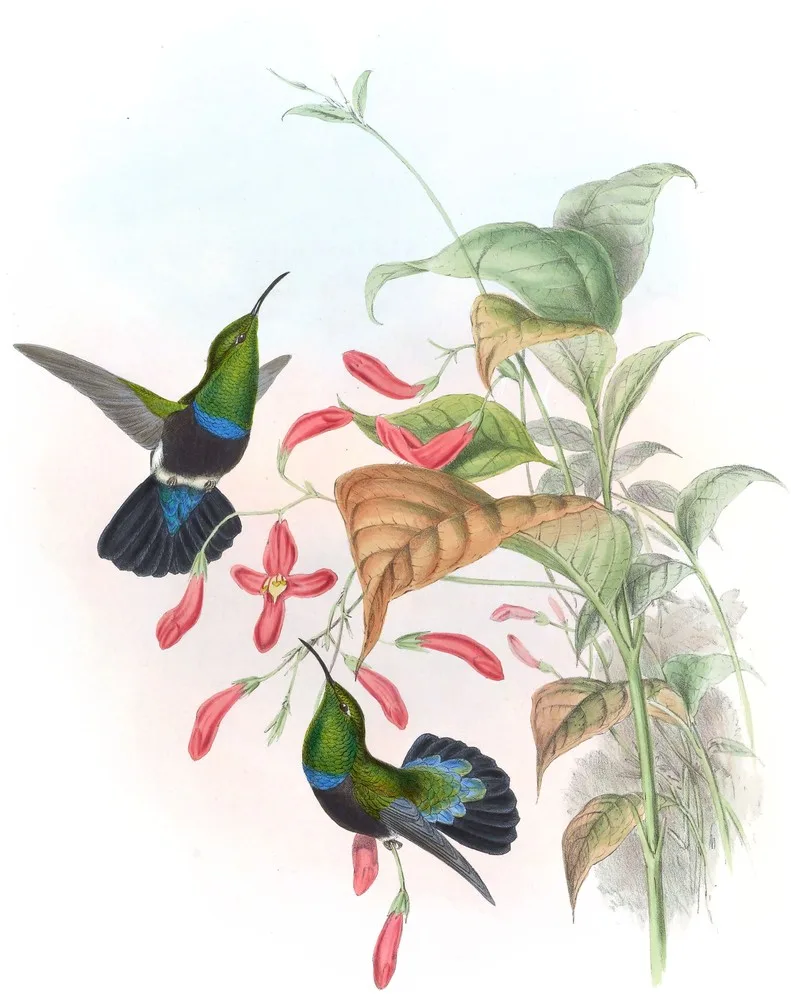
Head, all the upper surface and wing-coverts reddish-green; wings purplish-brown; upper and under tail-coverts largely developed and of a glittering blue, some of the feathers changing to green; tail black, with steel-blue reflexions; chin, throat and chest grass-green; across the breast a broad band of blue; flanks and abdomen velvety-black; bill black; feet blackish-brown.
The figures are of the size of life. The plant is the Stemonacanthus macrophyllus.
References
- Eulampis chlorolemus, Gould, MSS. 1851.
- Sericotes chlorolaimus, Reichenb. Aufz. der Colibris, p. 11.
- Eulampis chlorolemus, Bonap. Rev. et Mag. de Zool. 1854, p. 250.