燕尾刀翅蜂鸟属
Eupetomena hirundinacea
Eupetomena hirundinacea
Swallow-tail
- 中文名
- 燕尾刀翅蜂鸟属
- 学名
- Eupetomena hirundinacea
- 合集
- 古尔德蜂鸟图谱
- 绘者
- John Gould(约翰·古尔德)
- 年代
- 1850
- 图版号
- Pl. 42, Vol. II
- 原书页码
- p.42
- 授权
- CC0 1.0 Universal (Public domain)
十观
- 纵幅 1.47∶1
第一眼
搜尽奇峰打草稿。
—— 清·石涛《苦瓜和尚画语录》
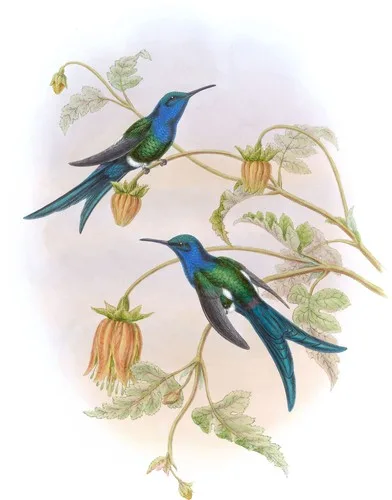
走遍山川,才有资格落笔。博物画的画家也一样:先在温室与山野里看够了活的花,纸上那一朵才不虚。这一幅是竖的:眼睛从下往上走,落点在中段那只鸟身上。先别急着看羽毛,让姿态先立起来。第二步凑近一寸:看线与色的交界,色有没有压住线,线有没有断。第三步,把视线放到最深的那一小块:整幅的用色秩序,都是从那里排开的。
名与实
学名 Eupetomena hirundinacea:前一词是属,管它归在哪一类;后一词是种加词,管它在这一类里凭什么与众不同。一百多年前的命名者,把一种植物的来历压进了两个词。中文名“燕尾刀翅蜂鸟属”是后人据学名回译的通行叫法,与古书里的旧名未必对得上——名与物之间,总隔着一层翻译。
形与色
翼小而振频极高,能悬停、能倒飞;羽色非颜料所致,是羽枝结构折射的光,随角度而变。此幅未作色相归档,只能就形制论。颜色不是平涂的:最浅处近乎纸色,最深处在花瓣重叠的缝里。把这两处找到,画面的呼吸就出来了。
构图与呼吸
画幅高而窄,鸟栖在枝的中段,上下留白多——十九世纪鸟谱的标准版式,留给它飞走的余地。全幅只画一只,不作解剖附图——这类图更近于“观赏”,而非“鉴定”。空白不是没画完,是给眼睛留的落脚处:一张图若四边都塞满,花反而会闷。
一刀一色
十九世纪后半叶,石版与彩色石印渐成主流:颜色可以直接印出,不再依赖手工,线条反倒退居其次。图像的“准确”提高了,手性却淡了。先判断它是“印”的还是“画”的,再谈好不好看——这是看老版画最实用的一条规矩。想动笔临它的人记住一句:先铺大块的形与色,干后再收细部;石印的柔和层次来自薄涂与网点,水彩分两三遍淡铺即可逼近。
诗境
夫列子御风而行,泠然善也,旬有五日而后反。
—— 《庄子·逍遥游》
蜂鸟悬停于空,不落不飞,最近于“御风”。庄子说的是一种自由的姿态,蜂鸟把它做成了生理事实。诗以气行,画以形立;两种“看”叠在一起,才是看画的意思。
花语
阿兹特克以蜂鸟为战神与太阳的化身;欧洲维多利亚时代则以蜂鸟为收藏与装饰的极致,百万只羽毛被做成胸饰。中国旧籍无此鸟,故无象征——这空白本身,就是一部博物学交流史。花语是后人添上去的,花本身并不知道;但这层“不知道”,正是它最动人的地方。
时与地
温带种类的蜂鸟则随花北迁,一年往返数千公里。仅产美洲,自阿拉斯加南部至火地岛,以安第斯山最为繁盛。中土无蜂鸟,汉籍不载,晚清海外游记始见其名。图上所记的 1850 年是刊行之年,不是采到那只鸟的年份;真正的观察记录通常比出版早一两年。那一代人对这类鸟的知识,多半来自标本与笼养。看这一类图,不妨把产地和季节都当“据说”来读。
书与人
《古尔德蜂鸟图谱》只署了约翰·古尔德一个人的名字。图版今属公有领域,可以自由取用;但纸上那层手工上色,仍是两百年前某一个人的手。
带走一双眼睛
把这三件事带走:先整体后细节;先线后色;先看画再翻书。任何一张老图版,都可以用这三条读。1850 年的那只鸟早已化作尘土,它留在纸上的样子,却比任何一只活着的同类都长寿。
关于本图版
此图原刊于《古尔德蜂鸟图谱》(Gould's Hummingbirds),绘者为约翰·古尔德,成书于 1849—1887 年间。图中描绘的是燕尾刀翅蜂鸟属,学名 Eupetomena hirundinacea,归入蜂鸟科(Trochilidae)。
全编共收录 421 幅图版,本图是其中一幅,原书将其列为 Pl. 42, Vol. II,见第 42 页,版式为纵幅。图像由公有领域原件扫描修复而来,细节在放大视图中仍清晰可辨。
原书文字(英文 / 法文)
Brazil, Cayenne, and the neighbouring countries.
This species being the most swallow-like member of the entire family of Trochilidæ, I have in this instance departed from the rule of priority and adopted the appropriate name of hirundinacea assigned to it by M. Lesson, instead of retaining the indefinite one of macrourus originally bestowed by Gmelin.
From the little we know of its habits, it seems to be a lowland and fluviatile species rather than a denizen of the mountain districts; its principal habitat, so far as we are at present aware, being the low country of Cayenne and the delta of the Lower Amazon; it is true we do receive specimens from Bahia, and Mr. Reeves informs me that it is also found in Minas Geraes; but it is much less numerous there than in the former locality. Mr. Wallace tells me that it flies very high, and chiefly resorts to the topmost branches of the loftiest trees; is more frequently to be seen in the early morn than at any other period of the day, and that at that hour it may often be observed perched on the smaller dead branches of the trees skirting the forest.
The sexes are precisely alike in colour; but at the same time present a great disparity in size, the female being very much smaller than the male, and having a much shorter tail.
The nestling birds do not differ materially from the adult, being very similar in colour, but of course of a less brilliant hue.
I find considerable variety in the tint of the head and neck of this species; some specimens having those parts clothed in a rich glittering prussian blue, while in others they are glossed with green.
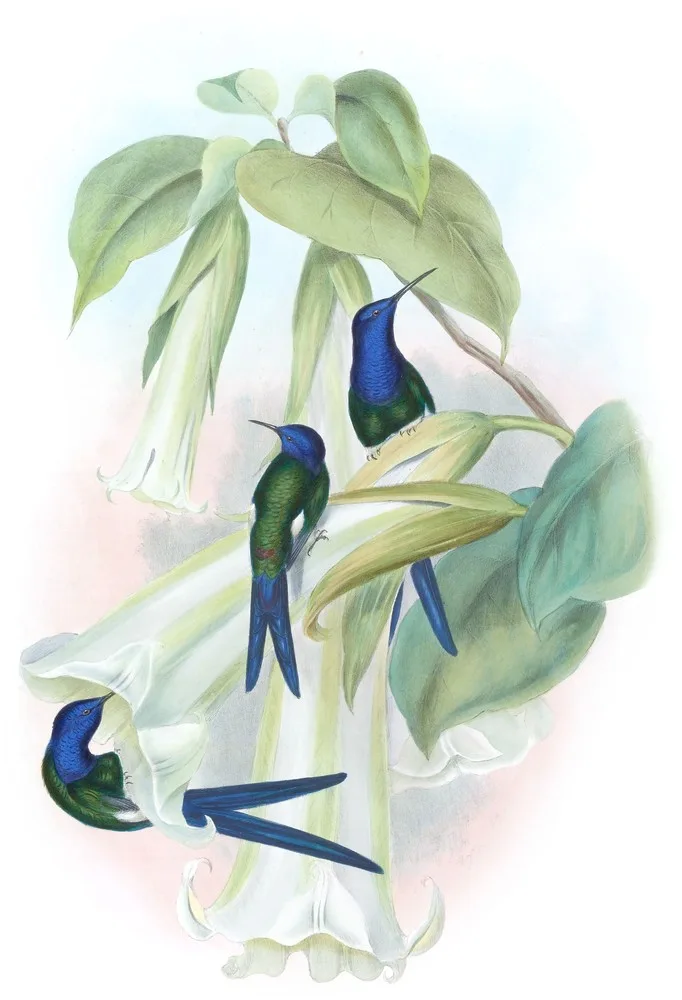
Head, neck and breast rich glittering prussian blue; upper surface, upper and under wing-coverts, flanks and abdomen dark green; across the rump an indistinct band of rufous; wings purplish brown glossed with steel-blue; upper and under tail-coverts and tail rich deep steel-blue; a tuft on each side of the body and the vent white; bill and feet black.
The Plate represents two males and a female of the natural size on a beautiful species of Datura, copied from a drawing obligingly sent to me by T. Reeves, Esq., of Rio de Janeiro.
References
- Trochilus macrourus, Gmel. Edit. Linn. Syst. Nat., tom. i. p.487.—Licht. Verz. der Doubl., p.13.
- Trochilus forcipatus, Lath. Ind. Orn., tom. 1. p. 304.
- Mellisuga Cayanensis caudâ bifurcâ, Raii, 83. 3.—Id. 187. 41.—Willoughby, 166.—Briss. Orn., tom. iii. p. 726. pl. xxxvi. fig. 9.
- Oiseau-mouche à queue d’acier bruni, Buff. Hist. des Ois., tom. vi. p. 36.
- Oiseau-mouche a queue fourchue de Cayenne, Vieill. Ois. dor., tom. i. p. 113.
- Cayenne Fork-tailed Humning Bird, Lath. Gen. Syn., tom. i. p. 751.—Shaw, Gen. Hist., vol. vii. p. 310.—Lath. Gen. Hist., vol. iv. p. 299.—Shaw, Nat. Misc., pl. 222.
- Ornismya hirundinacea, Less. Hist. Nat. des Ois. Mou., p. 98. pl. 25.—Ib. Supp., p. 179. pl. 39.—Ib. Traité d’Orn., p. 272.
- Polytmus macrourus, Gray and Mitch. Gen. of Birds, vol. 1. p. 107, Polytmus, sp. 9.