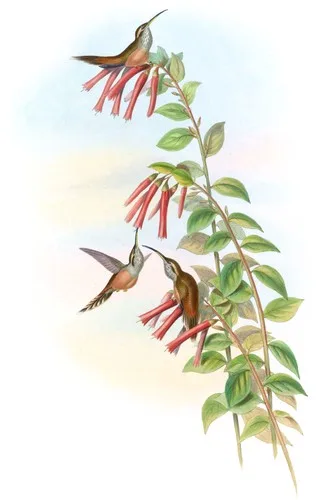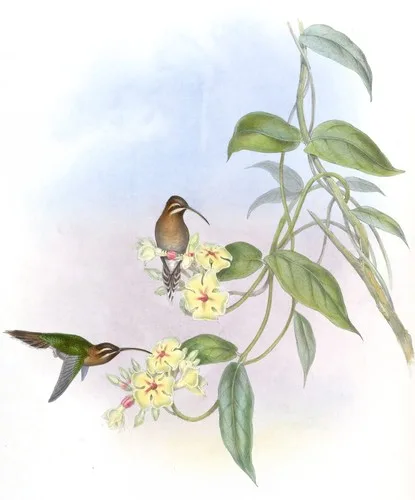
Phaëthornis pygmæus
Phaëthornis pygmæus
Pigmy Hermit
- 合集
- 古尔德蜂鸟图谱
- 绘者
- John Gould(约翰·古尔德)
- 年代
- 1849
- 图版号
- Pl. 41, Vol. I
- 原书页码
- p.41
- 授权
- CC0 1.0 Universal (Public domain)
关于本图版
本图选自约翰·古尔德的《古尔德蜂鸟图谱》(Gould's Hummingbirds),原书 1849—1887 年间出版。画面主体为 Phaëthornis pygmæus,在分类体系中列于蜂鸟科(Trochilidae)。
该合集全编共 421 幅图版,此图为其中之一,图版编号 Pl. 41, Vol. I,对应原书第 41 页,版式为纵幅。图像由公有领域原件扫描修复而来,细节在放大视图中仍清晰可辨。
原书文字(英文 / 法文)
South-eastern Brazil
This being the most diminutive species of the genus Phaëthornis yet discovered, the term pygmæus is a very appropriate name for it.
From P. eremita, to which it is nearly allied, it may be distinguished by its more slender bill, by its much smaller wing, and by the rounded form and more uniform bronzy colouring of its tail, the extremities of the feathers only being tipped with buff.
The true habitat of this diminutive bird is the southern portions of Brazil. It inhabits in tolerable abundance the province of Rio de Janeiro, but I have not seen it so far to the north as Bahia, a part of the country from whence the P. eremita is occasionally sent.
The sexes present the usual differences in size, the female being much smaller than her mate; but no variation whatever is found in their colouring.
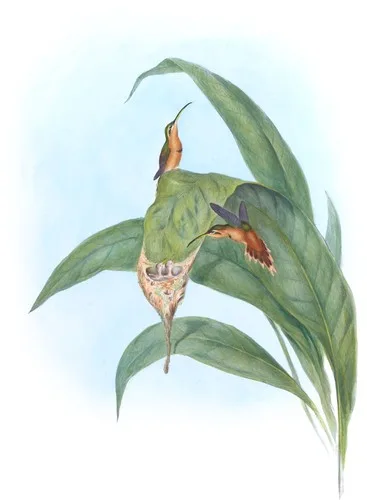
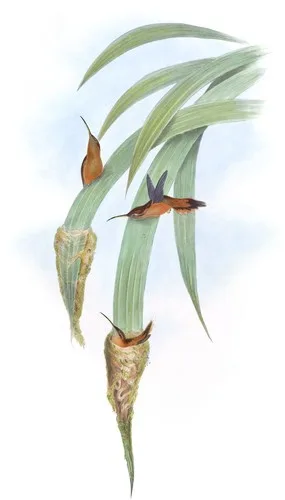
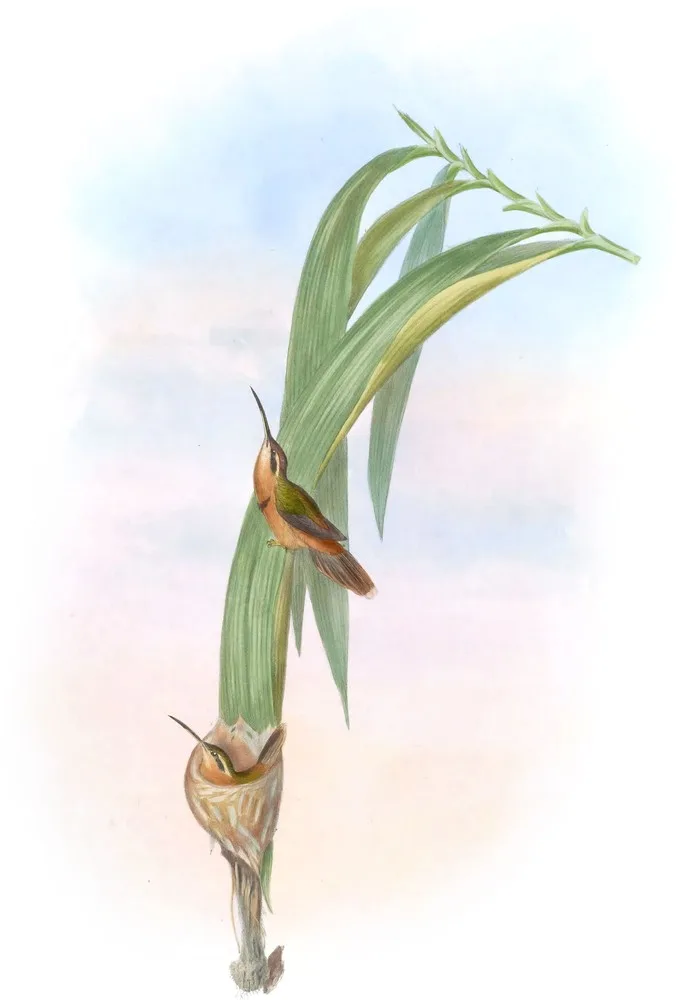
The figure of the beautiful nest represented on the accompanying Plate is copied from a drawing sent to me by Mr. Reeves. It will be seen that the interior of this delicate structure is formed of the softest materials,—the wool-like fibres of some flowering plant, sparingly decorated on the outside with thistledown-like seeds, &c.
Nothing whatever is known of its habits.
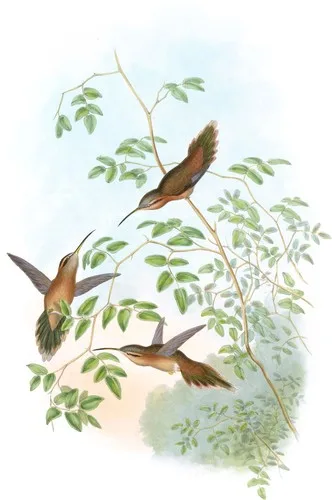
Upper surface and wing-coverts greenish bronze, inclining to dark brown on the head; wings purplish brown; tail pale bronzy brown, slightly tipped with buff; lores and ear-coverts black; line above the eye buff; rump and upper tail-coverts deep rust-red; under surface paler rust-red, crossed on the breast with a conspicuous crescent of black; base of the lower mandible fleshy-yellow; the remainder of the bill black 4 feet yellow.
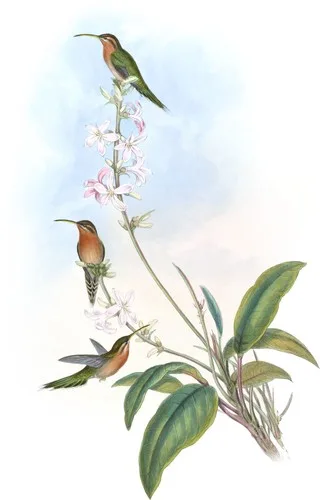
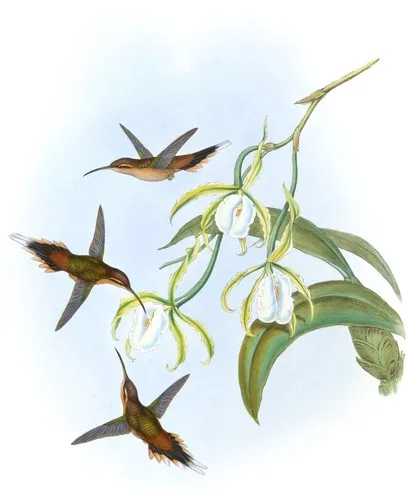
The Plate represents a male, a female, a nest and eggs, of the natural size.
References
- Trochilus pygmæus, Spix, Av. Bras., tom. i. p. 78. tab. lxxx. fig. 1.
- Phaëtornis pygmæus, Bonap. Consp. Gen. Av., p. 68, Phaëtornis, sp. 13.