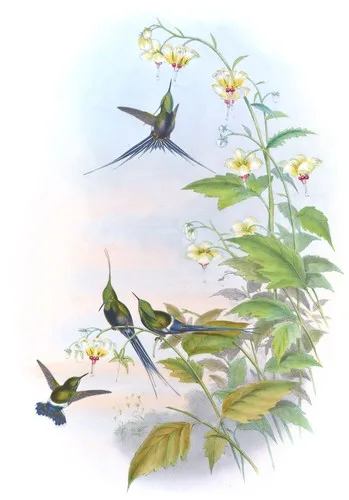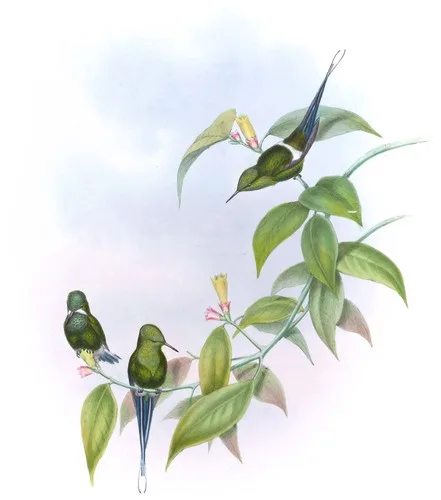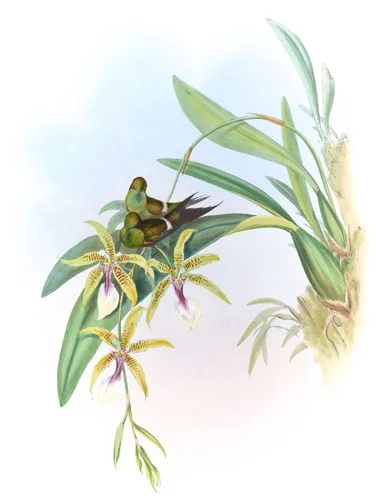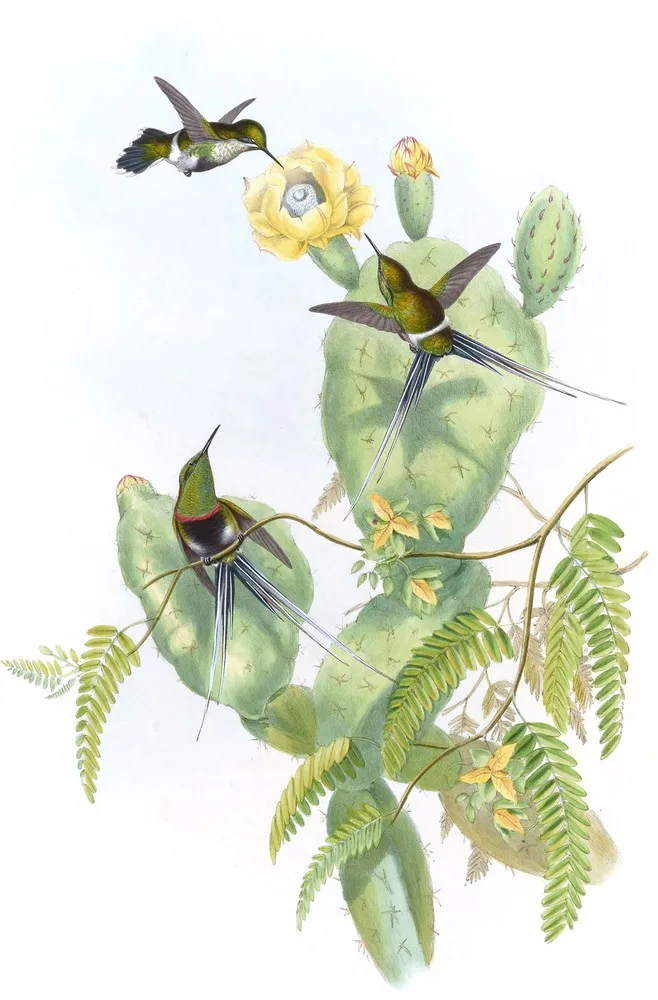
Gouldia Langsdorffi
Gouldia Langsdorffi
Langsdorff’s Thorn-tail
- 学名
- Gouldia Langsdorffi
- 合集
- 古尔德蜂鸟图谱
- 绘者
- John Gould(约翰·古尔德)
- 年代
- 1852
- 图版号
- Pl. 128, Vol. III
- 原书页码
- p.128
- 授权
- CC0 1.0 Universal (Public domain)
十观
- 纵幅 1.52∶1
- 1852 年刊
- 图版 128, Vol. III
第一眼
凡画山水,意在笔先。
—— 唐·王维《山水论》
下笔之前,心里已经有了整幅画。看画时可以反过来推:画家先定了什么,后添了什么。这一幅是竖的:眼睛从下往上走,落点在中段那只鸟身上。先别急着看羽毛,让姿态先立起来。第二步凑近一寸:看线与色的交界,色有没有压住线,线有没有断。第三步,把视线放到最深的那一小块:整幅的用色秩序,都是从那里排开的。
名与实
学名 Gouldia langsdorffi:前一词是属,管它归在哪一类;后一词是种加词,管它在这一类里凭什么与众不同。双名制的好处是唯一:全世界叫这个名字的,只能是这一种。此幅尚无通行中文名,姑以学名相称;在没有本地名字的地方,学名就是它唯一的身份证。
形与色
翼小而振频极高,能悬停、能倒飞;羽色非颜料所致,是羽枝结构折射的光,随角度而变。此幅未作色相归档,只能就形制论。没有解剖图,就靠主株一处一处看过去:叶怎么排,花怎么着生,果在哪里。
构图与呼吸
画幅高而窄,鸟栖在枝的中段,上下留白多——十九世纪鸟谱的标准版式,留给它飞走的余地。(高宽比约 1.52∶1)全幅只画一只,不作解剖附图——这类图更近于“观赏”,而非“鉴定”。老图谱爱把主株摆在偏中线的位置,左右留得不一样多:这一点偏心,正是画面活起来的原因。
一刀一色
十九世纪后半叶,石版与彩色石印渐成主流:颜色可以直接印出,不再依赖手工,线条反倒退居其次。图像的“准确”提高了,手性却淡了。拿放大镜(或手机微距)看三处:喙缘、覆羽、题名。线若连续不断,是刻的;色若越过轮廓半毫米,是手涂的。想动笔临它的人记住一句:先铺大块的形与色,干后再收细部;石印的柔和层次来自薄涂与网点,水彩分两三遍淡铺即可逼近。
诗境
夫列子御风而行,泠然善也,旬有五日而后反。
—— 《庄子·逍遥游》
蜂鸟悬停于空,不落不飞,最近于“御风”。庄子说的是一种自由的姿态,蜂鸟把它做成了生理事实。把这一句放回画面:画面就是诗句的落点——诗先写气,画后写形,两者在此处接上了。
花语
阿兹特克以蜂鸟为战神与太阳的化身;欧洲维多利亚时代则以蜂鸟为收藏与装饰的极致,百万只羽毛被做成胸饰。中国旧籍无此鸟,故无象征——这空白本身,就是一部博物学交流史。象征多半来自形状与气味:像杯的、像泪的、香的、臭的——先有形状,后有意义。
时与地
热带美洲几乎全年可见,花期即其季节。仅产美洲,自阿拉斯加南部至火地岛,以安第斯山最为繁盛。中土无蜂鸟,汉籍不载,晚清海外游记始见其名。图上所记的 1852 年是刊行之年,不是采到那只鸟的年份;真正的观察记录通常比出版早一两年。图上的产地常是“据说来自”,图上的花期常是“盛开那十日”——两处都要打个折扣读。
书与人
《古尔德蜂鸟图谱》(Gould's Hummingbirds)由约翰·古尔德绘,成于1849-1887。此幅为其中图版 128, Vol. III,见原书第 128 页。图版今属公有领域,可以自由取用;但纸上那层手工上色,仍是两百年前某一个人的手。
带走一双眼睛
把这三件事带走:先整体后细节;先线后色;先看画再翻书。任何一张老图版,都可以用这三条读。图谱的用意是“以备查考”,看久了却会忘记查考:1852 年的一个人,为一只鸟花了整整一天。
关于本图版
此图原刊于《古尔德蜂鸟图谱》(Gould's Hummingbirds),绘者为约翰·古尔德,成书于 1849—1887 年间。图中描绘的是 Gouldia Langsdorffi,归入蜂鸟科(Trochilidae)。
全编共收录 421 幅图版,本图是其中一幅,原书将其列为 Pl. 128, Vol. III,见第 128 页,版式为纵幅。图为公有领域原件的修复扫描,构图与设色未经改动。
原书文字(英文 / 法文)
Brazil; and I have a single specimen from the Rio Napo
This beautiful species was discovered by M. Langsdorff, the Russian Consul at Rio de Janeiro, after whom it was named by Vieillot, as a compliment due to the zeal displayed by him in the pursuit of natural history while the companion of Krusenstern, in his celebrated voyage round the world, and during his residence in Brazil; subsequently, Dr. Spix, unaware of its having been already named, assigned to it the specific appellation of hirundinaceus.
Mr. Reeves, of Rio de Janeiro, informs me, that during some years it is very plentiful in that province, and equally scarce in others: “the young birds arrive in July, but the old ones do not make their appearance until September and October, and depart again in November. I have only seen two nests; one of which I gave to Prince William of Hesse, the other is in my own collection; they are both exactly alike, and both were found on old dry moss-covered trees.”
That this bird enjoys a most extensive range over the interior of the country is very probable, for in a collection of birds lately transmitted from Quejos by Don Manuel Villavicencio, I found a specimen agreeing in every particular with those received from the province of Rio.
The female of this species, like the females of the other members of the genus, differs very considerably from the male. The tail-feathers are short, broad, and rounded at the end; and the centre ones scarcely a quarter of an inch in length, while the outer ones are upwards of three-quarters. In all probability the young birds of the year assume a similar plumage to that of the female.
The male has the crown of the head, throat and breast glittering metallic green, bounded below by a band of fiery orange-red; upper surface golden green with a band of white across the rump, expanding into a large patch on each side, and overhanging the thighs; upper part of the abdomen black; lower part of the abdomen, vent and under tail-coverts clouded greyish white; wings purplish brown; six middle tail-feathers and the bases of the lateral ones deep steel-blue, the remaining length of the latter brownish grey, the under surface of the shafts of the whole white; thighs greyish white, blotched with brownish black; bill black.
In the female the crown of the head and upper surface is bronzy green with a white mark across the rump, as in the male; chin black; a streak of white on each side from the angle of the mouth; throat spangled with bronzy green; central tail-feathers steel-blue fringed with white at the tip; lateral feathers greyish brown at the base, passing into steel-blue towards the extremity, and tipped with white; legs and thighs as in the male.
The figures, which are of the natural size, are intended to represent both sexes.
References
- Trochilus Langsdorffi, Viel. Eney. Méth. Orn., part ii. p. 574.—Temm. Pl. Col. 66. fig. 1. —Vieill. Ois. dor., tom. iii. ined. pl. 20.—Valenc. Dict. Sci. Nat., tom. xxxv. p. 493.—Less. Man. d’Orn., tom. ii. p. 77.—Ib. Ind. Gen. et Syn. du Gen. Trochilus, p. xxxii.
- Ormsmya Langsdorffii, Less. Hist. Nat. des Ois. Mou., p. 102. pl. 26; Supp., p. 129. pl. 16. —Ib. Les Troch., p. 101. pl. 85.—Jard. Nat. Lib. Humming Birds, vol. 1. p. 69. pl. 10.
- Colibri hirundinaceus, Spix, Av. Sp. Nov. Bras., tom. i. p. 80. tab. lxxxi. fig. 2.
- Melhisuga Langsdorffi, Gray and Mitch. Gen. of Birds, vol. i. p. 113, Mellisuga, sp. 68.
- Gouldia langsdorffi, Bonap. Consp. Gen. Av., p. 86, Gouldia, sp. 1.—Ib. Consp. Troch. in Rey. et Mag. de Zool. 1854, p. 257.