Heliangelus Clarissæ
Heliangelus Clarissæ
Sun Angel
- 合集
- 古尔德蜂鸟图谱
- 绘者
- John Gould(约翰·古尔德)
- 年代
- 1854
- 图版号
- Pl. 242, Vol. IV
- 原书页码
- p.242
- 授权
- CC0 1.0 Universal (Public domain)
十观
- 纵幅 1.47∶1
第一眼
真山水之川谷,远望之以取其势,近看之以取其质。
—— 宋·郭熙《林泉高致·山水训》
远看取其气势,近看取其质地。八个字,就是看画的两步:先退后看整体,再凑近看笔与色。看花鸟图版一样管用。这一幅是竖的:眼睛从下往上走,落点在中段那只鸟身上。先别急着看羽毛,让姿态先立起来。第二步凑近一寸:看线与色的交界,色有没有压住线,线有没有断。第三步,把视线放到最深的那一小块:整幅的用色秩序,都是从那里排开的。
名与实
学名缺席时,画面本身就是唯一的证据。此幅既无通行中文名,学名也不可靠,只能以原书题名相称——图谱里总有几幅这样的图,只能靠画面本身说话。
形与色
翼小而振频极高,能悬停、能倒飞;羽色非颜料所致,是羽枝结构折射的光,随角度而变。此幅未作色相归档,只能就形制论。没有解剖图,就靠主株一处一处看过去:叶怎么排,花怎么着生,果在哪里。
构图与呼吸
画幅高而窄,鸟栖在枝的中段,上下留白多——十九世纪鸟谱的标准版式,留给它飞走的余地。全幅只画一只,不作解剖附图——这类图更近于“观赏”,而非“鉴定”。空白不是没画完,是给眼睛留的落脚处:一张图若四边都塞满,花反而会闷。
一刀一色
十九世纪后半叶,石版与彩色石印渐成主流:颜色可以直接印出,不再依赖手工,线条反倒退居其次。图像的“准确”提高了,手性却淡了。拿放大镜(或手机微距)看三处:喙缘、覆羽、题名。线若连续不断,是刻的;色若越过轮廓半毫米,是手涂的。想动笔临它的人记住一句:先铺大块的形与色,干后再收细部;石印的柔和层次来自薄涂与网点,水彩分两三遍淡铺即可逼近。
诗境
穿花蛱蝶深深见,点水蜻蜓款款飞。
—— 唐·杜甫《曲江二首》
中土无蜂鸟,然“穿花”之态,杜甫早已写过:贴着花心走,是采蜜者的共同姿态。古人写到这一层,已不只是赏花,是借花说人;画面则只负责把那朵花留住。
花语
阿兹特克以蜂鸟为战神与太阳的化身;欧洲维多利亚时代则以蜂鸟为收藏与装饰的极致,百万只羽毛被做成胸饰。中国旧籍无此鸟,故无象征——这空白本身,就是一部博物学交流史。花语是给人与人的关系用的;植物自己只关心有没有传粉的虫。这两套语言,可以并行不悖。
时与地
温带种类的蜂鸟则随花北迁,一年往返数千公里。仅产美洲,自阿拉斯加南部至火地岛,以安第斯山最为繁盛。中土无蜂鸟,汉籍不载,晚清海外游记始见其名。图上所记的 1854 年是刊行之年,不是采到那只鸟的年份;真正的观察记录通常比出版早一两年。看叶的老嫩、花与果是否同在枝上,季节便八九不离十;看题名里藏着的地名,来路也猜得出七分。
书与人
《古尔德蜂鸟图谱》只署了约翰·古尔德一个人的名字。图版今属公有领域,可以自由取用;但纸上那层手工上色,仍是两百年前某一个人的手。
带走一双眼睛
下次看鸟,别急着认名:先看它停的姿态,再看羽色在哪一段最深,最后才翻图鉴——顺序一换,看鸟就从“对答案”变成了“看画”。图谱的用意是“以备查考”,看久了却会忘记查考:1854 年的一个人,为一只鸟花了整整一天。
关于本图版
这幅图版出自《古尔德蜂鸟图谱》(Gould's Hummingbirds),由约翰·古尔德绘制,1849—1887 年间出版。原书题作“Heliangelus Clarissæ”,归入蜂鸟科(Trochilidae)。
全编共收录 421 幅图版,本图是其中一幅,原书将其列为 Pl. 242, Vol. IV,见第 242 页,版式为纵幅。扫描件取自公有领域原件,经高分辨率修复与色彩校正,可按原大放大查看线条与设色。
原书文字(英文 / 法文)
The high lands of New Granada. Plentiful in collections from Bogota.
Every thousand feet of elevation from the base to the snow line of the great Cordilleran and Andean ranges, appears to be inhabited by its own peculiar species of Humming Bird, and so constantly does each keep to its own particular province, that it is the exception rather than the rule if this law be departed from; latitude also would seem to have an influence, but not in so marked a degree.
This law appears to have been unknown to former naturalists, and it is only within the last twenty years that travellers and collectors have made these regions the great fields of their enterprise; but having now done so, rich indeed have been the harvests they have reaped; not only have numerous new and beautiful species been discovered, but their collection and transmission to Europe have played a part in commerce but little known to the community at large. Ordinarily the skins of birds are collected for scientific cabinets, or for the decoration of the drawing-room or other apartments; but the great beauty and glittering metallic hues of the Humming Bird have attracted the notice of the plumassier and artificial florist, and their feathers are now extensively used for the decoration of head-dresses, &c. I have known as many as two thousand examples of a single species sold at one time in Paris for such purposes alone, and the beautiful bird figured on the accompanying Plate, although not known or described until 1841, is now transmitted, particularly to France, in such abundance, that although great numbers are used for ornamental shades for the drawing-room, I believe not a few fall into the mutilating hands of the plumassiers, for the decorative purposes above mentioned.
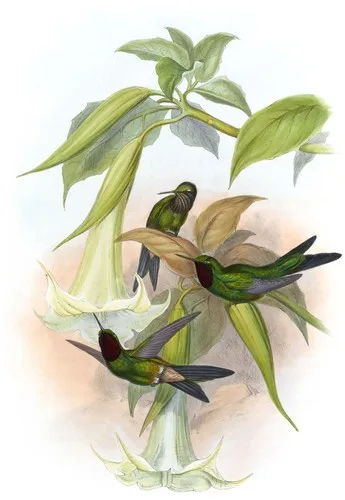
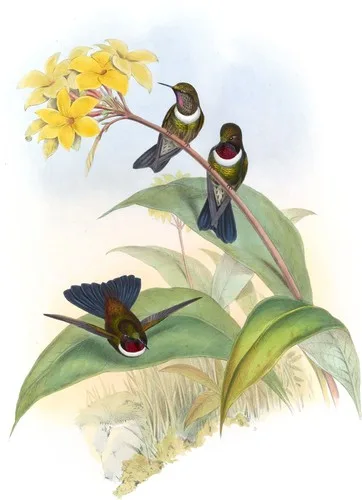
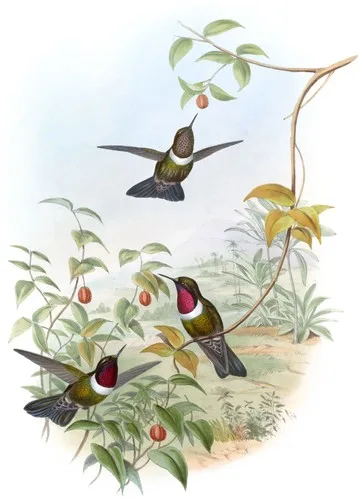
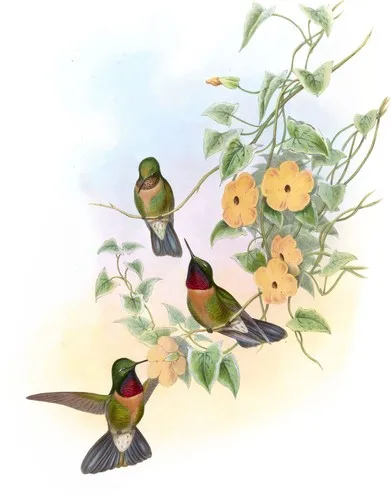
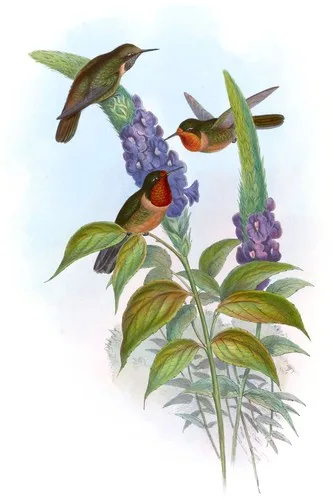
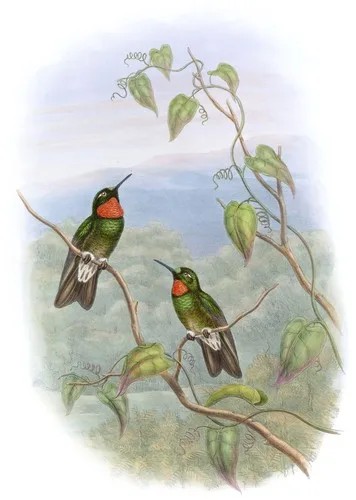
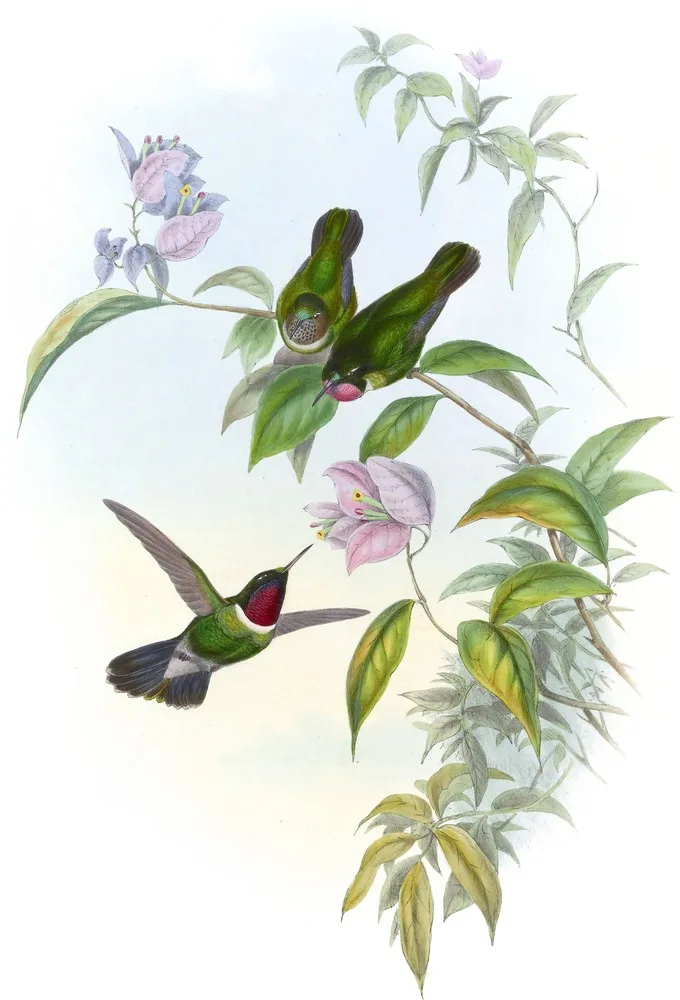
The Heliangelus Clarissæ enjoys a somewhat wide range over the temperate portions of the Columbian Andes, but its head-quarters appears to be the neighbourhood of Santa Fe de Bogota, where vast multitudes are killed by the Indians with the blow-pipe, and sold to the merchants of Bogota at a very low price; by the latter they are transmitted to Europe, and, as I have before stated, principally to Paris. When seen in the full glory of its newly-moulted plumage, this bird is indeed a very beautiful object; the rich puce-colour of its throat, separated from the glittering green of the sides of the chest by a snow-white gorget, rendering it at once both attractive and conspicuous. Such, I regret to say, is the brief account that can be given of this comparatively new bird;—to other naturalists, with suitable opportunities, must pertain the pleasing task of describing its habits, manners, flight, nidification, &c., of which at present nothing is known. The bird itself was first described by M. De Longuemare, who gave it the name of Clarisse in honour of Madame Parzudaki, the wife of the well-known naturalist of that name in Paris.
The male has a small spot of luminous green on the forehead; chin black; throat rich luminous violetred or puce-colour, the blue or violaceous hue prevailing on the upper and lateral margins; below this a gorget of white, succeeded by a series of rich luminous green feathers, narrow in the centre, broad on the sides, and blending with the bronzy green of the flanks; head, upper surface and wing-coverts bronzy green, the head, however, when viewed in front, appears black; lores and sides of the neck velvety black, separating the colours of the upper and under surface of the head and neck; immediately behind the eye a very small spot of white; wings chocolate-brown; two central tail-feathers bronzy green; lateral tailfeathers dull black, becoming brown at the tip; abdomen mottled buff and bronzy green; under tail-coverts white; bill black; feet brown.
The female has a faint indication of the luminous green on the forehead; the head, upper surface and two central tail-feathers bronzy green; lateral tail-feathers black, with lighter tips; throat mottled black and brown, with, when very adult, a series of violaceous-red feathers in the centre, bounded below by a more or less defined gorget of white, and succeeded by a few luminous green feathers, far less conspicuous than in the male.
The figures are of the natural size.
References
- Ornismia Clarisse, De Longuem. Rev. Zool. 1841, p. 306.—Less. Mag. de Zool. 1842, Ois., pl. 26.
- Mellisuga Clarissæ, Gray and Mitch. Gen. of Birds, vol. i. p. 112, Mellisuga, sp. 17.
- Heliangelus clarisse, Bonap. Consp. Gen. Av., p. 76, Heliangelus, sp. 1.
- Heliangelus clarissa, Bonap. in Rey. et Mag. de Zool. 1854, p. 252.
- Anactoria Clarissa, Reichenb. Aufz. der Colibris, &c., p. 12.