领蜂鸟属·Heliangelus Spencei
Heliangelus Spencei
Heliangelus Spencei
Spence’s Sun Angel
- 中文名
- 领蜂鸟属·Heliangelus Spencei
- 学名
- Heliangelus Spencei
- 合集
- 古尔德蜂鸟图谱
- 绘者
- John Gould(约翰·古尔德)
- 年代
- 1854
- 图版号
- Pl. 244, Vol. IV
- 原书页码
- p.244
- 授权
- CC0 1.0 Universal (Public domain)
关于本图版
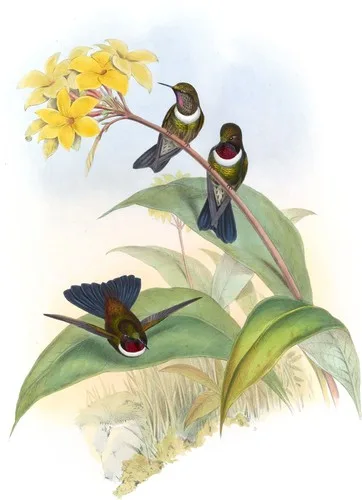
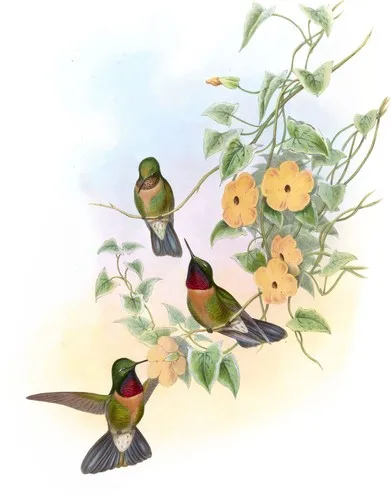
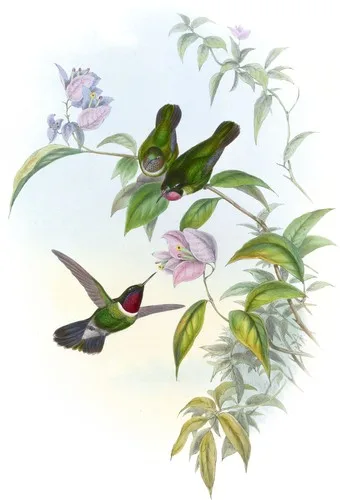
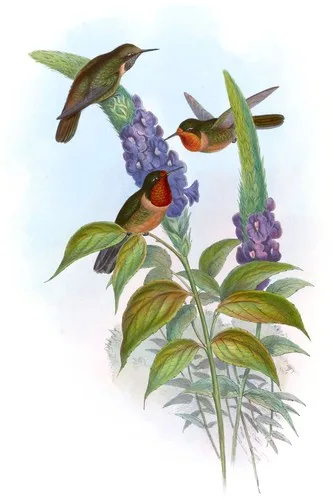
《古尔德蜂鸟图谱》(Gould's Hummingbirds)由约翰·古尔德绘制,1849—1887 年间印行,本图即其中一幅。图中描绘的是领蜂鸟,在分类体系中列于蜂鸟科(Trochilidae)。
该合集全编共 421 幅图版,此图为其中之一,图版编号 Pl. 244, Vol. IV,对应原书第 244 页,版式为纵幅。图像由公有领域原件扫描修复而来,细节在放大视图中仍清晰可辨。
原书文字(英文 / 法文)
The ranges of Sierra Nevada de Merida in New Granada
Up to the present time no species of the genus Heliangelus has been found to the northward of the Isthmus of Panama;—Central America in fact appears, with few exceptions, to have an ornithology peculiarly its own;—the H. Spencei, however, approaches the line of demarcation more nearly than any other, inhabiting, as it does, the extreme northern limit of the country called Columbia.
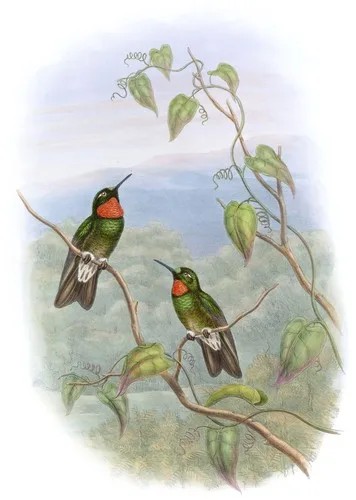
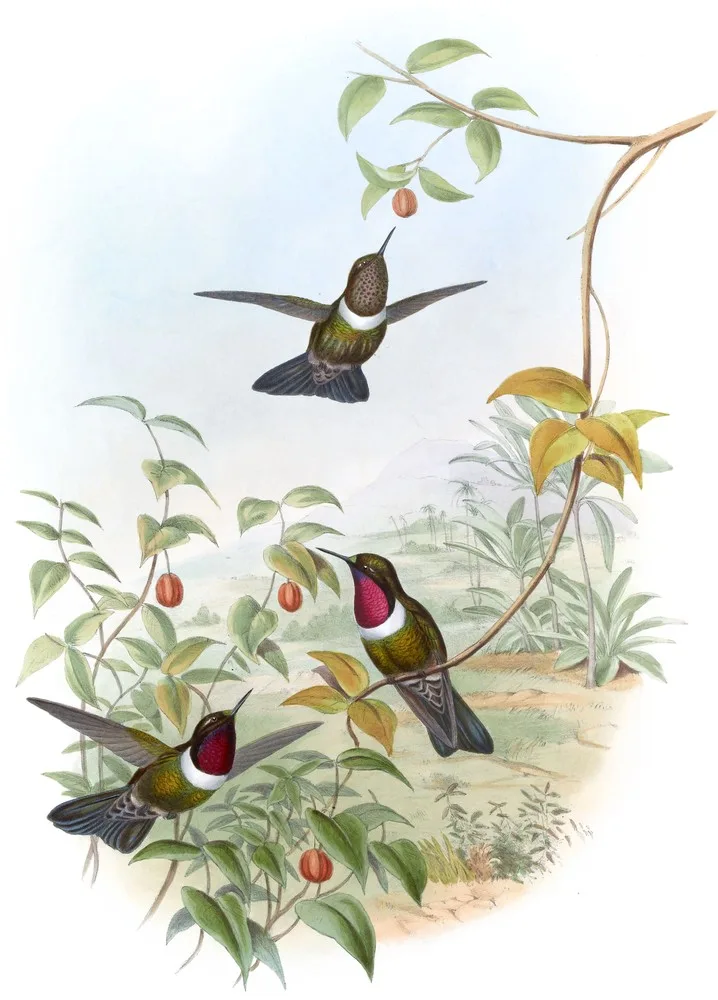
My specimens are from the Sierra Nevada de Merida, where they were procured a few years since, and sent to this country by the botanical travellers Messrs. Funck and Schlim. It is not only a very rare and very beautiful species, but (which is of more importance to the ornithologist, especially one who has undertaken the office of historian of this lovely group) exhibits characters which at once distinguish it from every other member of the genus. These peculiar features consist in the quiet subdued colouring of the violaceous throat, the feathers of which are less glittering or metallic than im any of the other species, in the brilliant spot on the forehead being of a silvery or glaucous green, instead of brilliant grass-green, and in the band across the breast being both broader and of a more snowy whiteness. The colouring of the throat not admitting of my employing a metallic agent in its representation, the figure in the accompanying Plate gives but a faint idea of the beauty of this fine species, which can only be appreciated by an examination of actual specimens.
It gave me great pleasure when I found that M. Bourcier had named this species in honour of the father of British entomologists, and it is very gratifying to me to have this opportunity of assisting to perpetuate the name of a man so truly scientific and amiable as Mr. Spence.
The female of H. Spencei closely assimilates to the female of H. Clarissæ, but the throat-markings are more suffused with brown.
The male has a narrow mark of luminous silvery green on the forehead; all the upper and under surface golden green, with a tinge of brown on the head and rump; throat violaceous red, bounded below by a gorget of white, next to which are a few luminous green feathers; lores and sides of the neck black; wings purplish brown; two centre tail-feathers bronzy green; the lateral feathers bronzy brown, tipped with brownish grey; under tail-coverts brown, fringed with grey; bill black; feet brown.
The female is similar to the male, but is less brilliant, and has the throat mottled with brown and black.
The figures are of the natural size.
References
- Trochilus Spencei, Bourc. in Proce. of Zool. Soc., part xv. p. 46.—Ib. Rev. Zool. 1847, p. 258.
- Mellisuga Spencei, Gray and Mitch. Gen. of Birds, vol. i. p. 112, Mellisuga, sp. 41.
- Heliangelus spencii, Bonap. Consp. Gen. Av., p. 76, Heliangelus, sp. 2.—Ib. Rev. et Mag. de Zool. 1854, p. 252.
- Diotima Spencei, Reichenb. Aufz. der Colibris, p. 12.
十二观
一幅图版,分十二个角度来读:名物、形色、刀笔、构图、时序、故土、谱系、花语、诗境、典故、观法、余韵。前七观是它的来历,后五观是它的余味。
-
名物考
原书题作「Heliangelus Spencei」,编为图版 244, Vol. IV(原书第 244 页)。学名“Heliangelus spencei”。双名制里,属名指其类,种加词多取产地、形态或受赠者之名——一百多年前的命名者,把一种生物的来历压进了两个词。此幅尚无通行中文名,姑以学名相称;在没有本地名字的地方,学名就是它唯一的身份证。
-
形与色
蜂鸟为美洲最小之鸟,喙细长如针,舌分叉成管,可伸入花心吸蜜;翼小而振频极高,能悬停、能倒飞;羽色非颜料所致,是羽枝结构折射的光,随角度而变。此幅未作色相归档;看它的形制,仍能读出那个季节的用色习惯。画幅高而窄,形与色的关系因此看得格外清楚:先读轮廓,再读色层,最后才看笔触。
-
刀笔与色层
十九世纪后半叶,石版与彩色石印渐成主流:颜色可以直接印出,不再依赖手工,线条反倒退居其次。图像的“准确”提高了,手性却淡了。此幅的线条与色块,可以拿放大镜看:线若连续不断,是刻的;色若溢出轮廓半毫米,是手涂的。工艺留下的破绽,比题跋更诚实。
-
构图与留白
画幅高而窄,主株一路向上,上下留白多,是图谱中最常见的立轴式构图。(画幅高宽比约 1.39∶1)全幅只画一株,不作解剖附图——这类图更近于“观赏”,而非“鉴定”。
-
时序
热带美洲几乎全年可见,花期即其季节;温带种类的蜂鸟则随花北迁,一年往返数千公里。图上所记的 1854 年是刊行之年,不是花期;真正的花期藏在原书的采集记录里,比出版早一两年。
-
故土
仅产美洲,自阿拉斯加南部至火地岛,以安第斯山最为繁盛。中土无蜂鸟,汉籍不载,晚清海外游记始见其名。同一部图谱里,同类往往排在一起;把几幅并看,差别比单看一幅清楚得多。
-
谱系
《古尔德蜂鸟图谱》(Gould's Hummingbirds)由约翰·古尔德绘,成于1849-1887。此幅为其中图版 244, Vol. IV,见原书第 244 页。图版今属公有领域,可自由取用;但纸上那层手工上色,仍是两百年前某一个人的手。
-
花语与象征
阿兹特克以蜂鸟为战神与太阳的化身;欧洲维多利亚时代则以蜂鸟为收藏与装饰的极致,百万只羽毛被做成胸饰。中国旧籍无此鸟,故无象征——这空白本身,就是一部博物学交流史。象征会随世道改口:同一种花,在一个世纪里可以说完全相反的话。
-
诗境
穿花蛱蝶深深见,点水蜻蜓款款飞。
—— 唐·杜甫《曲江二首》
中土无蜂鸟,然“穿花”之态,杜甫早已写过:贴着花心走,是采蜜者的共同姿态。诗以气行,画以形立;两种“看”叠在一起,才是看画的意思。
-
典与谱
古尔德《蜂鸟图谱》(1849—1887)以石版手工上色,金箔衬底,使羽色在纸上仍有金属光;这套图册本身就是十九世纪印刷与收藏狂热合流的产物。中国的花谱重品第与品格,欧洲的植物志重形态与命名;此图站在后一条线上,却也经得起前一种眼光——毕竟看花的人,两样都要。此幅刊于 1854 年,正是两套传统彼此看见的年代:欧洲的植物志开始收中国原产的种,中国的花谱也开始记海外的花。
-
观法
看喉部与背部的金属光:那是结构色,画家须用金箔或叠色才追得上;再看舌与喙的比例,长喙者多取深管花,短喙者取浅花——鸟与花是配套演化的。古法看画讲“远观其势,近取其质”,图版亦然:退后两步看姿态,凑近看线与色的交界。
-
余韵
二百年后,这只鸟的后代或许仍在某处活着;而纸上这一只,永远停在 1854 年的那个季节。