向日葵族·Helianthea Bonapartei
Helianthea Bonapartei
Helianthea Bonapartei
Bonaparte’s Star-frontlet
- 中文名
- 向日葵族·Helianthea Bonapartei
- 学名
- Helianthea Bonapartei
- 合集
- 古尔德蜂鸟图谱
- 绘者
- John Gould(约翰·古尔德)
- 年代
- 1854
- 图版号
- Pl. 236, Vol. IV
- 原书页码
- p.236
- 授权
- CC0 1.0 Universal (Public domain)
十观
- 纵幅 1.66∶1
第一眼
江馆清秋,晨起看竹,烟光日影露气,皆浮动于疏枝密叶之间。
—— 清·郑板桥《题画竹》
郑板桥说他画竹,是先看见“烟光日影露气”在枝叶间浮动,才动手。看画时找这一层空气,比记住花的名字更要紧。这一幅是竖的:眼睛从下往上走,落点在上半部。先让整株立起来,再看细节。第二步凑近一寸:看线与色的交界,色有没有压住线,线有没有断。第三步,把视线放到最深的那一小块:整幅的用色秩序,都是从那里排开的。
名与实
学名 Helianthea bonapartei:前一词是属,管它归在哪一类;后一词是种加词,管它在这一类里凭什么与众不同。名字是通行证,也是懒办法——记住两个词,就抓住了一整个物种。此幅尚无通行中文名,姑以学名相称;在没有本地名字的地方,学名就是它唯一的身份证。
形与色
山茶为常绿灌木或小乔木,叶厚革质、缘有细齿,表面如涂蜡;花单生枝顶,重瓣者花瓣层叠如覆瓦,凋时整朵坠落,不散不乱。此幅未作色相归档,只能就形制论。看形制不必求全:记住叶序、花被数与着生方式,这一类的骨架就立住了。
构图与呼吸
画幅高而窄,主株一路向上,上下留白多,是图谱中最常见的立轴式构图。全幅只画一株,不作解剖附图——这类图更近于“观赏”,而非“鉴定”。空白不是没画完,是给眼睛留的落脚处:一张图若四边都塞满,花反而会闷。
一刀一色
十九世纪后半叶,石版与彩色石印渐成主流:颜色可以直接印出,不再依赖手工,线条反倒退居其次。图像的“准确”提高了,手性却淡了。工艺留下的破绽比题跋更诚实:刻工不会撒谎,上色的人赶时间的时候会。想动笔临它的人记住一句:先铺大块的形与色,干后再收细部;石印的柔和层次来自薄涂与网点,水彩分两三遍淡铺即可逼近。
诗境
惟有山茶偏耐久,绿丛又放数枝红。
—— 宋·陆游《山茶一树自冬至清明后著花不已》
“惟有山茶偏耐久”——诗以气行,画以形立;两种“看”叠在一起,才是看画的意思。
花语
中国以山茶为“耐久”之友,陆游所谓“惟有山茶偏耐久”;西方则以茶花为东方之艳与不可得,小仲马《茶花女》之后,它又多了一层薄命的意味。象征会随世道改口:同一株植物,在一个世纪里可以说完全相反的话。
时与地
冬末至春初,正月的寒里开。花期极长,一朵可撑十余日,故有“耐久”之名。中国西南及日本。云南山茶最盛,十九世纪传入欧洲后引起轰动,被称作“东方的玫瑰”。图上所记的 1854 年是刊行之年,不是花期;真正的花藏在原书的采集记录里,通常比出版早一两年。看叶的老嫩、花与果是否同在枝上,季节便八九不离十;看题名里藏着的地名,来路也猜得出七分。
书与人
《古尔德蜂鸟图谱》只署了约翰·古尔德一个人的名字。版画是集体工程:绘图、刻版、上色各有其人,真正决定这幅图好不好看的,常是没留下名字的刻工与上色师。
带走一双眼睛
如果只能记一句,就记郭熙那八个字:远望取其势,近看取其质。看图、看花、看人,都一样。图谱的用意是“以备查考”,看久了却会忘记查考:1854 年的一个人,为一朵花花了整整一天。
关于本图版
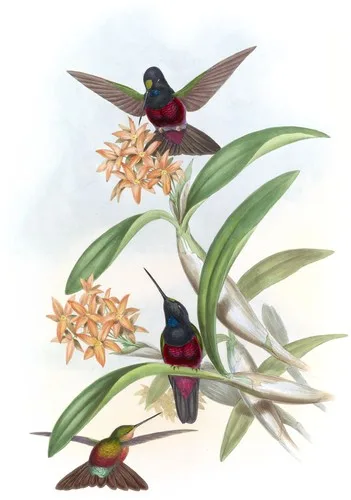
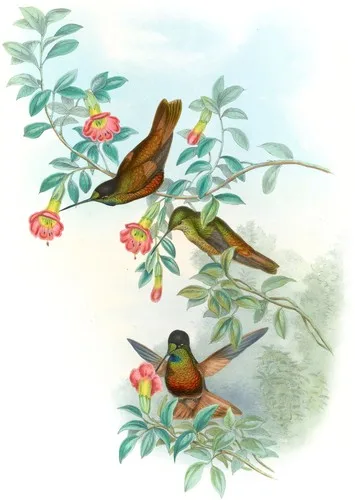
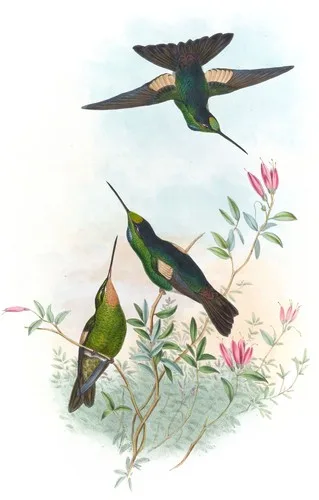
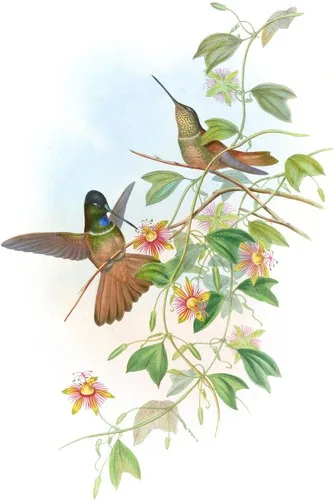
本图选自约翰·古尔德的《古尔德蜂鸟图谱》(Gould's Hummingbirds),原书 1849—1887 年间出版。向日葵(Helianthea Bonapartei)是本图的主角,在分类体系中列于蜂鸟科(Trochilidae)。
该合集全编共 421 幅图版,此图为其中之一,图版编号 Pl. 236, Vol. IV,对应原书第 236 页,版式为纵幅。图为公有领域原件的修复扫描,构图与设色未经改动。
原书文字(英文 / 法文)
New Granada. Examples frequently occur in collections from Bogota.
Although inhabiting the same country, this beautiful Humming-Bird has not been so long known to European ornithologists as the Helianthea typica, the first description of it having appeared so recently as 1840.
In dedicating this species to Prince Charles Lucien Bonaparte, M. Boissoneau states that he desires to do honour to one of the most learned ornithologists of our time; and never certainly was a compliment of this kind more appropriately bestowed, since no one has done more, and few so much, to advance this department of science than that accomplished and amiable man.
The remarks I have made respecting the destruction of the Helianthea typica by the Indian hunters, apply with greater force to the present species, which, owing to its greater beauty, is even more diligently sought after; being, however, a far less numerous species, a much smaller number are collected. Bogota is the locality whence the greater number of the specimens sent to London and Paris are despatched; but I suspect that this is not the centre of the area over which the bird ranges, and have some reasons for believing that it is more abundant to the southward, in the direction of Popayan, where, as its rich colours would lead us to imagine, it dwells in a warmer climate; the bleak Paramos then are not its favourite abode; but the more genial regions below, at an elevation of from three thousand five hundred to six thousand feet, constitute a habitat congenial to its mode of life.
The Hehanthea Bonapartei is certainly one of the most beautiful members of its genus. Mr. Mark tells me that the Spanish residents in Bogota call it “La Dorada,” or Golden Humming Bird, and “Siete colores,” or Seven colours, and that it is the universal favourite; this gentleman also states that in the spring months it is frequently met with near the villages of Guaduas and Fusugasuga, situate about two days’ journey from Bogota.
The sexes present the same differences that are found to exist in the Helianthea typica.
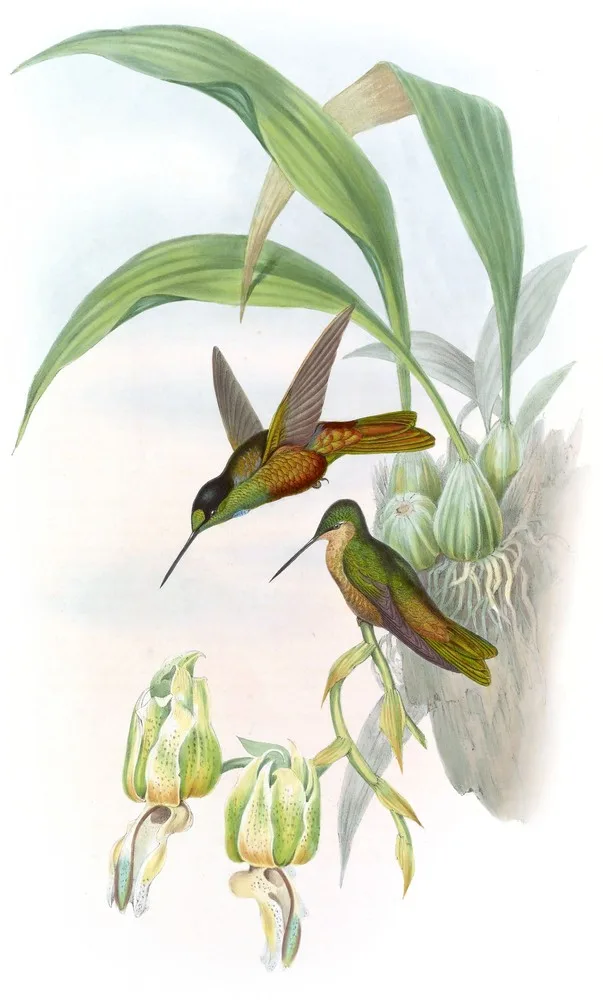
The male has: on the forehead a spot of luminous metallic green; lores, crown of the head and occiput velvety black; back, wing-coverts and sides of the neck dark bronzy green; rump and upper tail-coverts shining coppery red; wings purple-brown; throat and chest brilliant metallic green, with a gorget-shaped mark of deep shining blue in the centre of the former; abdomen resplendent metallic coppery red or flamecolour; tail and under tail-coverts bronze; bill black.
The female has the upper surface bronzy green, deepening into coppery bronze on the upper tail-coverts; throat buff; feathers of the sides of the neck and breast tipped with green; under tail-coverts buff.
The figures represent the two sexes of the size of life. The beautiful orchid is the Stanhopea saccata.
References
- Ornisima Bonaparte, Boiss. Rev. Zool. 1840, p. 6.—Boure. Ann. Sci. Phys. &c. de Lyon, tom. v. p. 307, pl. xiv.
- Trochilus aurigaster, Lodd.
- Mellisuga Bonapartei, Gray and Mitch. Gen. of Birds, vol. i. p. 112, Mellisuga, sp. 8.
- Helianthea bonapartii, Bonap. Consp. Gen. Av., p. 74, Helianthea, sp. 2.
- Helianthea Bonaparti, Bonap. Consp. Troch. in Rev. et Mag. de Zool. 1854, p. 251.