Helianthea Lutetiæ
Helianthea Lutetiæ
Comte de Paris
- 合集
- 古尔德蜂鸟图谱
- 绘者
- John Gould(约翰·古尔德)
- 年代
- 1854
- 图版号
- Pl. 238, Vol. IV
- 原书页码
- p.238
- 授权
- CC0 1.0 Universal (Public domain)
十观
- 纵幅 1.56∶1
第一眼
搜尽奇峰打草稿。
—— 清·石涛《苦瓜和尚画语录》
走遍山川,才有资格落笔。博物画的画家也一样:先在温室与山野里看够了活的花,纸上那一朵才不虚。这一幅是竖的:眼睛从下往上走,落点在上半部。先让整株立起来,再看细节。第二步凑近一寸:看线与色的交界,色有没有压住线,线有没有断。第三步,把视线放到最深的那一小块:整幅的用色秩序,都是从那里排开的。
名与实
没有学名可依,就看题名:题名里往往藏着产地、赠者或一句形容。此幅既无通行中文名,学名也不可靠,只能以原书题名相称——图谱里总有几幅这样的图,只能靠画面本身说话。
形与色
山茶为常绿灌木或小乔木,叶厚革质、缘有细齿,表面如涂蜡;花单生枝顶,重瓣者花瓣层叠如覆瓦,凋时整朵坠落,不散不乱。此幅未作色相归档,只能就形制论。别只看花:叶脉的走向、萼片的长短、甚至茎上的毛,都是画家用来区分物种的证据。
构图与呼吸
画幅高而窄,主株一路向上,上下留白多,是图谱中最常见的立轴式构图。全幅只画一株,不作解剖附图——这类图更近于“观赏”,而非“鉴定”。空白不是没画完,是给眼睛留的落脚处:一张图若四边都塞满,花反而会闷。
一刀一色
十九世纪后半叶,石版与彩色石印渐成主流:颜色可以直接印出,不再依赖手工,线条反倒退居其次。图像的“准确”提高了,手性却淡了。拿放大镜(或手机微距)看三处:花瓣边缘、叶脉、题名。线若连续不断,是刻的;色若越过轮廓半毫米,是手涂的。想动笔临它的人记住一句:先铺大块的形与色,干后再收细部;石印的柔和层次来自薄涂与网点,水彩分两三遍淡铺即可逼近。
诗境
旖旎细风飘水麝,玲珑残雪浸山茶。
—— 宋·贺铸《摊破浣溪沙》
“旖旎细风飘水麝”——把这一句放回画面:花冠就是诗句的落点——诗先写气,画后写形,两者在此处接上了。
花语
中国以山茶为“耐久”之友,陆游所谓“惟有山茶偏耐久”;西方则以茶花为东方之艳与不可得,小仲马《茶花女》之后,它又多了一层薄命的意味。象征多半来自形状与气味:像杯的、像泪的、香的、臭的——先有形状,后有意义。
时与地
冬末至春初,正月的寒里开。花期极长,一朵可撑十余日,故有“耐久”之名。中国西南及日本。云南山茶最盛,十九世纪传入欧洲后引起轰动,被称作“东方的玫瑰”。图上所记的 1854 年是刊行之年,不是花期;真正的花藏在原书的采集记录里,通常比出版早一两年。看叶的老嫩、花与果是否同在枝上,季节便八九不离十;看题名里藏着的地名,来路也猜得出七分。
书与人
《古尔德蜂鸟图谱》只署了约翰·古尔德一个人的名字。图版今属公有领域,可以自由取用;但纸上那层手工上色,仍是两百年前某一个人的手。
带走一双眼睛
鉴赏力不是知识,是习惯:每次多看一眼,十年之后你看什么都和别人不一样。图谱的用意是“以备查考”,看久了却会忘记查考:1854 年的一个人,为一朵花花了整整一天。
关于本图版
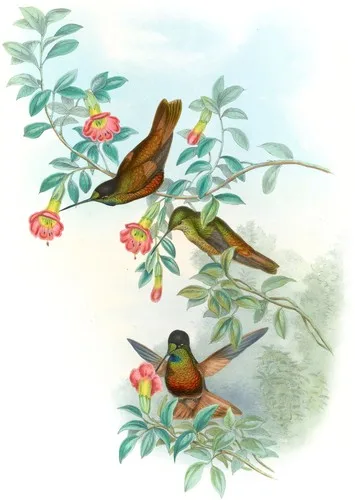
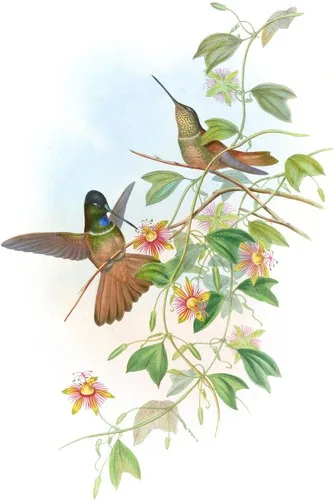
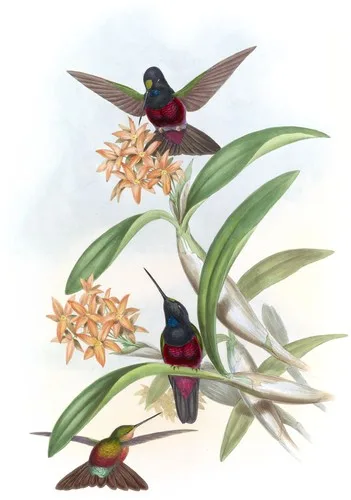
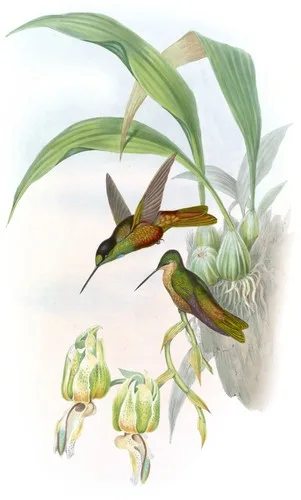
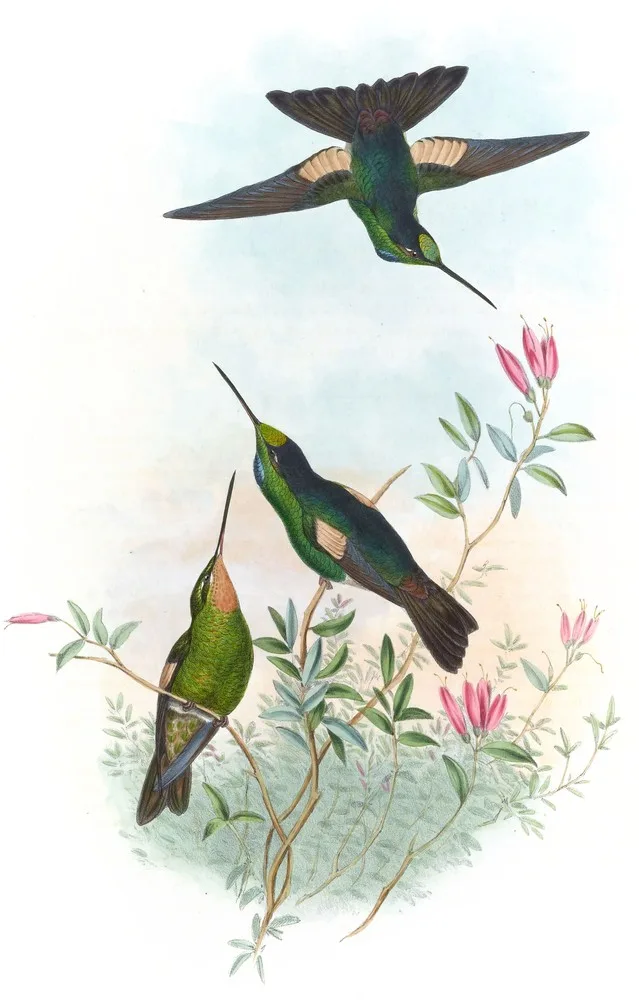
本图选自约翰·古尔德的《古尔德蜂鸟图谱》(Gould's Hummingbirds),原书 1849—1887 年间出版。画面主体为 Helianthea Lutetiæ,在分类体系中列于蜂鸟科(Trochilidae)。
该合集全编共 421 幅图版,此图为其中之一,图版编号 Pl. 238, Vol. IV,对应原书第 238 页,版式为纵幅。扫描件取自公有领域原件,经高分辨率修复与色彩校正,可按原大放大查看线条与设色。
原书文字(英文 / 法文)
Popayan and Ecuador. Professor Jameson and Mr. Fraser state that “This bird is found in the valleys of Lloa and Pelogalli, but not nearer Quito.” —Ibis, vol. i. p. 400.
The Helhanthea Lutetiæ may fairly rank among the finest species of its genus.
In size it surpasses the H. typica and H. Eos, from which, and indeed from every other known species, it differs in the uniform deep grass-green of the chest and abdomen, and, with the exception of H. Eos, in the bright buff colouring of the secondaries, forming a conspicuous mark like an epaulet near the shoulders. The native habitat of this fine species is Ecuador, in which country it takes the place of the H. Bonaparti, H. typica, and H. Eos of Columbia, and the H. violifera of Peru. I believe its discovery to be due to the researches of the late M. DeLattre, who, in conjunction with M. Bourcier, named it Lu¢etie in honour of the Comte de Paris as a compliment to his illustrious father, the late Duke of Orleans, who by his patronage of the natural sciences contributed so largely to their development.
As is usual in this genus, the sexes differ very considerably in their colouring. The females of all the species, however, are very similar; but the female of H. Lutetie having the buffy epaulet-like mark on the shoulder, it is impossible to mistake the species to which it pertains.
The Helianthea Lutetiæ appears to be very common in the neighbourhood of Quito, as is evidenced by the numerous examples obtained by Professor Jameson, M. Bourcier, and every collector who has visited those regions. The specimens from which the original description was taken were procured by M. DeLattre on the Volcano of Purace near Popayan.
I am indebted to M. Bourcier for the loan of the drawing of the interesting plant figured on the accompanying Plate.
The male has a spot of glittering metallic green on the forehead; the sides of the head, crown, and back of the neck velvety-black; upper surface brownish-black glossed with green; wing-coverts dark green; wings purplish-brown, with the exception of the secondaries, which are buff, forming a conspicuous mark near the shoulder; tail dark bronzy-brown; under surface shining deep grass-green, with a. spot of rich metallic steel-blue in the centre of the throat; bill black; feet brown.
The female has the crown of the head and upper surface bronzy-green; wings and tail as in the male; chin and centre of the throat deep sandy-buff; under surface bronzy-green.
The Plate represents the sexes of the natural size.
References
- Trochilus Lutetieæ, DeLatt. et Bource. Rev. Zool. 1846, p. 307.
- Mellisuga lutetiæ, Gray and Mitch. Gen. of Birds, vol. i. p. 112, Mellisuga, sp. 7.
- Helianthea lutetiae, Bonap. Consp. Gen. Av., p.74, Helianthea, sp.3.—Reich. Aufz. der Col., p. 9.
- Helianthea lutetiæ, Bonap. Rev. et Mag. de Zool. 1854, p. 251.