向日葵族
Helianthea osculans
Helianthea osculans
Buff-tailed Star-frontlet
- 中文名
- 向日葵族
- 学名
- Helianthea osculans
- 合集
- 古尔德蜂鸟图谱
- 绘者
- John Gould(约翰·古尔德)
- 年代
- 1887
- 图版号
- Pl. 378, Suppl. Vol.
- 原书页码
- p.378
- 授权
- CC0 1.0 Universal (Public domain)
十观
- 纵幅 1.34∶1
第一眼
竖划三寸,当千仞之高;横墨数尺,体百里之迥。
—— 南朝宋·宗炳《画山水序》
三寸的竖线可当千仞高山,几尺横墨能容百里之远。尺幅从来不是障碍,取舍才是本事。这一幅是竖的:眼睛从下往上走,落点在上半部。先让整株立起来,再看细节。第二步凑近一寸:看线与色的交界,色有没有压住线,线有没有断。第三步,把视线放到最深的那一小块:整幅的用色秩序,都是从那里排开的。
名与实
学名 Helianthea osculans:前一词是属,管它归在哪一类;后一词是种加词,管它在这一类里凭什么与众不同。名字是通行证,也是懒办法——记住两个词,就抓住了一整个物种。中文名“向日葵族”是后人据学名回译的通行叫法,与古书里的旧名未必对得上——名与物之间,总隔着一层翻译。
形与色
山茶为常绿灌木或小乔木,叶厚革质、缘有细齿,表面如涂蜡;花单生枝顶,重瓣者花瓣层叠如覆瓦,凋时整朵坠落,不散不乱。此幅未作色相归档,只能就形制论。颜色不是平涂的:最浅处近乎纸色,最深处在花瓣重叠的缝里。把这两处找到,画面的呼吸就出来了。
构图与呼吸
画幅高而窄,主株一路向上,上下留白多,是图谱中最常见的立轴式构图。全幅只画一株,不作解剖附图——这类图更近于“观赏”,而非“鉴定”。空白不是没画完,是给眼睛留的落脚处:一张图若四边都塞满,花反而会闷。
一刀一色
十九世纪后半叶,石版与彩色石印渐成主流:颜色可以直接印出,不再依赖手工,线条反倒退居其次。图像的“准确”提高了,手性却淡了。还有一种证据在纸背:铜版压进纸里的那道痕、上色处微微凸起的颜料、再版时磨浅的线。扫描件里也能看出七分。想动笔临它的人记住一句:先铺大块的形与色,干后再收细部;石印的柔和层次来自薄涂与网点,水彩分两三遍淡铺即可逼近。
诗境
东园三日雨兼风,桃李飘零扫地空。惟有山茶偏耐久,绿丛又放数枝红。
—— 宋·陆游《山茶》
以桃李之零落反衬山茶之耐久——诗人赞的不是颜色,是“别人都谢了我还开着”的那点倔强。古人写到这一层,已不只是赏花,是借花说人;画面则只负责把那朵花留住。
花语
中国以山茶为“耐久”之友,陆游所谓“惟有山茶偏耐久”;西方则以茶花为东方之艳与不可得,小仲马《茶花女》之后,它又多了一层薄命的意味。花语是后人添上去的,花本身并不知道;但这层“不知道”,正是它最动人的地方。
时与地
冬末至春初,正月的寒里开。花期极长,一朵可撑十余日,故有“耐久”之名。中国西南及日本。云南山茶最盛,十九世纪传入欧洲后引起轰动,被称作“东方的玫瑰”。图上所记的 1887 年是刊行之年,不是花期;真正的花藏在原书的采集记录里,通常比出版早一两年。图上的产地常是“据说来自”,图上的花期常是“盛开那十日”——两处都要打个折扣读。
书与人
《古尔德蜂鸟图谱》只署了约翰·古尔德一个人的名字。从画稿到成图要过好几双手:转刻的人求准,上色的人求快——快与准之间,就是各幅之间深浅不一的来历。
带走一双眼睛
鉴赏力不是知识,是习惯:每次多看一眼,十年之后你看什么都和别人不一样。1887 年的那朵花早已化作尘土,它留在纸上的样子,却比任何一株活着的同类都长寿。
关于本图版
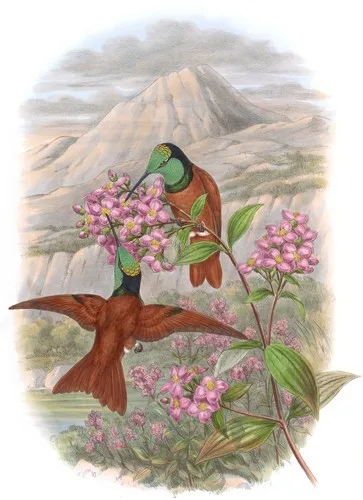
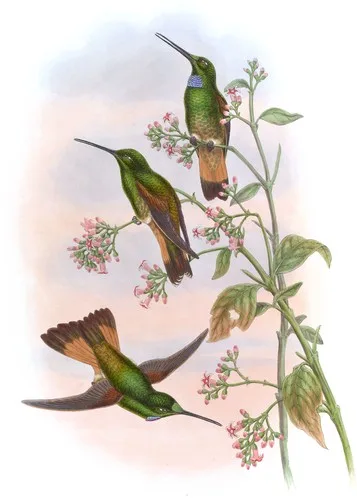
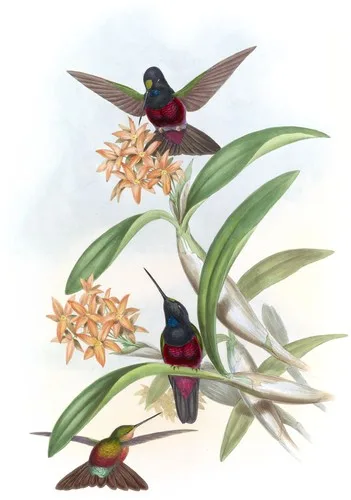
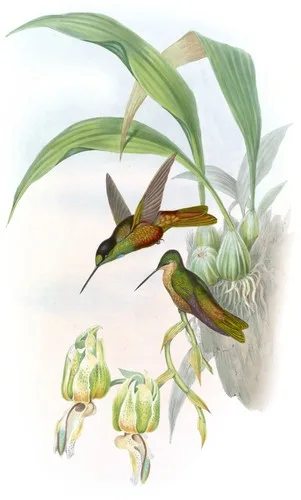
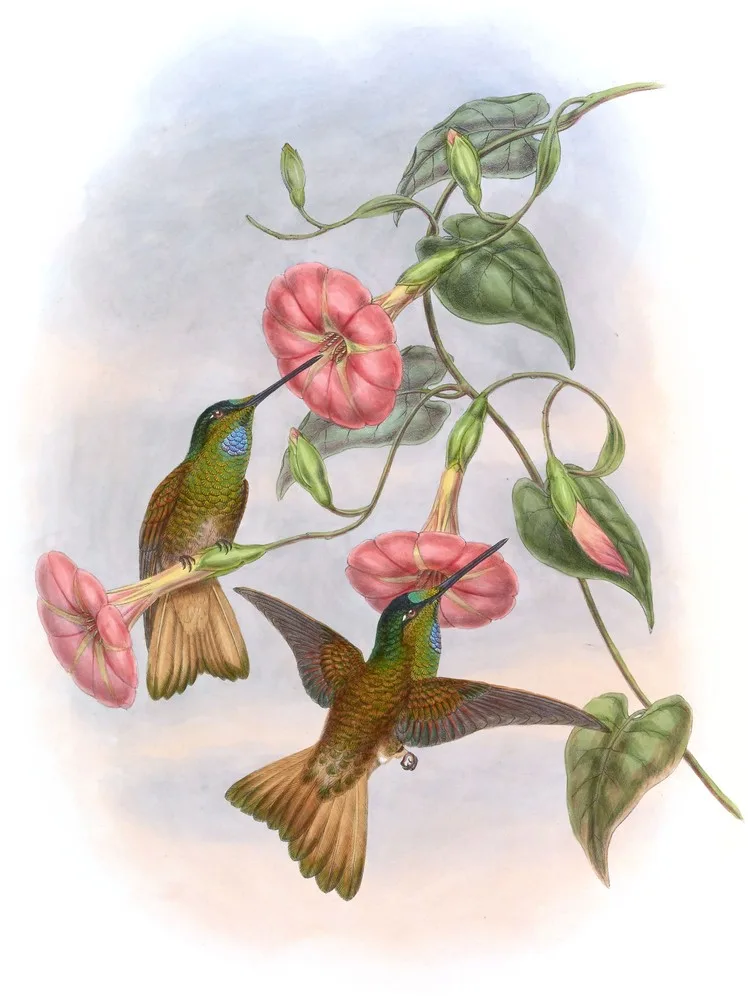
这幅图版出自《古尔德蜂鸟图谱》(Gould's Hummingbirds),由约翰·古尔德绘制,1849—1887 年间出版。向日葵(Helianthea osculans)是本图的主角,归入蜂鸟科(Trochilidae)。
全编共收录 421 幅图版,本图是其中一幅,原书将其列为 Pl. 378, Suppl. Vol.,见第 378 页,版式为纵幅。扫描件取自公有领域原件,经高分辨率修复与色彩校正,可按原大放大查看线条与设色。
原书文字(英文 / 法文)
Mr. Whitely collected this bird at Cachuapata and Huasampilla in Peru, and at present he appears to be the only naturalist who has met with the species.
It is of about the same size as H. violifera, but differs from that bird in having a stouter and longer bill, by the spot on the forehead being larger, and green instead of blue, by the tips of the tail-coverts and tail-feathers being tinged with olive-green, and by the breast being of a more brilliant green, and destitute of any crescentic greyish-white mark across the chest.
Male. Crown of the head, viewed anteriorly, black, with a spot of brilliant green on the forehead, as in H. bonapartei; back and upper tail-coverts bronzy green; shoulders golden brown; primaries purplish black, the exterior web of the first buff; throat and breast brilliant green, with a patch of an equally brilliant blue in the centre of the former; abdomen buff, tinged and mottled with green; thighs buffy white; under tail-coverts light buff; tail-feathers deep buff, tinged with green at the tip, especially the two centre ones; bill black. Total length 5
Mr. Elliot says that the female differs in having no frontal or gular spot. The throat is buff, spotted with green; otherwise it resembles the male.
The Plate represents an adult male in two positions, drawn from the original specimen.
[R. B. S.]
References
- Helhanthea osculans, Gould, Proc. Zool. Soc. 1871, p. 503.—Sclater & Salvin, Nomencl. Av. Neotr. p. 89 (1873) —Whitely, Proc. Zool. Soc. 1873, p. 191, 1874, p. 677.—Klliot, Ibis, 1874, p. 334.—Id. Synopsis of the Humming-Birds, p. 73 (1878).—Tacz. Orn. du Pérou, i. p. 376 (1884).
- Calligenia osculans, Mulsant, Hist. Nat. Oiseaux-Mouches, i. p. 300 (1876).