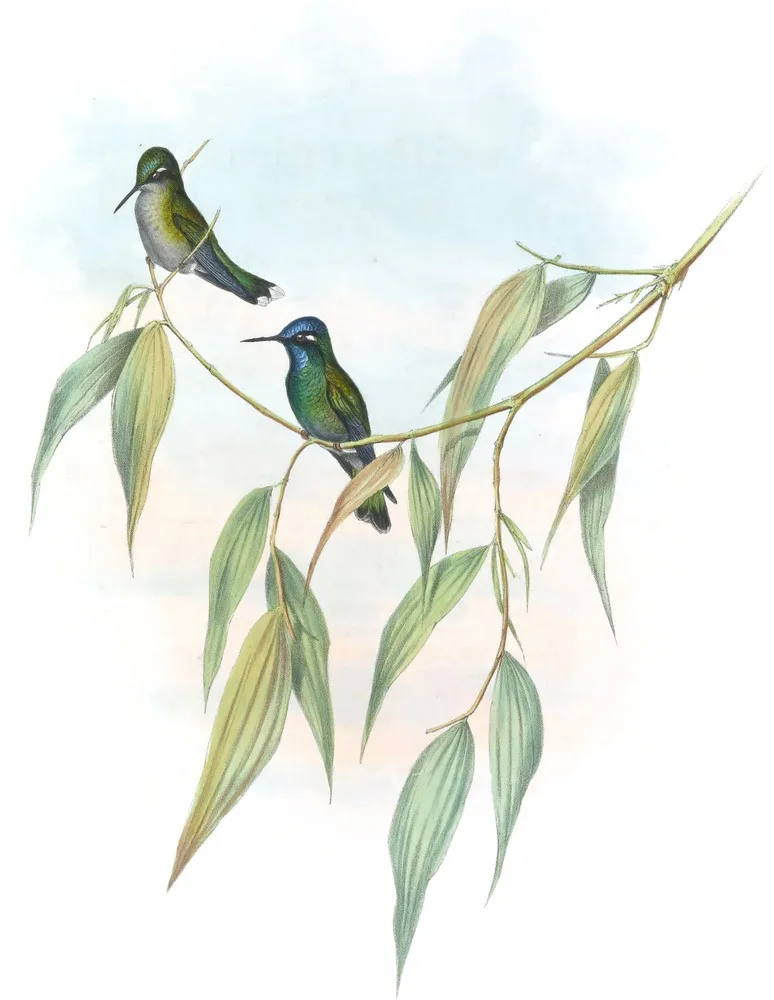
Klais Guimeti
Klais Guimeti
Guimet’s Flutterer
- 学名
- Klais Guimeti
- 合集
- 古尔德蜂鸟图谱
- 绘者
- John Gould(约翰·古尔德)
- 年代
- 1854
- 图版号
- Pl. 210, Vol. IV
- 原书页码
- p.210
- 授权
- CC0 1.0 Universal (Public domain)
关于本图版
此图原刊于《古尔德蜂鸟图谱》(Gould's Hummingbirds),绘者为约翰·古尔德,成书于 1849—1887 年间。原书题作“Klais Guimeti”,归入蜂鸟科(Trochilidae)。
全编共收录 421 幅图版,本图是其中一幅,原书将其列为 Pl. 210, Vol. IV,见第 210 页,版式为纵幅。图为公有领域原件的修复扫描,构图与设色未经改动。
原书文字(英文 / 法文)
Venezuela and the Andes of New Granada.
This highly curious and interesting little Humming-bird stands quite alone among the numerous species of the great family of the Trochilidæ, presenting, as it does, so many peculiar characters, that it is not easy to say to which of the genera it is most nearly allied: perhaps that of Myiabeillia is the one to which it presents the greatest affinity.
Its native country is the Caraccas, whence numerous specimens were brought by the late Mr. David Dyson. I believe its habitat to be somewhat limited, and that it is probably confined to the secondary hills which stretch away to the eastward of the great Columbian ranges. Besides the Caraccas, Dr. Reichenbach states that the countries of Columbia, Venezuela, and V eragua are visited by it; and such is probably the case, as it certainly occurs, although but sparingly, in collections from Bogota.
MM. Bourcier and Mulsant have dedicated this species to M. Guimet, a chemist of Lyons, the inventor of a peculiar blue which bears his name.
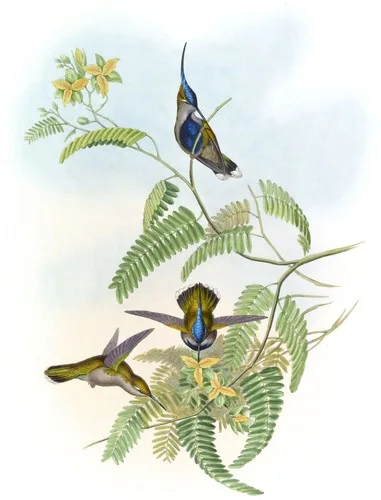
The sexes are very dissimilar, the female being dressed in a dingy garb as compared with that of the male. The accompanying drawing and the following descriptions will fully illustrate the sexes and the differences of their colouring.
The male has the head, face and throat very deep rich blue; all the upper surface, wing- and tail-coverts green; wings purplish-brown; under surface dull bronzy-green; two centre tail-feathers bronzy-green, the remainder bronzy-green at the base, then dull black, and slightly tipped with grey; behind the eye a small mark of pure white; bill black; feet dark brown.
The female has the crown of the head slightly tinged with bluish-green; upper surface golden-green; wings purplish-brown; tail as in the male, but the lateral feathers more largely tipped with grey; all the under surface grey, glossed on the sides of the neck and flanks with bronze.
The Plate represents the sexes of the natural size.
References
- Trochilus Guimeti, Bourc. et Muls. Ann. de la Soc. Sci. de Lyon, tom. vi. 1843, p. 38. pl. 2.— Ib. Rev. Zool. 1843, p. 72.
- Hylocharis Guimeti, Gray and Mitch. Gen. of Birds, vol. i. p. 114, Hylocharis, sp. 33.
- Klais Guimeti, Reich. Aufz. der Col., p. 13.
- Myiabeillia guimeti, Bonap. Rev. et Mag. de Zool. 1854, p. 253.
十二观
- 略纵 1.29∶1
- 1854 年刊
- 图版 210, Vol. IV
这不是词条,是一条看画的次序:先站定看整体,再看名字与形色、构图与刀工,然后问它几时开、从哪里来、经了谁的手;最后是中国诗文——同一朵花,中国古人是怎么看的。十二观读完,这幅图就打开了。
-
第一眼
凡画山水,意在笔先。
—— 唐·王维《山水论》
下笔之前,心里已经有了整幅画。看画时可以反过来推:画家先定了什么,后添了什么。这一幅略高于宽,落点在中央偏上那只鸟的头部。第二步凑近一寸:看线与色的交界,色有没有压住线,线有没有断。第三步,把视线放到最深的那一小块:整幅的用色秩序,都是从那里排开的。
-
名与实
学名 Klais guimeti:前一词是属,管它归在哪一类;后一词是种加词,管它在这一类里凭什么与众不同。名字是通行证,也是懒办法——记住两个词,就抓住了一整个物种。此幅尚无通行中文名,姑以学名相称;在没有本地名字的地方,学名就是它唯一的身份证。
-
形与色
翼小而振频极高,能悬停、能倒飞;羽色非颜料所致,是羽枝结构折射的光,随角度而变。此幅未作色相归档,只能就形制论。别只看花:叶脉的走向、萼片的长短、甚至茎上的毛,都是画家用来区分物种的证据。
-
构图与呼吸
画幅略高于宽,鸟身居中偏上,视线落在头部与喙。(高宽比约 1.29∶1)全幅只画一只,不作解剖附图——这类图更近于“观赏”,而非“鉴定”。老图谱爱把主株摆在偏中线的位置,左右留得不一样多:这一点偏心,正是画面活起来的原因。
-
一刀一色
十九世纪后半叶,石版与彩色石印渐成主流:颜色可以直接印出,不再依赖手工,线条反倒退居其次。图像的“准确”提高了,手性却淡了。工艺留下的破绽比题跋更诚实:刻工不会撒谎,上色的人赶时间的时候会。
-
时序
热带美洲几乎全年可见,花期即其季节;温带种类的蜂鸟则随花北迁,一年往返数千公里。图上所记的 1854 年是刊行之年,不是采到那只鸟的年份;真正的观察记录通常比出版早一两年。看这一类图最好的时候,是它的花期:文字说不清的“开得正盛”,在树下站三分钟就懂了。
-
故土
仅产美洲,自阿拉斯加南部至火地岛,以安第斯山最为繁盛。中土无蜂鸟,汉籍不载,晚清海外游记始见其名。产地写在图上的,往往是“据说来自”;真正的野外记录,要等采集人回来才敢落笔。
-
书与人
《古尔德蜂鸟图谱》(Gould's Hummingbirds)由约翰·古尔德绘,成于1849-1887。此幅为其中图版 210, Vol. IV,见原书第 210 页。图版今属公有领域,可以自由取用;但纸上那层手工上色,仍是两百年前某一个人的手。
-
诗境
夫列子御风而行,泠然善也,旬有五日而后反。
—— 《庄子·逍遥游》
蜂鸟悬停于空,不落不飞,最近于“御风”。庄子说的是一种自由的姿态,蜂鸟把它做成了生理事实。诗以气行,画以形立;两种“看”叠在一起,才是看画的意思。
-
文心
庭下如积水空明,水中藻荇交横,盖竹柏影也。
—— 宋·苏轼《记承天寺夜游》
月光像积水,竹柏的影子像水草。苏轼写的是错觉——而画画用的正是这种眼睛:先看错,才看得真。古尔德《蜂鸟图谱》(1849—1887)以石版手工上色,金箔衬底,使羽色在纸上仍有金属光;这套图册本身就是十九世纪印刷与收藏狂热合流的产物。记住这一句,下次在别处见到同类,它会自己浮上来——鉴赏力就是这样一句一句攒出来的。
-
花语
阿兹特克以蜂鸟为战神与太阳的化身;欧洲维多利亚时代则以蜂鸟为收藏与装饰的极致,百万只羽毛被做成胸饰。中国旧籍无此鸟,故无象征——这空白本身,就是一部博物学交流史。在图谱里,它首先是一个物种,其次才是一种象征——这个次序值得记住。
-
带走一双眼睛
如果只能记一句,就记郭熙那八个字:远望取其势,近看取其质。看图、看花、看人,都一样。1854 年的那只鸟早已化作尘土,它留在纸上的样子,却比任何一只活着的同类都长寿。