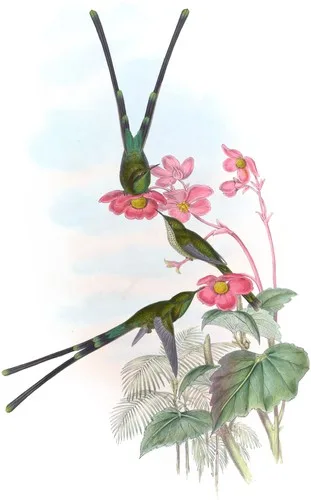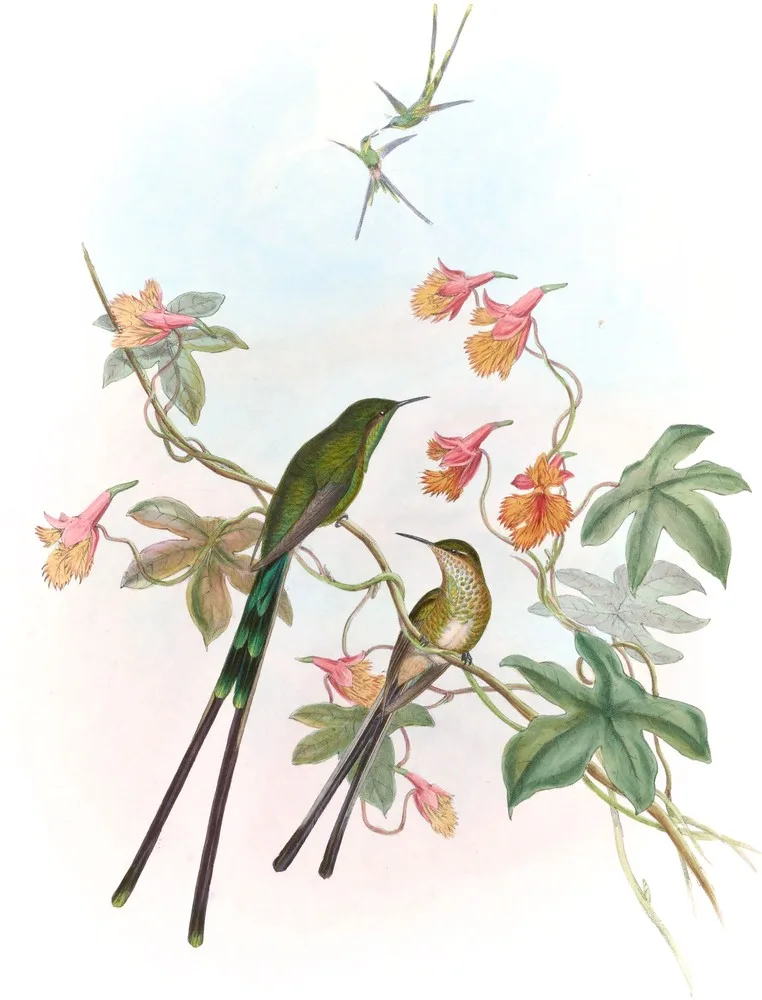
篱笆豆粉蝶
Lesbia eucharis
Lesbia eucharis
Train-bearer
- 中文名
- 篱笆豆粉蝶
- 学名
- Lesbia eucharis
- 合集
- 古尔德蜂鸟图谱
- 绘者
- John Gould(约翰·古尔德)
- 年代
- 1852
- 图版号
- Pl. 171, Vol. III
- 原书页码
- p.171
- 授权
- CC0 1.0 Universal (Public domain)
十观
- 纵幅 1.31∶1
第一眼
夫象物必在于形似,形似须全其骨气。
—— 唐·张彦远《历代名画记》
形似只是门槛,骨气才是要害。看一株植物,先看它立不立得住——这就是骨气。这一幅是竖的:眼睛从下往上走,落点在中段那只鸟身上。先别急着看羽毛,让姿态先立起来。第二步凑近一寸:看线与色的交界,色有没有压住线,线有没有断。第三步,把视线放到最深的那一小块:整幅的用色秩序,都是从那里排开的。
名与实
学名 Lesbia eucharis:前一词是属,管它归在哪一类;后一词是种加词,管它在这一类里凭什么与众不同。一百多年前的命名者,把一种植物的来历压进了两个词。中文名“篱笆豆粉蝶”是后人据学名回译的通行叫法,与古书里的旧名未必对得上——名与物之间,总隔着一层翻译。
形与色
翼小而振频极高,能悬停、能倒飞;羽色非颜料所致,是羽枝结构折射的光,随角度而变。此幅未作色相归档,只能就形制论。别只看花:叶脉的走向、萼片的长短、甚至茎上的毛,都是画家用来区分物种的证据。
构图与呼吸
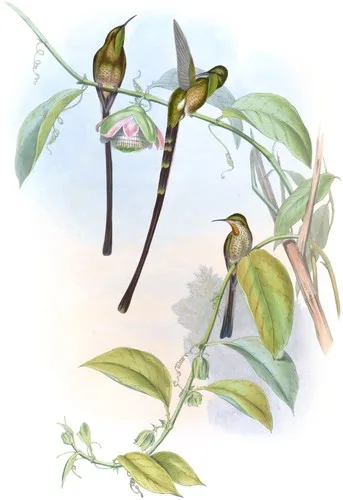
画幅高而窄,鸟栖在枝的中段,上下留白多——十九世纪鸟谱的标准版式,留给它飞走的余地。全幅只画一只,不作解剖附图——这类图更近于“观赏”,而非“鉴定”。试着用拇指遮住空白处——画面立刻变闷;放开,它才重新“喘上气”。留白,是给主体让出的气口。
一刀一色
十九世纪后半叶,石版与彩色石印渐成主流:颜色可以直接印出,不再依赖手工,线条反倒退居其次。图像的“准确”提高了,手性却淡了。先判断它是“印”的还是“画”的,再谈好不好看——这是看老版画最实用的一条规矩。想动笔临它的人记住一句:先铺大块的形与色,干后再收细部;石印的柔和层次来自薄涂与网点,水彩分两三遍淡铺即可逼近。
诗境
穿花蛱蝶深深见,点水蜻蜓款款飞。
—— 唐·杜甫《曲江二首》
中土无蜂鸟,然“穿花”之态,杜甫早已写过:贴着花心走,是采蜜者的共同姿态。诗以气行,画以形立;两种“看”叠在一起,才是看画的意思。
花语
阿兹特克以蜂鸟为战神与太阳的化身;欧洲维多利亚时代则以蜂鸟为收藏与装饰的极致,百万只羽毛被做成胸饰。中国旧籍无此鸟,故无象征——这空白本身,就是一部博物学交流史。象征多半来自形状与气味:像杯的、像泪的、香的、臭的——先有形状,后有意义。
时与地
热带美洲几乎全年可见,花期即其季节。仅产美洲,自阿拉斯加南部至火地岛,以安第斯山最为繁盛。中土无蜂鸟,汉籍不载,晚清海外游记始见其名。图上所记的 1852 年是刊行之年,不是采到那只鸟的年份;真正的观察记录通常比出版早一两年。同一株植物,春秋两季像两种东西;同一座山,一百年前与今天叫两个名字。图把这两样都冻结在了纸上。
书与人
《古尔德蜂鸟图谱》只署了约翰·古尔德一个人的名字。从画稿到成图要过好几双手:转刻的人求准,上色的人求快——快与准之间,就是各幅之间深浅不一的来历。
带走一双眼睛
鉴赏力不是知识,是习惯:每次多看一眼,十年之后你看什么都和别人不一样。图谱的用意是“以备查考”,看久了却会忘记查考:1852 年的一个人,为一只鸟花了整整一天。
关于本图版
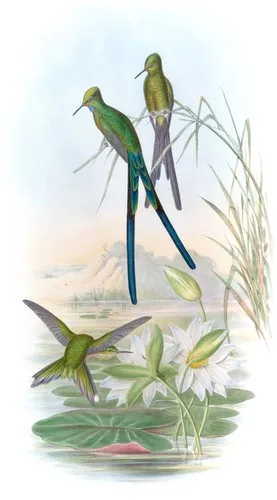
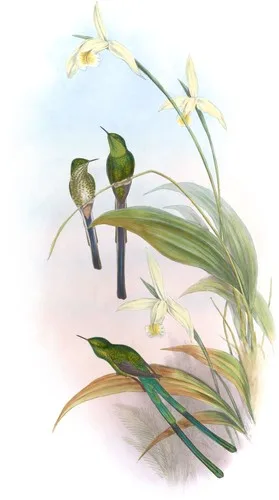
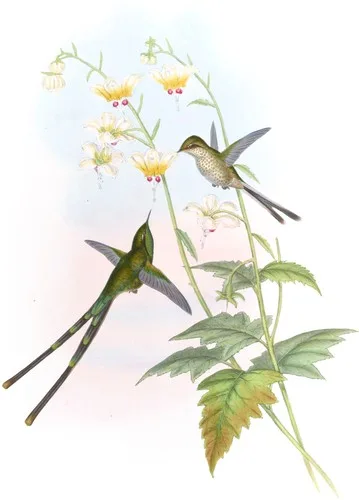
这幅图版出自《古尔德蜂鸟图谱》(Gould's Hummingbirds),由约翰·古尔德绘制,1849—1887 年间出版。篱笆豆粉蝶(Lesbia eucharis)是本图的主角,归入蜂鸟科(Trochilidae)。
全编共收录 421 幅图版,本图是其中一幅,原书将其列为 Pl. 171, Vol. III,见第 171 页,版式为纵幅。图为公有领域原件的修复扫描,构图与设色未经改动。
原书文字(英文 / 法文)
New Granada
It may be thought by some persons that the Leshia Eucharis and L. Amaryllis are one and the same species, but a comparison of the two birds will readily prove that such is not the case, and that M. Bourcier’s view of the subject in separating them was correct.
In the size of their bodies and in the length of their wings the two birds are very much alike; but the tail of the Amaryllis far exceeds in length that of Eucharis; its colour also is very different, particularly that of the eight middle feathers, these feathers being wholly green on that portion of their apical surface which projects beyond the next in succession, or all that portion of each feather which is not overlapped when the tail is closed. A glance at the eeu on the Plates of the two species will at once render this clear to the reader.
The precise country wherein this bird flies has not been satisfactorily ascertained: my own specimens, which, unfortunately, are not very good ones, were obtained by M. Warszewicz, I believe, in Peru; while “New Granada” is written on the label attached to M. Bourcier’s bird now before me. I have indeed two males belonging to this gentleman, one of which he believes to be the adult of the Nouna-Koali; but it will be seen, on reference to my account of that species, that I do not coincide in that view. The only difference observable in the two specimens is, that a bronzy hue pervades the upper part of the body and those portions of the tail which are green in Eucharis; but this difference is, I am sure, entirely due to its having been longer exposed to the light, that is, to a greater period having elapsed since its last moult; with this exception, I find no difference between them, either in the size of the body or the form of the markings, both having the same luminous gular patch that is found in the Amarylis, but very different from the smaller species, the Nuna, the Gouldi, and the gracilis.
My figure of the female is taken from one of the specimens brought by M. Warszewicz, which, it will be seen, very closely resembles the female of L. Amaryllis.
The male has the head, upper surface, wing-coverts, sides of the neck, abdomen, and flanks bronzy green; a gorget of luminous green on the throat; wings purplish black; tail deep brownish black, the eight middle tail-feathers largely tipped with green, and the outer one tipped with bronzy green; these feathers moreover have the basal half of their outer webs of a pinky buff; under tail-coverts buff, glossed with bronze; bill black.
The female is similar to the male on the upper surface, but her tail is much shorter and less brilliant, and the apical three-fourths of the basal portion of the web of the outer feather greyish white; under surface buff, spangled with shining green.
The Plate represents the two sexes of the size of life. The plant is the Topæolum Smithi.
References
- Trochilus Eucharis, Boure. Rev. Zool. 1848, p.
- Lesbia Eucharis, Reichenb. Auf. der Col., p. 8.
- Cynanthus eucharis, Bonap. Rev. et Mag. de Zool. 1854, p. 252.