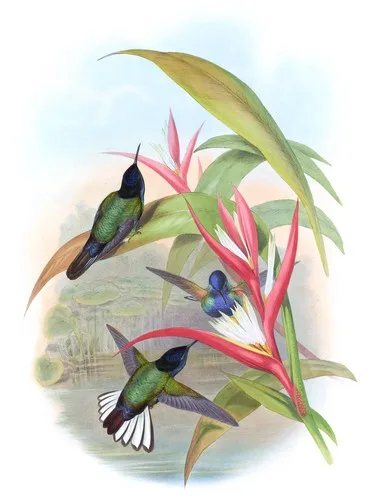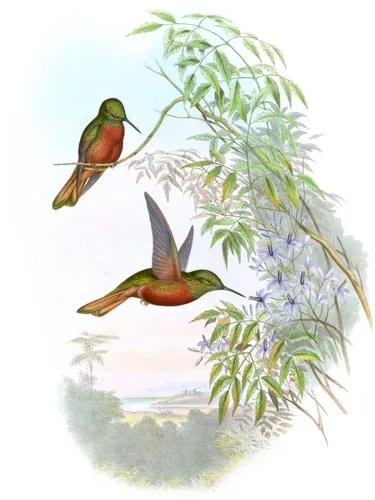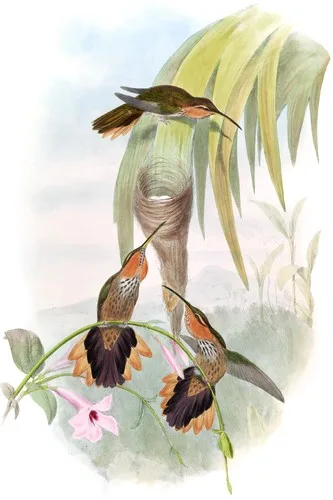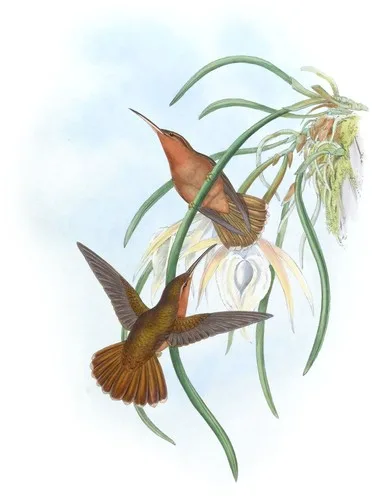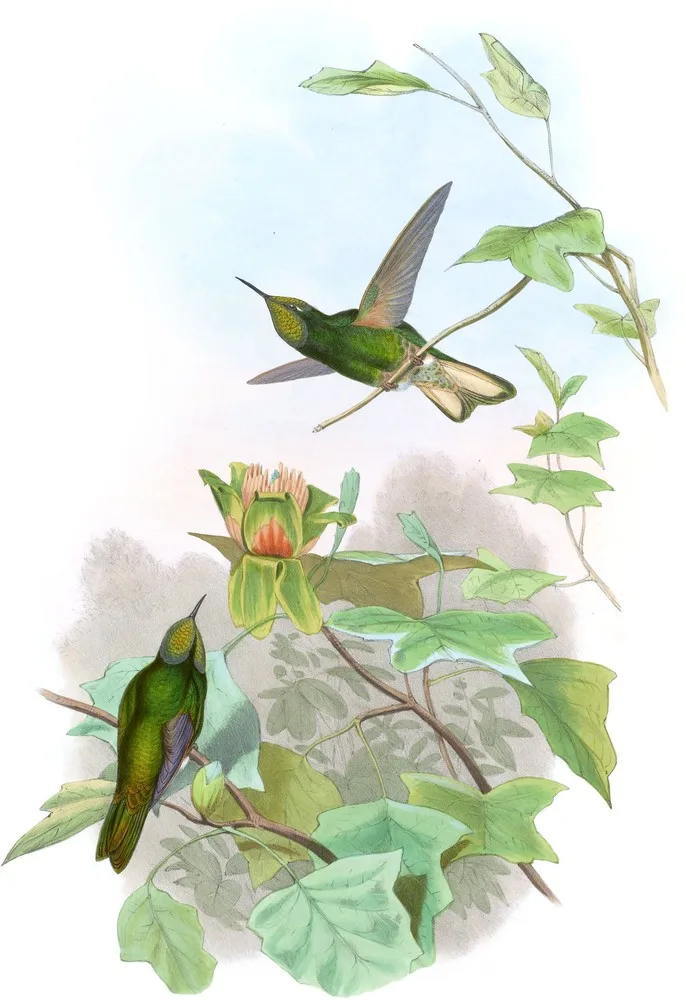
Panoplites flavescens
Panoplites flavescens
Yellow-fronted Panoplites
- 学名
- Panoplites flavescens
- 合集
- 古尔德蜂鸟图谱
- 绘者
- John Gould(约翰·古尔德)
- 年代
- 1850
- 图版号
- Pl. 111, Vol. II
- 原书页码
- p.111
- 授权
- CC0 1.0 Universal (Public domain)
十观
- 纵幅 1.46∶1
第一眼
搜尽奇峰打草稿。
—— 清·石涛《苦瓜和尚画语录》
走遍山川,才有资格落笔。博物画的画家也一样:先在温室与山野里看够了活的花,纸上那一朵才不虚。这一幅是竖的:眼睛从下往上走,落点在中段那只鸟身上。先别急着看羽毛,让姿态先立起来。第二步凑近一寸:看线与色的交界,色有没有压住线,线有没有断。第三步,把视线放到最深的那一小块:整幅的用色秩序,都是从那里排开的。
名与实
学名 Panoplites flavescens:前一词是属,管它归在哪一类;后一词是种加词,管它在这一类里凭什么与众不同。名字是通行证,也是懒办法——记住两个词,就抓住了一整个物种。此幅尚无通行中文名,姑以学名相称;在没有本地名字的地方,学名就是它唯一的身份证。
形与色
蜂鸟为美洲最小之鸟,喙细长如针,舌分叉成管,可伸入花心吸蜜;翼小而振频极高,能悬停、能倒飞。此幅未作色相归档,只能就形制论。看形制不必求全:记住喙形、翼式与栖姿,这一类的骨架就立住了。
构图与呼吸
画幅高而窄,鸟栖在枝的中段,上下留白多——十九世纪鸟谱的标准版式,留给它飞走的余地。全幅只画一只,不作解剖附图——这类图更近于“观赏”,而非“鉴定”。空白不是没画完,是给眼睛留的落脚处:一张图若四边都塞满,花反而会闷。
一刀一色
十九世纪后半叶,石版与彩色石印渐成主流:颜色可以直接印出,不再依赖手工,线条反倒退居其次。图像的“准确”提高了,手性却淡了。工艺留下的破绽比题跋更诚实:刻工不会撒谎,上色的人赶时间的时候会。想动笔临它的人记住一句:先铺大块的形与色,干后再收细部;石印的柔和层次来自薄涂与网点,水彩分两三遍淡铺即可逼近。
诗境
穿花蛱蝶深深见,点水蜻蜓款款飞。
—— 唐·杜甫《曲江二首》
中土无蜂鸟,然“穿花”之态,杜甫早已写过:贴着花心走,是采蜜者的共同姿态。把这一句放回画面:画面就是诗句的落点——诗先写气,画后写形,两者在此处接上了。
花语
阿兹特克以蜂鸟为战神与太阳的化身;欧洲维多利亚时代则以蜂鸟为收藏与装饰的极致,百万只羽毛被做成胸饰。中国旧籍无此鸟,故无象征——这空白本身,就是一部博物学交流史。象征多半来自形状与气味:像杯的、像泪的、香的、臭的——先有形状,后有意义。
时与地
热带美洲几乎全年可见,花期即其季节。仅产美洲,自阿拉斯加南部至火地岛,以安第斯山最为繁盛。中土无蜂鸟,汉籍不载,晚清海外游记始见其名。图上所记的 1850 年是刊行之年,不是采到那只鸟的年份;真正的观察记录通常比出版早一两年。同一株植物,春秋两季像两种东西;同一座山,一百年前与今天叫两个名字。图把这两样都冻结在了纸上。
书与人
《古尔德蜂鸟图谱》只署了约翰·古尔德一个人的名字。从画稿到成图要过好几双手:转刻的人求准,上色的人求快——快与准之间,就是各幅之间深浅不一的来历。
带走一双眼睛
鉴赏力不是知识,是习惯:每次多看一眼,十年之后你看什么都和别人不一样。1850 年的那只鸟早已化作尘土,它留在纸上的样子,却比任何一只活着的同类都长寿。
关于本图版
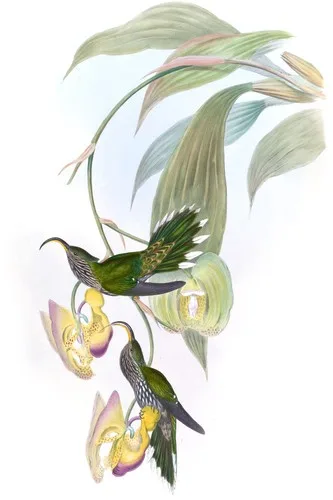
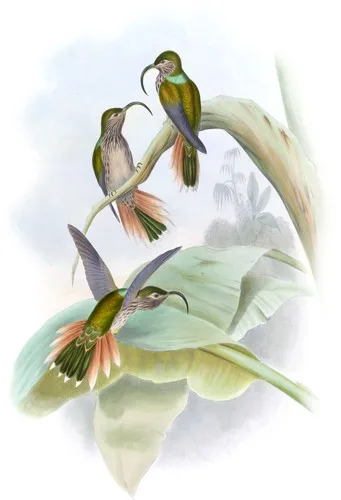
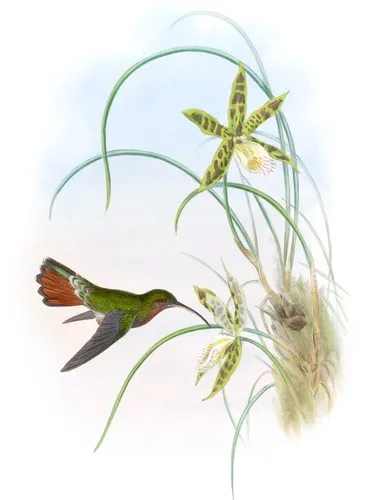
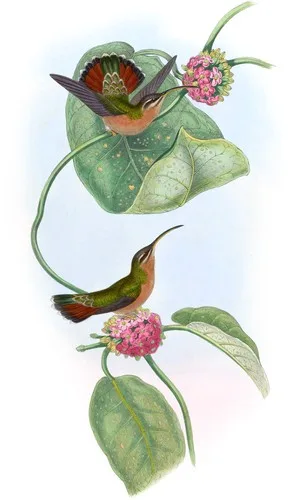
这幅图版出自《古尔德蜂鸟图谱》(Gould's Hummingbirds),由约翰·古尔德绘制,1849—1887 年间出版。图中描绘的是 Panoplites flavescens,归入蜂鸟科(Trochilidae)。
全编共收录 421 幅图版,本图是其中一幅,原书将其列为 Pl. 111, Vol. II,见第 111 页,版式为纵幅。图为公有领域原件的修复扫描,构图与设色未经改动。
原书文字(英文 / 法文)
Ecuador and New Granada
In all probability the first example of this bird which reached this country was the one forwarded to me direct from Popayan in 1830. It was from this specimen that Mr. Loddiges took his description of the species, which appeared in the Proceedings of the Committee of Science and Correspondence of the Zoological Society for 1832.
That the bird enjoys a wide range of habitat is evidenced by the circumstance of its being found in more or less abundance in various and distant localities along the line of the Western Andes: thus, as already mentioned, I have myself received it from Popayan; M. Bourcier met with it in Ecuador; it is one of the commonest of the numerous species sent from Bogota; and that it inhabits countries still farther north, we know from the circumstance of M. Warszewicz having collected specimens near the Isthmus of Panama. Mr. Mark, Her Majesty’s Consul at Bogota, informs me that it is found about two days’ journey from that city, particularly near the villages of Guaduas and Fusugasuga, and that it is very generally dispersed over this elevated region at an altitude of from three thousand five hundred to six thousand feet above the sea-level, where the thermometer ranges from seventy to eighty degrees.
The Panoplites flavescens is one of the commonest of the Andean Humming Birds that is sent to Europe. Differences occasionally occur in the colouring of the specimens we receive, some having the crown and throat splendid metallic greenish yellow, relieved by a darker olive-green hue on the neck and chest, and other specimens, probably younger birds, having a lighter and more uniform cast of plumage. In form the bird is precisely like the P. Jardinei, and, as will be seen on comparing the figures of the two species, has a similarly marked and lightly coloured tail. I have not been able to detect any difference in the colouring of the sexes, and I believe they are only to be distinguished by actual dissection.
Crown of the head and throat luminous yellowish green; plumage of the upper and under surface and wing-coverts dark green; wings brownish purple; under surface of the shoulder and the axille rufous; vent buffy white; thighs clothed with somewhat lengthened white feathers; central tail-feathers greenish bronze, the remainder delicate buff, broadly margined externally and round the tip with greenish bronze; bill black.
The figures are of the natural size.
References
- Trochilus flavescens, Lodd. in Proc. of Comm. of Sci. and Corr. of Zool. Soc., Part xi. p. 7.
- Ormsnua paradisea, Boiss. Rey. Zool. 1840, p. 6.
- Mellisuga flavescens, Gray and Mitch. Gen. of Birds, vol. i. p. 112, Mellisuga, sp. 26.
- Amazilius flavescens, Bonap. Consp. Gen. Av., p. 78, Amazilius, sp. 9.
- Clytolema flavescens, Bonap. Consp. Troch. in Rev. et Mag. de Zool. 1854, p. 254.