Panoplites Jardinei
Panoplites Jardinei
Jardine’s Panoplites
- 学名
- Panoplites Jardinei
- 合集
- 古尔德蜂鸟图谱
- 绘者
- John Gould(约翰·古尔德)
- 年代
- 1850
- 图版号
- Pl. 110, Vol. II
- 原书页码
- p.110
- 授权
- CC0 1.0 Universal (Public domain)
关于本图版
本图选自约翰·古尔德的《古尔德蜂鸟图谱》(Gould's Hummingbirds),原书 1849—1887 年间出版。原书题作“Panoplites Jardinei”,在分类体系中列于蜂鸟科(Trochilidae)。
该合集全编共 421 幅图版,此图为其中之一,图版编号 Pl. 110, Vol. II,对应原书第 110 页,版式为纵幅。图为公有领域原件的修复扫描,构图与设色未经改动。
原书文字(英文 / 法文)
Nanegal and other warm parts of Ecuador
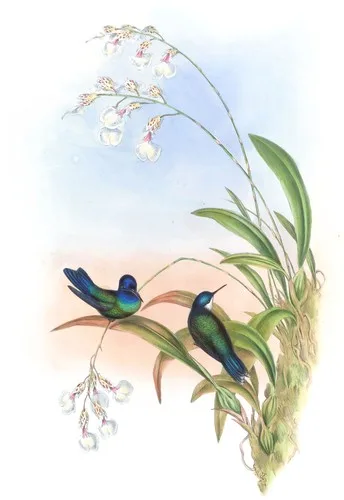
The accompanying Plate is intended to represent one of the most beautiful of the Trochilidæ yet discovered; I say intended, for whatever success may have attended my attempts to convey an idea of the beauty of these exquisite living gems, I must confess that the means at my command are utterly inadequate to do justice to the present species, whose crown, back, shoulders and chest-sides are clothed with hues of metallic blue and green of such resplendent brilliancy, that it is quite impossible to represent them upon paper; those therefore of my readers who may wish to view them, must seek an opportunity for attentively examining the birds themselves.
The native country of this glittering gem is the temperate regions of Ecuador, where, in certain localities, it is tolerably common. It is still, however, a rare bird in Europe, and there are few collections which comprise examples, and none, I believe, so fine as those contained in my own. For these I am indebted to my good friend Professor Jameson, of Quito, a gentleman of high scientific attainments, and who has largely contributed to our knowledge of the Zoology and Botany of the rich district in which he resides. That he may have still a long life to enjoy, is, I am sure, the sincere wish of all his scientific friends and correspondents; among whom is included one whose name is familiar to every zoologist, as that of an ardent lover of natural history, and who has spent the greater part of his life in the promotion of its cause; need I add that I allude to Sir William Jardine, Bart., after whom this lovely bird has been named, by M. Bourcier, of Paris, as a just tribute to his merits as a naturalist.
M. Bourcier, who first brought the species to Europe, states that the bird inhabits the hot regions of the great forests in the environs of Nanégan. In the letter accompanying the specimens transmitted by Professor Jameson, he says:
Having from time to time procured from collectors a considerable number of fine species of Trochilidæ from an extensive forest about two days’ journey distant from Quito, I could no longer resist my inclination to visit that part of the country; and as I particularly wished to ascertain the precise localities frequented by the more interesting species, I determined at once to carry my project into effect, and only regretted that you were not here to accompany me. You are aware that explorations in these countries are achieved at the expense of great bodily fatigue; the journey on foot usually commences at the upper boundary of the forest, say at 10,000 feet, and is continued downwards to that of 4000 above the sea-level. The Trochilidæ observed at the first-mentioned elevation, were Eriocnemis Luciani, Aglæactis cupripennis and Helianthea Lutetiæ, all feeding on the flowers of the Syphocampylus giganteus. A little lower down, another species, unknown to me, frequented the flowers of different species of Fuchsia; and at a station 6000 feet, where I remained for the night, I saw for the first time that magnificent species named Jardini. It was by no means uncommon, and I shot a splendid specimen on a tree belonging to the family Myrtaceæ, which appeared to be its favourite haunt. From the height of the tree I could not reach the blossoms; all I could do was to procure a branch with the leaves, which are rather large.
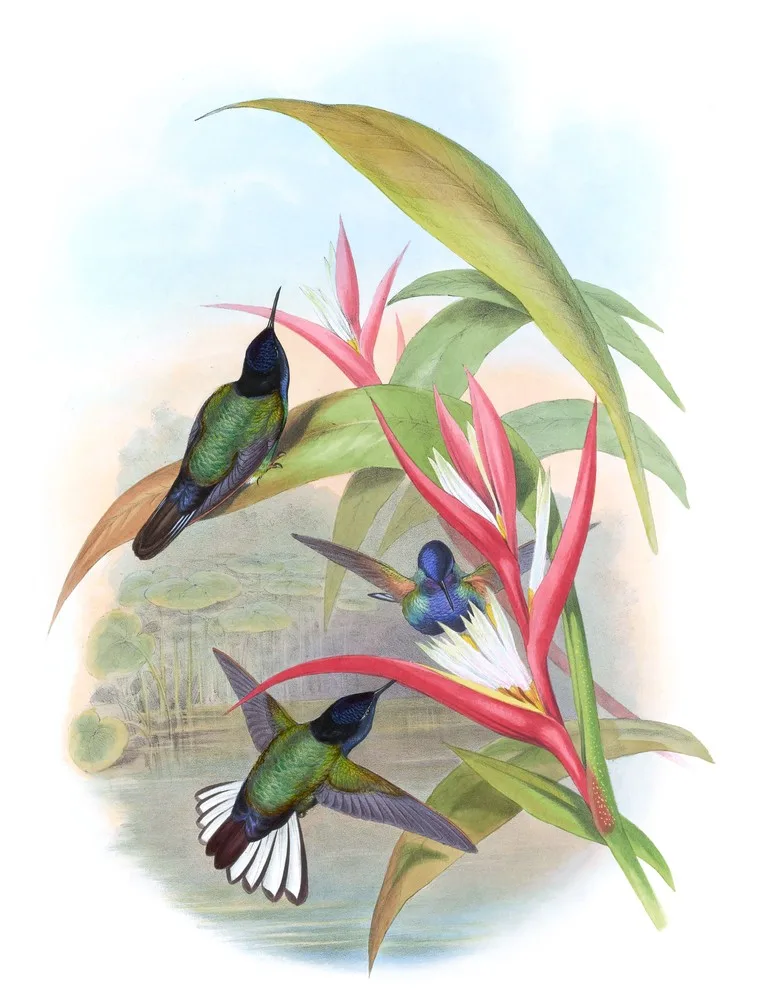
Crown of the head shining violet-blue; back and sides of the neck velvety black; upper surface luminous metallic-bluish verditer green; wing-coverts shining yellowish green, passing into bronzy green towards the primaries; wings dark brownish purple; throat, breast and abdomen violet-blue, bordered on the sides of the neck and flanks with glittering green; under surface of the shoulder rust-red; lower part of the flanks, vent and under tail-coverts dusky black, the latter tipped with white; two centre tail-feathers dark bronzy purple, the remainder white, each margined externally and tipped with dull greenish black; upper tailcoverts dull bluish purple; bill black.
After a careful examination of the specimens, I believe that the sexes of this and the other species of the genus do not differ in their plumage.
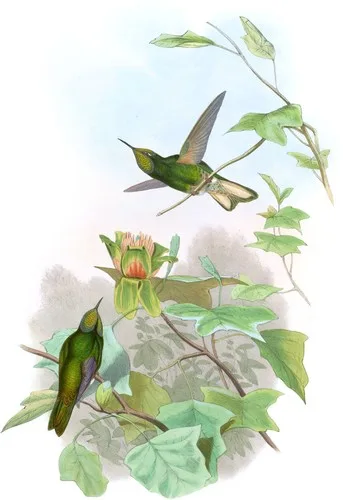
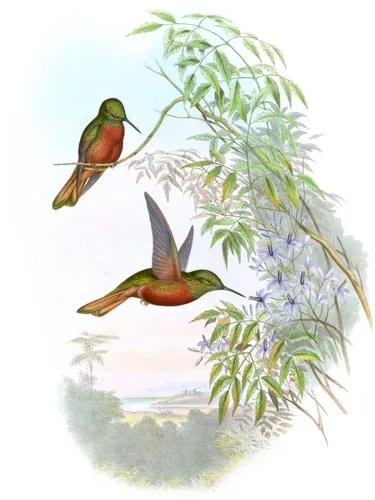
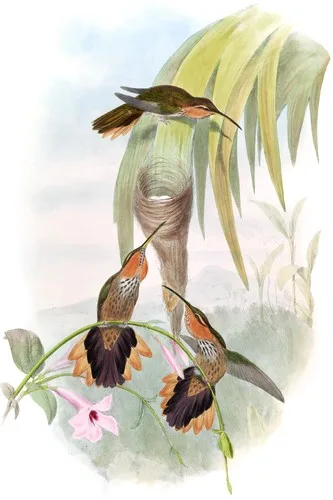
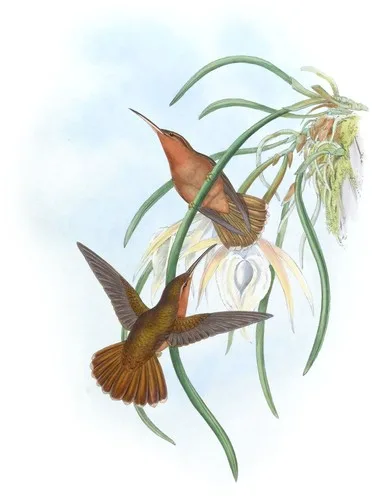
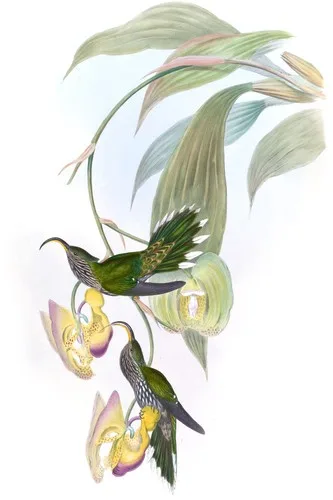
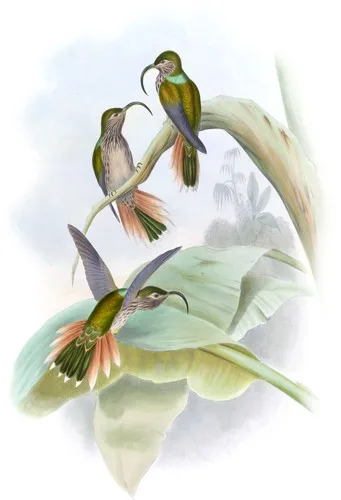
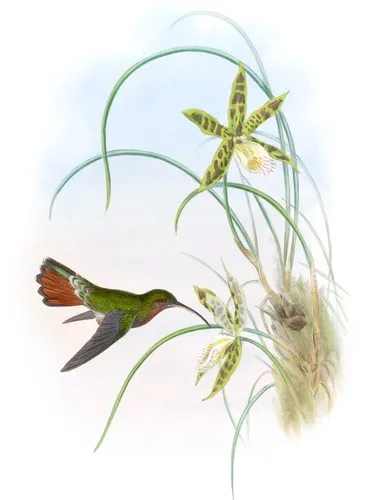
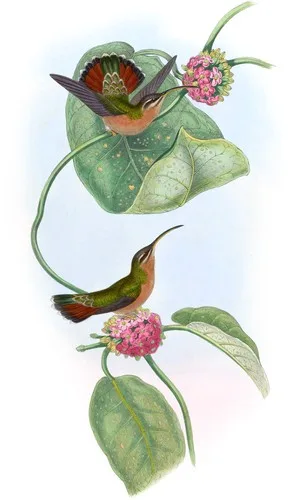
The figures are of the natural size. The plant is a species of Heliconia.
References
- Trochilus Jardini, Bourc. Comptes rendus de Acad. des Sci., tom. xxxii. p. 187.
- Florisuga jardinii, Bonap. Consp. Troch. in Rey. et Mag. de Zool. 1854, p. 253.
十二观
- 纵幅 1.31∶1
- 1850 年刊
- 图版 110, Vol. II
这不是词条,是一条看画的次序:先站定看整体,再看名字与形色、构图与刀工,然后问它几时开、从哪里来、经了谁的手;最后是中国诗文——同一朵花,中国古人是怎么看的。十二观读完,这幅图就打开了。
-
第一眼
真山水之川谷,远望之以取其势,近看之以取其质。
—— 宋·郭熙《林泉高致·山水训》
远看取其气势,近看取其质地。八个字,就是看画的两步:先退后看整体,再凑近看笔与色。看花鸟图版一样管用。这一幅是竖的:眼睛从下往上走,落点在中段那只鸟身上。先别急着看羽毛,让姿态先立起来。第二步凑近一寸:看线与色的交界,色有没有压住线,线有没有断。第三步,把视线放到最深的那一小块:整幅的用色秩序,都是从那里排开的。
-
名与实
学名 Panoplites jardinei:前一词是属,管它归在哪一类;后一词是种加词,管它在这一类里凭什么与众不同。双名制的好处是唯一:全世界叫这个名字的,只能是这一种。此幅尚无通行中文名,姑以学名相称;在没有本地名字的地方,学名就是它唯一的身份证。
-
形与色
翼小而振频极高,能悬停、能倒飞;羽色非颜料所致,是羽枝结构折射的光,随角度而变。此幅未作色相归档,只能就形制论。颜色不是平涂的:最浅处近乎纸色,最深处在花瓣重叠的缝里。把这两处找到,画面的呼吸就出来了。
-
构图与呼吸
画幅高而窄,鸟栖在枝的中段,上下留白多——十九世纪鸟谱的标准版式,留给它飞走的余地。(高宽比约 1.31∶1)全幅只画一只,不作解剖附图——这类图更近于“观赏”,而非“鉴定”。空白不是没画完,是给眼睛留的落脚处:一张图若四边都塞满,花反而会闷。
-
一刀一色
十九世纪后半叶,石版与彩色石印渐成主流:颜色可以直接印出,不再依赖手工,线条反倒退居其次。图像的“准确”提高了,手性却淡了。工艺留下的破绽比题跋更诚实:刻工不会撒谎,上色的人赶时间的时候会。
-
时序
热带美洲几乎全年可见,花期即其季节;温带种类的蜂鸟则随花北迁,一年往返数千公里。图上所记的 1850 年是刊行之年,不是采到那只鸟的年份;真正的观察记录通常比出版早一两年。要判断一幅图的季节,不必看题跋:看叶的老嫩、花与果是否同在枝上,也就八九不离十了。
-
故土
仅产美洲,自阿拉斯加南部至火地岛,以安第斯山最为繁盛。中土无蜂鸟,汉籍不载,晚清海外游记始见其名。今天再看,图上的产地已是一百多年前的产地;植物会迁徙,地方也会改名字。
-
书与人
《古尔德蜂鸟图谱》(Gould's Hummingbirds)由约翰·古尔德绘,成于1849-1887。此幅为其中图版 110, Vol. II,见原书第 110 页。图版今属公有领域,可以自由取用;但纸上那层手工上色,仍是两百年前某一个人的手。
-
诗境
穿花蛱蝶深深见,点水蜻蜓款款飞。
—— 唐·杜甫《曲江二首》
中土无蜂鸟,然“穿花”之态,杜甫早已写过:贴着花心走,是采蜜者的共同姿态。古人写到这一层,已不只是赏花,是借花说人;画面则只负责把那朵花留住。
-
文心
竖划三寸,当千仞之高;横墨数尺,体百里之迥。
—— 南朝宋·宗炳《画山水序》
三寸的竖线可当千仞高山,几尺横墨能容百里之远。一只蜂鸟只有拇指大,画家却要在几厘米里放下整片花丛——尺度从来不是障碍。古尔德《蜂鸟图谱》(1849—1887)以石版手工上色,金箔衬底,使羽色在纸上仍有金属光;这套图册本身就是十九世纪印刷与收藏狂热合流的产物。记住这一句,下次在别处见到同类,它会自己浮上来——鉴赏力就是这样一句一句攒出来的。
-
花语
阿兹特克以蜂鸟为战神与太阳的化身;欧洲维多利亚时代则以蜂鸟为收藏与装饰的极致,百万只羽毛被做成胸饰。中国旧籍无此鸟,故无象征——这空白本身,就是一部博物学交流史。花语是后人添上去的,花本身并不知道;但这层“不知道”,正是它最动人的地方。
-
带走一双眼睛
鉴赏力不是知识,是习惯:每次多看一眼,十年之后你看什么都和别人不一样。图谱的用意是“以备查考”,看久了却会忘记查考:1850 年的一个人,为一只鸟花了整整一天。