巨蜂鸟
Patagona gigas
Patagona gigas
Giant Humming Bird
- 中文名
- 巨蜂鸟
- 学名
- Patagona gigas
- 合集
- 古尔德蜂鸟图谱
- 绘者
- John Gould(约翰·古尔德)
- 年代
- 1854
- 图版号
- Pl. 232, Vol. IV
- 原书页码
- p.232
- 授权
- CC0 1.0 Universal (Public domain)
关于本图版
《古尔德蜂鸟图谱》(Gould's Hummingbirds)由约翰·古尔德绘制,1849—1887 年间印行,本图即其中一幅。图中描绘的是巨蜂鸟,学名 Patagona gigas,在分类体系中列于蜂鸟科(Trochilidae)。
该合集全编共 421 幅图版,此图为其中之一,图版编号 Pl. 232, Vol. IV,对应原书第 232 页,版式为纵幅。图像由公有领域原件扫描修复而来,细节在放大视图中仍清晰可辨。
原书文字(英文 / 法文)
Ecuador, Peru, Bolivia, and Chile
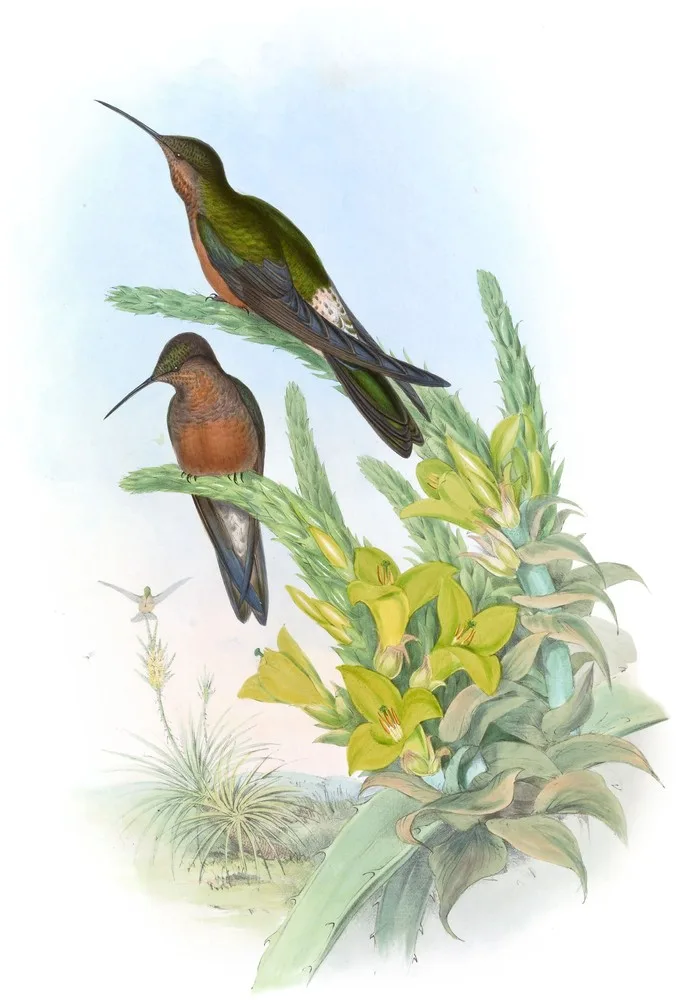
The figures on the accompanying Plate give a faithful representation, the size of life, of this the largest of the Humming Birds, which has been truly designated as the giant of its family, for by no other species is it approached in size.
It is said to be a bold and vigorous flier, to be quick in all its actions, and to pass from flower to flower with the greatest rapidity, notwithstanding the length and volume of its wings, which would seem to be far better adapted for lengthened and continuous progress than for poising in the air, which the bird is in constant habit of doing while visiting, with little choice of species, the numerous flowers of the forest, and among others the Cacti. It is stated, that, unlike the other species of the family, it may be frequently seen perched on some small tree or shrub. It enjoys an extensive range of habitat over the southernmost portions of South America, being found in most parts of Bolivia, Southern Peru and Chili.
M. Lesson states, that it inhabits the forests in the interior of Chili, and that it advances into the country of the Araucanos, the wild Pampas of the Puelches, to the south of Old Chili, and to the foot of the Andes. M. Warszewicz collected specimens in Bolivia, at an elevation of from 12,000 to 14,000 feet. Mr. Bonelli informs me, that “it annually visits in abundance the villa grounds of General Santa Cruz near La Paz, and that it goes as far to the eastward as Chuquesaca; procures its insect food from maize, barley, and various leguminous plants; flies about all the shrubs with such rapid motions and quick turns that it is extremely difficult to procure examples; and dwells in all the temperate and colder regions of La Paz.” Mr. Cuming tells me that in Chili it is strictly migratory, arriving from the north in August; and, after spending three months in that country, during which it breeds, returns to whence it came.
Of this form I consider but one species has yet been discovered, for, although some slight difference in colouring has occurred in the many specimens which have come under my notice, I regard them all as identical; the principal difference being in the colouring of the abdomen, which in some is sandy red, in others olive and brown.
There appears to be little difference in the colouring of the sexes; less, in fact, than in size, for the female is very much smaller than her mate.
The nest is a somewhat large cup-shaped structure, composed of mosses, lichens and similar materials put together with cobwebs, and placed in the fork of a branch of some tree or shrub, generally on one overhanging a turbulent stream of water. The eggs are white, two in number, of the usual lengthened form, and about three-quarters of an inch from end to end.
The Patagona gigas has now become very common, and examples may be seen in nearly every Collection.
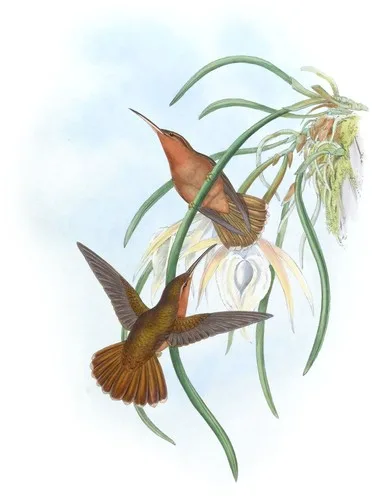
Head and all the upper surface pale brown, glossed with green; wings and tail similar but somewhat darker, and the green gloss more conspicuous, especially on the tail-feathers; basal portion of the shafts of the lateral feathers white; an irregular patch of white on the rump; upper tail-coverts narrowly fringed with white; breast mottled brown and buff; throat and abdomen rusty red; under tail-coverts white, with a wash of brown in the centre of each; bill blackish brown; feet brown.
The figures are the size of life. The plant is the Puya Chilensis.
References
- Trochilus gigas, Vieill. Gal. des Ois., tom. i. p. 296. pl. 180.—Ib. Ois. dor., tom. iti. inedit. pl. 25.—Jard. Nat. Lib. Humming Birds, vol. ii. p. 50. pl. 3.
- Ornysmya tristis, Less. Hist. Nat. des Ois. mou., p. xi. & 43. pl. 3.—Ib. Ind. Gen. et Syn. des Ois. du Genre Trochilus, p. Iv.
- Cynanthus tristis, Ib. Traité d’Orn., p. 272.
- Ormsmya giganteus, D’Orb. et LaFres.
- Patagona gigas, G. R. Gray, List of Gen. of Birds, 2nd edit., p. 18.—Bonap. Consp. Gen. Av., p. 75.—Ib. Rev. et Mag. de Zool. 1854, p. 251.—Reichenb. Aufz. der Colibris, p. 14.
- Hylocharis gigas, Gray and Mitch. Gen. of Birds, vol. i. p. 114, Hylocharis, sp. 1.
十二观
一幅图版,分十二个角度来读:名物、形色、刀笔、构图、时序、故土、谱系、花语、诗境、典故、观法、余韵。前七观是它的来历,后五观是它的余味。
-
名物考
原书题作「Patagona gigas」,编为图版 232, Vol. IV(原书第 232 页)。学名“Patagona gigas”。双名制里,属名指其类,种加词多取产地、形态或受赠者之名——一百多年前的命名者,把一种生物的来历压进了两个词。中文名“巨蜂鸟”是后人据学名回译的通行叫法,与古书里的旧名未必对得上;名与物之间,总隔着一层翻译。
-
形与色
蜂鸟为美洲最小之鸟,喙细长如针,舌分叉成管,可伸入花心吸蜜;翼小而振频极高,能悬停、能倒飞;羽色非颜料所致,是羽枝结构折射的光,随角度而变。此幅未作色相归档;看它的形制,仍能读出那个季节的用色习惯。此幅只画一株,形制的每一处都摊在纸面上,没有遮掩。
-
刀笔与色层
十九世纪后半叶,石版与彩色石印渐成主流:颜色可以直接印出,不再依赖手工,线条反倒退居其次。图像的“准确”提高了,手性却淡了。此幅的线条与色块,可以拿放大镜看:线若连续不断,是刻的;色若溢出轮廓半毫米,是手涂的。工艺留下的破绽,比题跋更诚实。
-
构图与留白
画幅高而窄,主株一路向上,上下留白多,是图谱中最常见的立轴式构图。(画幅高宽比约 1.48∶1)全幅只画一株,不作解剖附图——这类图更近于“观赏”,而非“鉴定”。
-
时序
热带美洲几乎全年可见,花期即其季节;温带种类的蜂鸟则随花北迁,一年往返数千公里。图上所记的 1854 年是刊行之年,不是花期;真正的花期藏在原书的采集记录里,比出版早一两年。
-
故土
仅产美洲,自阿拉斯加南部至火地岛,以安第斯山最为繁盛。中土无蜂鸟,汉籍不载,晚清海外游记始见其名。今天再看,图上的产地已是一百多年前的产地;植物会迁徙,地方也会改名字。
-
谱系
《古尔德蜂鸟图谱》(Gould's Hummingbirds)由约翰·古尔德绘,成于1849-1887。此幅为其中图版 232, Vol. IV,见原书第 232 页。图版今属公有领域,可自由取用;但纸上那层手工上色,仍是两百年前某一个人的手。
-
花语与象征
阿兹特克以蜂鸟为战神与太阳的化身;欧洲维多利亚时代则以蜂鸟为收藏与装饰的极致,百万只羽毛被做成胸饰。中国旧籍无此鸟,故无象征——这空白本身,就是一部博物学交流史。象征会随世道改口:同一种花,在一个世纪里可以说完全相反的话。
-
诗境
夫列子御风而行,泠然善也,旬有五日而后反。
—— 《庄子·逍遥游》
蜂鸟悬停于空,不落不飞,最近于“御风”。庄子说的是一种自由的姿态,蜂鸟把它做成了生理事实。把这一句放回画面,画面就是诗句的落点——诗先写气,画后写形,两者在此处接上了。
-
典与谱
古尔德《蜂鸟图谱》(1849—1887)以石版手工上色,金箔衬底,使羽色在纸上仍有金属光;这套图册本身就是十九世纪印刷与收藏狂热合流的产物。中国的花谱重品第与品格,欧洲的植物志重形态与命名;此图站在后一条线上,却也经得起前一种眼光——毕竟看花的人,两样都要。图谱求准,花谱求品;把两种读法叠在一起,才不至于只看懂一半。
-
观法
看喉部与背部的金属光:那是结构色,画家须用金箔或叠色才追得上;再看舌与喙的比例,长喙者多取深管花,短喙者取浅花——鸟与花是配套演化的。别忘了看题名与编号:它们不是画面的一部分,却是这幅图进入知识体系的入口。
-
余韵
图谱的用意是“以备查考”,看久了却会忘记查考:1854 年的一个人,为一只鸟花了整整一天。