Sporadinus Riccordi
Sporadinus Riccordi
Riccord’s Humming-Bird
- 学名
- Sporadinus Riccordi
- 合集
- 古尔德蜂鸟图谱
- 绘者
- John Gould(约翰·古尔德)
- 年代
- 1861
- 图版号
- Pl. 348, Vol. V
- 原书页码
- p.348
- 授权
- CC0 1.0 Universal (Public domain)
十观
- 略纵 1.13∶1
第一眼
六法者何?一、气韵生动是也;二、骨法用笔是也;三、应物象形是也;四、随类赋彩是也;五、经营位置是也;六、传移模写是也。
—— 南齐·谢赫《古画品录》
一千五百年前的六条标准:气韵、用笔、形似、设色、构图、临摹。你在这幅图上一样样对过去,就是一次完整的读画。这一幅略高于宽,落点在中央偏上那只鸟的头部。第二步凑近一寸:看线与色的交界,色有没有压住线,线有没有断。第三步,把视线放到最深的那一小块:整幅的用色秩序,都是从那里排开的。
名与实
学名 Sporadinus riccordi:前一词是属,管它归在哪一类;后一词是种加词,管它在这一类里凭什么与众不同。名字是通行证,也是懒办法——记住两个词,就抓住了一整个物种。此幅尚无通行中文名,姑以学名相称;在没有本地名字的地方,学名就是它唯一的身份证。
形与色
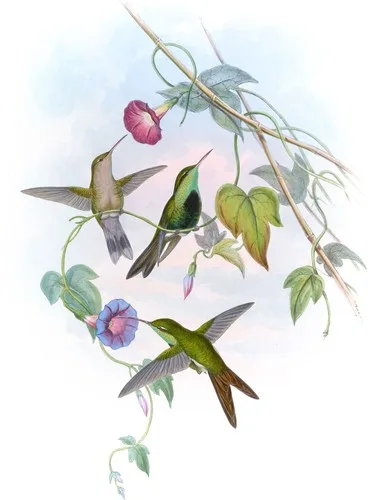
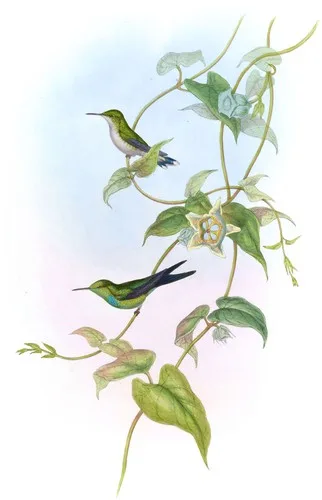
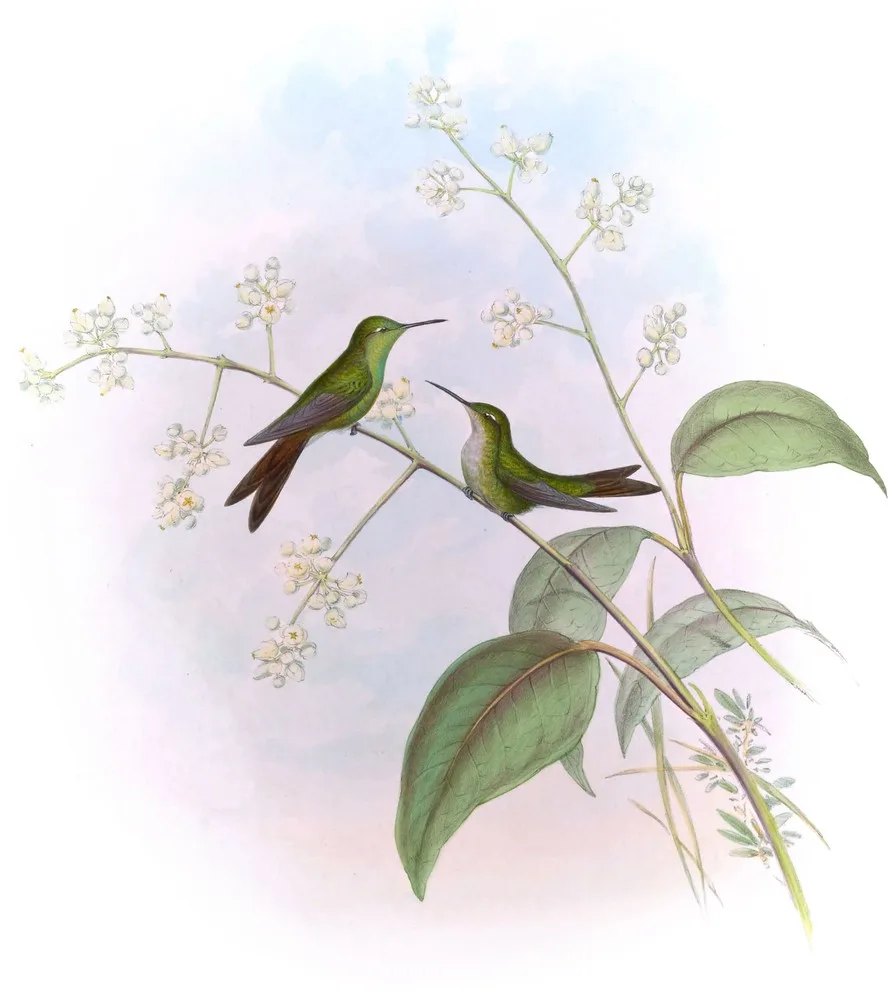
翼小而振频极高,能悬停、能倒飞;羽色非颜料所致,是羽枝结构折射的光,随角度而变。此幅未作色相归档,只能就形制论。此幅只画一个种,形制的每一处都摊在纸面上,没有遮掩。
构图与呼吸
画幅略高于宽,鸟身居中偏上,视线落在头部与喙。全幅只画一只,不作解剖附图——这类图更近于“观赏”,而非“鉴定”。老图谱爱把主株摆在偏中线的位置,左右留得不一样多:这一点偏心,正是画面活起来的原因。
一刀一色
十九世纪后半叶,石版与彩色石印渐成主流:颜色可以直接印出,不再依赖手工,线条反倒退居其次。图像的“准确”提高了,手性却淡了。拿放大镜(或手机微距)看三处:喙缘、覆羽、题名。线若连续不断,是刻的;色若越过轮廓半毫米,是手涂的。想动笔临它的人记住一句:先铺大块的形与色,干后再收细部;石印的柔和层次来自薄涂与网点,水彩分两三遍淡铺即可逼近。
诗境
夫列子御风而行,泠然善也,旬有五日而后反。
—— 《庄子·逍遥游》
蜂鸟悬停于空,不落不飞,最近于“御风”。庄子说的是一种自由的姿态,蜂鸟把它做成了生理事实。把这一句放回画面:画面就是诗句的落点——诗先写气,画后写形,两者在此处接上了。
花语
阿兹特克以蜂鸟为战神与太阳的化身;欧洲维多利亚时代则以蜂鸟为收藏与装饰的极致,百万只羽毛被做成胸饰。中国旧籍无此鸟,故无象征——这空白本身,就是一部博物学交流史。象征会随世道改口:同一只鸟,在一个世纪里可以说完全相反的话。
时与地
热带美洲几乎全年可见,花期即其季节。仅产美洲,自阿拉斯加南部至火地岛,以安第斯山最为繁盛。中土无蜂鸟,汉籍不载,晚清海外游记始见其名。图上所记的 1861 年是刊行之年,不是采到那只鸟的年份;真正的观察记录通常比出版早一两年。那一代人对这类鸟的知识,多半来自标本与笼养。看这一类图,不妨把产地和季节都当“据说”来读。
书与人
《古尔德蜂鸟图谱》只署了约翰·古尔德一个人的名字。版画是集体工程:绘图、刻版、上色各有其人,真正决定这幅图好不好看的,常是没留下名字的刻工与上色师。
带走一双眼睛
把这三件事带走:先整体后细节;先线后色;先看画再翻书。任何一张老图版,都可以用这三条读。二百年后,这只鸟的后代或许仍在某处活着;而纸上这一只,永远停在 1861 年的那个季节。
关于本图版
此图原刊于《古尔德蜂鸟图谱》(Gould's Hummingbirds),绘者为约翰·古尔德,成书于 1849—1887 年间。原书题作“Sporadinus Riccordi”,归入蜂鸟科(Trochilidae)。
全编共收录 421 幅图版,本图是其中一幅,原书将其列为 Pl. 348, Vol. V,见第 348 页,版式为纵幅。扫描件取自公有领域原件,经高分辨率修复与色彩校正,可按原大放大查看线条与设色。
原书文字(英文 / 法文)
The Island of Cuba
I have frequently had occasion to remark how limited are the areas affected by some species of this great group of birds, many being confined to even the smallest of the West Indian Islands; indeed, most of those islands are tenanted by species peculiar to each, and Cuba is not an exception to the rule,—two, at least, of the species which fly there are not to be found elsewhere.
Besides being remarkable for the limited extent of its habitat, this species is rendered conspicuous by differing in structure from (with one exception) all the other members of the family; this difference of structure, however, is only appreciable by the Trochilidist and those who have paid much attention to the subject. The differences referred to principally consist in the long and forked form of the tail, and the peculiar shape of the feathers of which it is composed,—features which are found in one other species only, the Sporadinus elegans, a bird inhabiting the island of St. Domingo.
I have great pleasure in extracting a short note from the ‘Journal für Ornithologie,’ a publication of great merit and interest, issued by our German coadjutors under the superintendence of the learned ornithologist, M. Cabanis. The note is, I believe, from the pen of Dr. Gundlach, who states that the Sporadinus Riccordi is “a very common bird on the island of Cuba, which it never leaves throughout the year. I have found fresh-laid eggs in January, May, and September. I once found a nest that had probably served the same bird for years; it was, in this case, a nest built upon an old one, and, after this operation had been repeated for five or six nests, the whole structure had turned over ou one side, a new nest had been built upon it, and a second again upon this. They nest, as I said above, almost throughout the year. The eggs of each brood are two in number, white, and are set upon for fourteen days before the young appear; when the latter come out of the eggs they are black, with some bright down upon the back. The very short diminutive beak, which is then rather broad than long, is whitish.”
The following note respecting this species is from the pen of M. Alcide D’Orbigny, and is to be found in M. Ramon de la Sagra’s ‘Histoire de Cuba,’ p. 29:—
Far from migrating, like the Red Humming-Bird (Trochilus colubris), this is one of the stationary inhabitants of the island of Cuba, which it never leaves, and of which it is one of the most beautiful ornaments. The inhabitants (to imitate, doubtless, the sound which it makes whilst flying) give it the name of Zun-Zun. Interesting in its plumage and habits, its works are likewise not without merit. Artificially built, and often composed of wool from the silk which surrounds the seed of Asclepias anasarica, its nest is attached to the forks of young twigs; like that of all the Trochilidæ, it contains only one or two eggs, from which the young are produced, who, at their birth, have the beak very short.”
Much difference occurs in the colouring of the sexes of this bird, but in form they are very similar,—the female having the same peculiarity in the shape of the tail.
For the loan of the fine female from which my figure of that sex was taken, I am indebted to the liberality * of my friend M. Bourcier of Paris, my own collection not being graced with one; neither, so far as I am aware, is there one in any other collection in this country.
The entire plumage of the body of the male is bronzy green, the bronzy hue pe on the head, and the green becoming very luminous on the throat and under surface; wings purplish brown; four central tail-feathers dark bronze, the remainder dark purplish black, glossed with bronze on their outer webs; under tail-coverts white, with a streak of brown down the centre; bill dark brown, except at the base of the under mandible, which appears to have been reddish.
The female has the crown of the head brown; all the upper surface, wing-coverts, tail-coverts, sides of the neck and flanks bronzy green; wings purplish brown; tail as in the male, but the bronzy hue somewhat greener; throat and centre of the abdomen pale buff; under tail-coverts buffy white.
The Plate represents both sexes of the size of life. The plant is the Lacepedea insignis.
References
- Orthorhynchus Ricordi, Ramon de la Sagra, Hist. de Cuba, p. 128. tab. 21. fig. 2.
- Ormsmya Parzudhaki, Less. Rev. Zool. 1888, p. 315.
- Sporadinus ricordi, Bonap. Rey. et Mag. de Zool. 1854, p. 255.
- Hylocharis Ricordi, Gray and Mitch. Gen. of Birds, vol. i. p. 114, Hylocharis, sp. 23.
- Trochilus ricordi, Grev. Mag. de Zool. 1835, Ois., pls. 41, 42.—Bonap. Consp. Gen. Av., p. 81, Trochilus, sp. 2.
- Riccordia Raimondi, Reichenb. Auf. der Col., p. 8.
- Chlorestes riccordi, Gundl. in Cab. Journ. fiir Orn. 1856, tom. iv. p. 99.