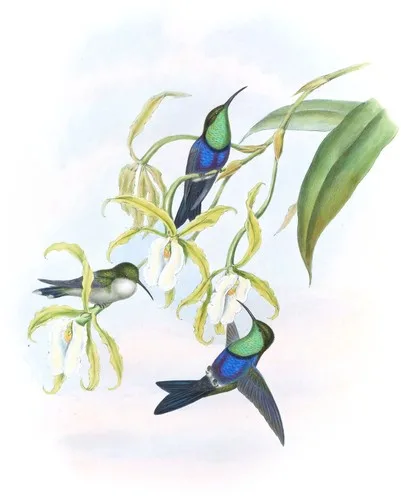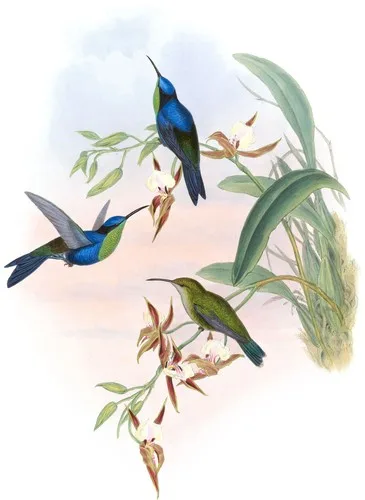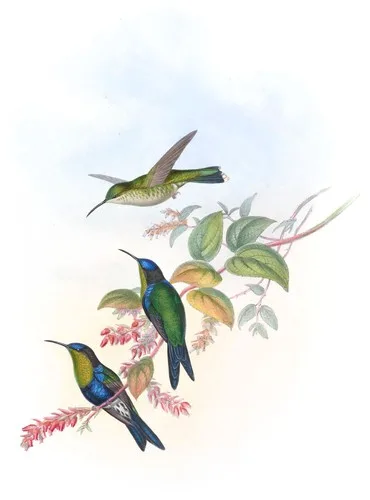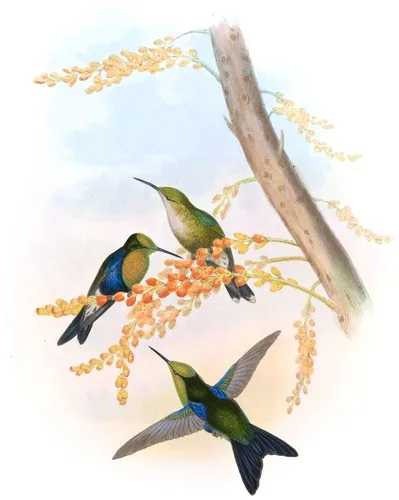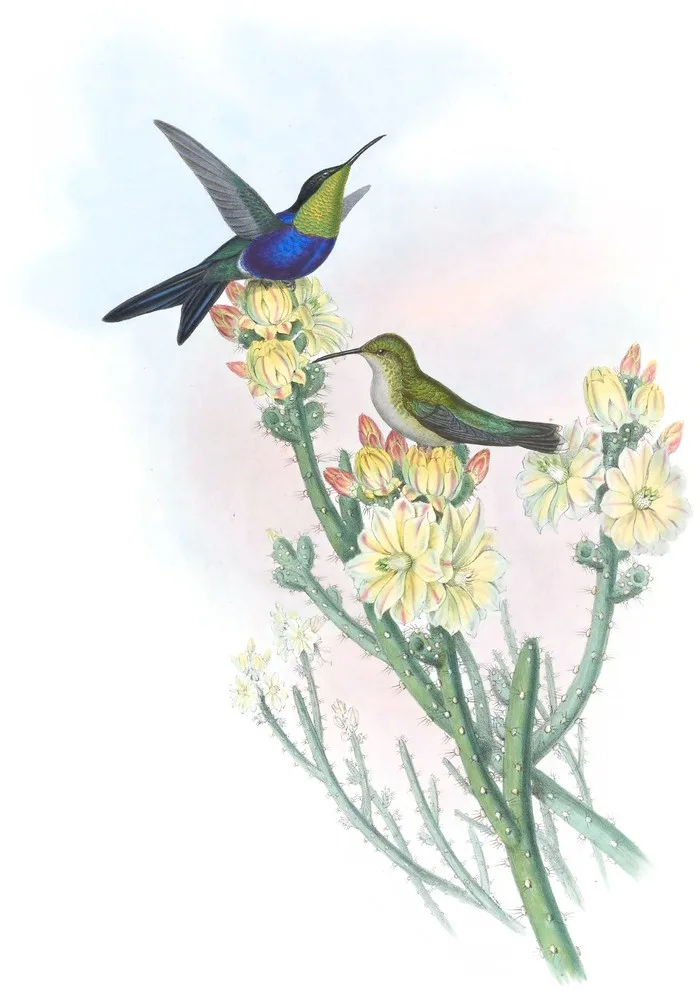
叉尾妍蜂鸟
Thalurania furcata
Thalurania furcata
Cayenne Wood-Nymph
- 中文名
- 叉尾妍蜂鸟
- 学名
- Thalurania furcata
- 合集
- 古尔德蜂鸟图谱
- 绘者
- John Gould(约翰·古尔德)
- 年代
- 1850
- 图版号
- Pl. 101, Vol. II
- 原书页码
- p.101
- 授权
- CC0 1.0 Universal (Public domain)
十观
- 纵幅 1.43∶1
第一眼
搜尽奇峰打草稿。
—— 清·石涛《苦瓜和尚画语录》
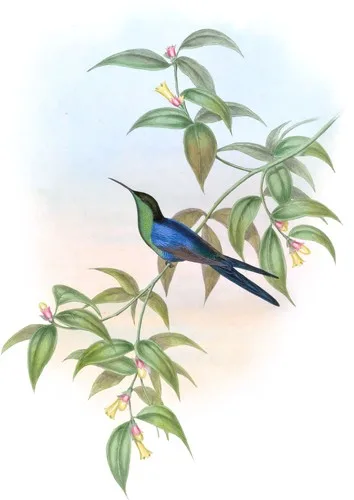
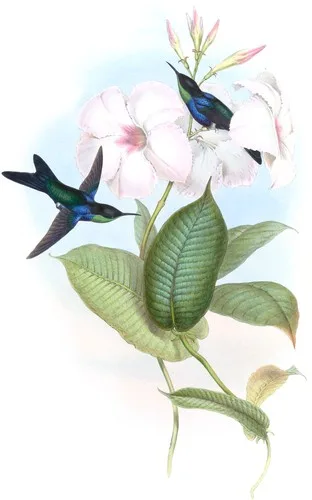
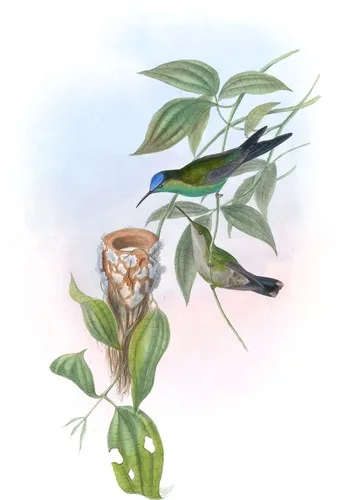
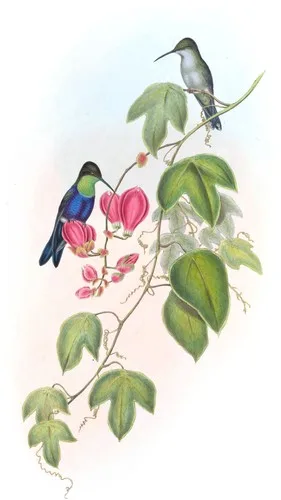
走遍山川,才有资格落笔。博物画的画家也一样:先在温室与山野里看够了活的花,纸上那一朵才不虚。这一幅是竖的:眼睛从下往上走,落点在中段那只鸟身上。先别急着看羽毛,让姿态先立起来。第二步凑近一寸:看线与色的交界,色有没有压住线,线有没有断。第三步,把视线放到最深的那一小块:整幅的用色秩序,都是从那里排开的。
名与实
学名 Thalurania furcata:前一词是属,管它归在哪一类;后一词是种加词,管它在这一类里凭什么与众不同。名字是通行证,也是懒办法——记住两个词,就抓住了一整个物种。中文名“叉尾妍蜂鸟”是后人据学名回译的通行叫法,与古书里的旧名未必对得上——名与物之间,总隔着一层翻译。
形与色
翼小而振频极高,能悬停、能倒飞;羽色非颜料所致,是羽枝结构折射的光,随角度而变。此幅未作色相归档,只能就形制论。看羽:先看覆羽的层次,再看飞羽的排列,最后才看颜色——颜色是最后才被注意到的部分。
构图与呼吸
画幅高而窄,鸟栖在枝的中段,上下留白多——十九世纪鸟谱的标准版式,留给它飞走的余地。全幅只画一只,不作解剖附图——这类图更近于“观赏”,而非“鉴定”。试着用拇指遮住空白处——画面立刻变闷;放开,它才重新“喘上气”。留白,是给主体让出的气口。
一刀一色
十九世纪后半叶,石版与彩色石印渐成主流:颜色可以直接印出,不再依赖手工,线条反倒退居其次。图像的“准确”提高了,手性却淡了。工艺留下的破绽比题跋更诚实:刻工不会撒谎,上色的人赶时间的时候会。想动笔临它的人记住一句:先铺大块的形与色,干后再收细部;石印的柔和层次来自薄涂与网点,水彩分两三遍淡铺即可逼近。
诗境
夫列子御风而行,泠然善也,旬有五日而后反。
—— 《庄子·逍遥游》
蜂鸟悬停于空,不落不飞,最近于“御风”。庄子说的是一种自由的姿态,蜂鸟把它做成了生理事实。古人写到这一层,已不只是赏花,是借花说人;画面则只负责把那朵花留住。
花语
阿兹特克以蜂鸟为战神与太阳的化身;欧洲维多利亚时代则以蜂鸟为收藏与装饰的极致,百万只羽毛被做成胸饰。中国旧籍无此鸟,故无象征——这空白本身,就是一部博物学交流史。花语是给人与人的关系用的;植物自己只关心有没有传粉的虫。这两套语言,可以并行不悖。
时与地
热带美洲几乎全年可见,花期即其季节。仅产美洲,自阿拉斯加南部至火地岛,以安第斯山最为繁盛。中土无蜂鸟,汉籍不载,晚清海外游记始见其名。图上所记的 1850 年是刊行之年,不是采到那只鸟的年份;真正的观察记录通常比出版早一两年。同一株植物,春秋两季像两种东西;同一座山,一百年前与今天叫两个名字。图把这两样都冻结在了纸上。
书与人
《古尔德蜂鸟图谱》只署了约翰·古尔德一个人的名字。图版今属公有领域,可以自由取用;但纸上那层手工上色,仍是两百年前某一个人的手。
带走一双眼睛
鉴赏力不是知识,是习惯:每次多看一眼,十年之后你看什么都和别人不一样。图谱的用意是“以备查考”,看久了却会忘记查考:1850 年的一个人,为一只鸟花了整整一天。
关于本图版
这幅图版出自《古尔德蜂鸟图谱》(Gould's Hummingbirds),由约翰·古尔德绘制,1849—1887 年间出版。叉尾妍蜂鸟(Thalurania furcata)是本图的主角,归入蜂鸟科(Trochilidae)。
全编共收录 421 幅图版,本图是其中一幅,原书将其列为 Pl. 101, Vol. II,见第 101 页,版式为纵幅。扫描件取自公有领域原件,经高分辨率修复与色彩校正,可按原大放大查看线条与设色。
原书文字(英文 / 法文)
Cayenne and Guiana
It is impossible to say with certainty whether the bird described and figured by Brisson and the older authors be identical with the species here represented or not; if it be, they are certainly quite wrong in stating Jamaica to be one of its habitats, an error which I am surprised to find repeated by Lesson, Jardine, and other recent authorities; for so exclusively, in fact, does the bird inhabit the continent of South America, that I believe it never occurs in any of the islands, not even the adjacent one of Trinidad; it enjoys, indeed, a very restricted range, being confined to Cayenne and Guiana, and scarcely extending so far as the Amazon towards Brazil.
The bird of the same form and style of colouring which is found about Para, and which is usually considered to be the same, possesses, in the opinion of some, sufficient differences to warrant its being considered distinct, and to receive a separate appellation, that of T. furcatoïdes. Judging from the great numbers that are annually skinned and sent to Europe, this bird must be very numerous in Cayenne; it frequently arrives in hundreds at a time, consequently a considerable commerce exists between the dealers in Paris and the collectors in Cayenne. Being an exceedingly pretty and elegant species, great care is taken to obtain it only at that season of the year when it is in its finest plumage, and much attention is devoted to the making up of the skins. As is usual with all the members of this genus, the female is totally different from the male in colour, and considerably so in the form and character of the tail. It is surprising how few of this sex are prepared, which is doubtless due to their plumage being too dull and unattractive to demand attention.
The male has the crown of the head, back of the neck, back and wing-coverts black in some lights, deep green in others; throat shining grass-green; band across the back and shoulders violet; under surface beautiful deep violet-blue; wings purplish brown; tail bluish black; under tail-coverts brown, margined with grey.
The Plate represents both sexes of the size of life. The plant is the Opuntia Salmiana.
References
- Mellisuga Jamaicensis, violacea, cauda bifurca, Briss. Orn., tom. iii. pp. 728, 732. pl. xxxvii. fig. 6.—Id., 8vo, tom. ii. p. 40.
- Trochilus furcatus, Gmel., Edit. Linn. Syst. Nat., tom. i. p. 486.—Lath. Ind. Orn., vol. i. p. 304. —Jard. Nat. Lib., Humming-birds, vol. i. p. 125. pl. 23.—Vieill. Eney. Méth. Orn., part ii. p. 572.—Shaw, Gen. Zool., vol. viii. p. 309.—Ib., Steph. Cont., vol. xiv. p. 239.
- L’Oiseau-mouche violet à queue fourchue, Buff. Hist. Nat. des Ois., tom. vi. p. 37.—Vieill. Ois. Dor., tom. i. p. 71. pl. 34.
- L’Oiseau-mouche à queue fourchue, Buff. Pl. Enl. 599. fig. 2.
- Ornismya furcata, Less. Hist. Nat. des Ois.-mou., pp. xiv, 82. pl. 18.—Ib. Ind. Gen. et Syn. des Ois. du gen. Trochilus, p. xxij—Ib. Traité d’Orn. p. 278.
- Polytmus furcatus, Gray and Mitch. Gen. of Birds, vol. i. p. 108, Polytmus, sp. 61.
- Thalurana furcata, Gould in Proc. of Zool. Soc., part xx. p. 8.—Bonap. Rev. et Mag. de Zool. 1854, p. 254.—Reichenb. Aufz. der Col., p. 7.
- Thalurana fureatus, Bonap. Consp. Gen. Av., p. 76, Thalurania, sp. 1.
- Lesser Fork-tailed Humming-bird, Lath. Gen. Syn., vol. ii. p. 75?—Ib. Gen. Hist., vol. iv. p. 297? Fureated Humming-bird, Shaw, Nat. Mise., vol. xi. pl. 397.