紫顶妍蜂鸟
Thalurania glaucopis
Thalurania glaucopis
Brazilian Wood Nymph
- 中文名
- 紫顶妍蜂鸟
- 学名
- Thalurania glaucopis
- 合集
- 古尔德蜂鸟图谱
- 绘者
- John Gould(约翰·古尔德)
- 年代
- 1850
- 图版号
- Pl. 99, Vol. II
- 原书页码
- p.99
- 授权
- CC0 1.0 Universal (Public domain)
关于本图版
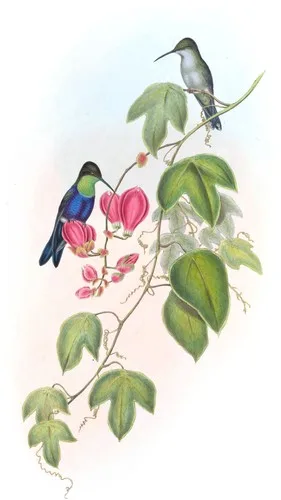
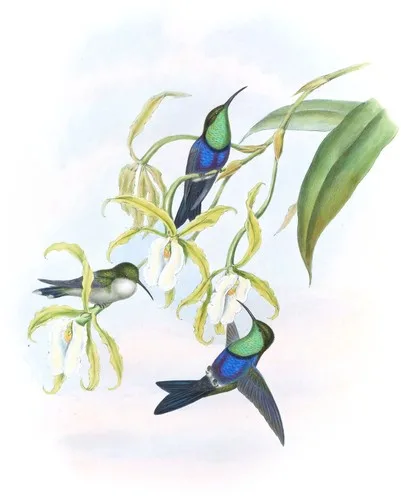
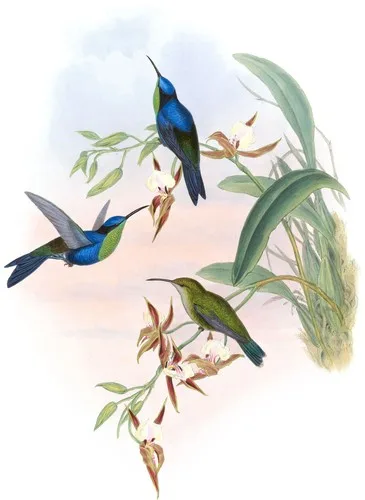
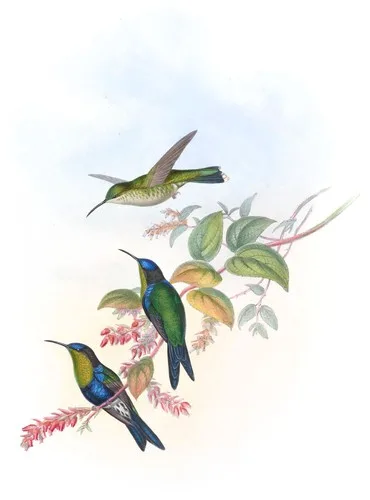
本图选自约翰·古尔德的《古尔德蜂鸟图谱》(Gould's Hummingbirds),原书 1849—1887 年间出版。图中描绘的是紫顶妍蜂鸟,学名 Thalurania glaucopis,在分类体系中列于蜂鸟科(Trochilidae)。
该合集全编共 421 幅图版,此图为其中之一,图版编号 Pl. 99, Vol. II,对应原书第 99 页,版式为纵幅。扫描件取自公有领域原件,经高分辨率修复与色彩校正,可按原大放大查看线条与设色。
原书文字(英文 / 法文)
South-eastern Brazil
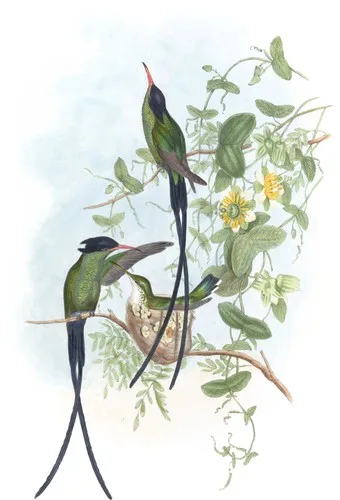
This is one of the Humming Birds, the breasts and crowns of which constitute the materials so extensively used for the construction of the beautiful artificial feather-flowers so frequently forwarded to this country and to the Continent; and we cannot but wonder, when we remember the wholesale destruction with which the bird is visited, that it has not become very scarce, or even extirpated; but the contrary seems to be the case, for no one member of the family is more frequently to be seen in collections, many hundreds of specimens being annually sent to Europe from Rio de Janeiro, which appears to be its head-quarters, as, according to Mr. Reeves, it is found there during the whole of the year.
It is also common in Minas-Geraes, Santa Catharina, and other provinces of Brazil. It is said to be in full plumage in August and September, at which season it is principally procured, and supplied to the nuns for the purpose above alluded to.
Mr. Reeves informs me, that “the numbers annually killed for the fabrication of artificial flowers are immense. Its haunts are the margins of rivers, the virgin forests, and gardens. Its nest is generally se to the drooping branch of a Creeper; on being disturbed, it utters a note which may be described Fip-fip-fip-fip, quickly pronounced.”
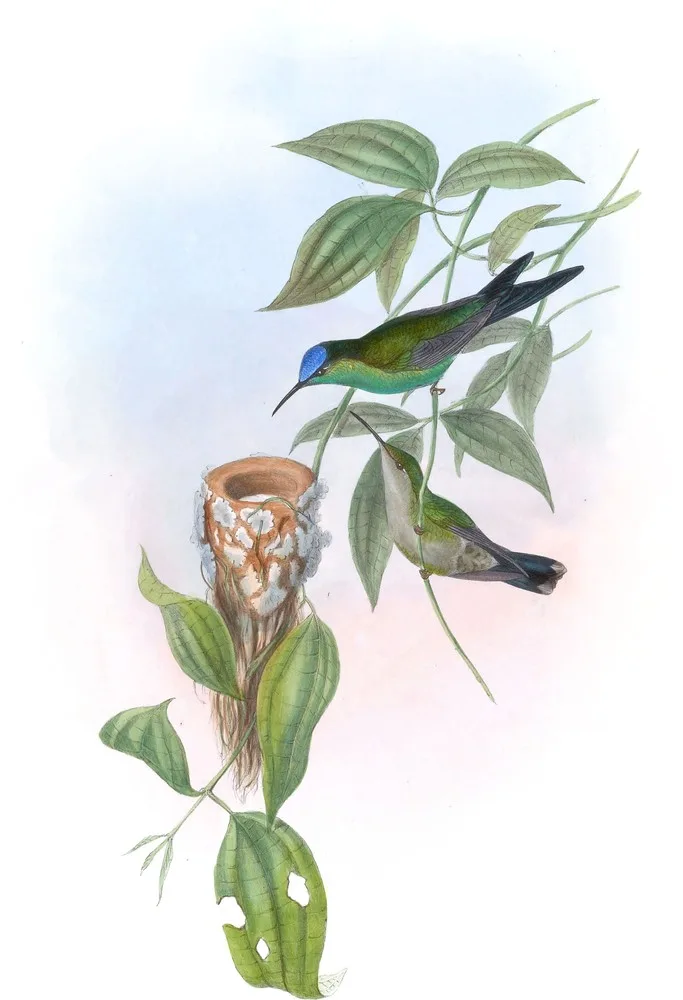
The females appear to escape the wholesale destruction, none of their colours being bright or attractive; indeed, as will be seen on reference to the accompanying Plate, few birds are less gaily adorned.
The nest of this species is of a lengthened form, with a cup-shaped depression at the top: the materials of which it is constructed vary in accordance with those that may be at hand in the situations in which it is placed, but it is generallly composed of the brown inner fibres of the Palm fruit, and beautifully decorated with flat pieces of lichen of various sizes and colour.
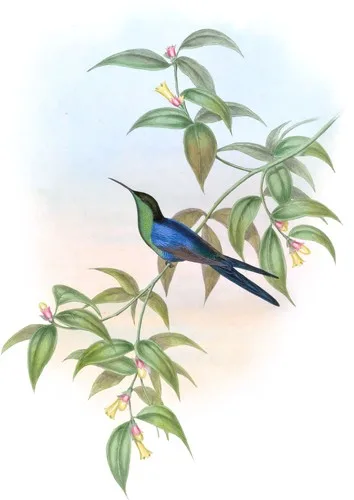
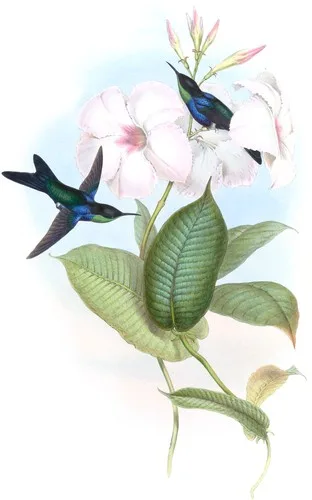
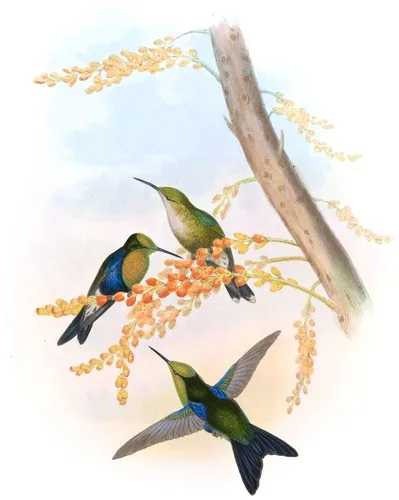
The male has the centre of the crown fine metallic blue; sides and back of the head and nape dark green, appearing black when viewed in front; upper surface, shoulders and wing-coverts green, becoming of a brighter green on the upper tail-coverts; wings purplish black; tail black, with steel-blue reflexions; the whole of the under surface, including the under tail-coverts, yellowish shining green; bill and feet blackish brown.
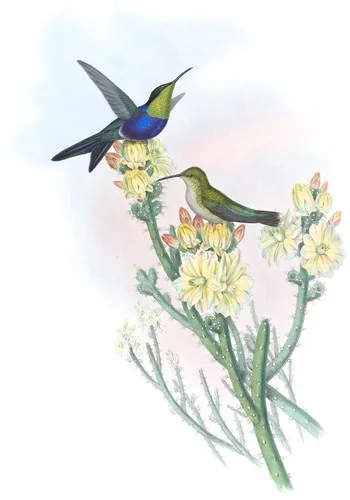
The female has the whole of the upper surface green; wings purplish black; two central tail-feathers ‘and the basal portion of the lateral ones bronzy green; the remainder of the lateral feathers black, with steel-blue reflexions, and the external one tipped with grey; under surface grey, washed with green on the flanks.
The figures are the size of life.
For the drawing of the Brazilian plant, the name of which is unknown to me, I am indebted to T. Reeves, Esq.
References
- Trochilus glaucopis, Gmel. Edit. Linn. Syst. Nat., tom. i. p. 497.—Pr. Max. Beitr. zur Naturg. von Bras., p. 85.—Vieill. 2nde Edit. du Nouv. Dict. d’Hist. Nat., tom. vil. p. 370, et tom. xxi. p. 428.—Ib. Ency. Méth. Orn., part i. p.557.—Jard. Nat. Lib. Humming Birds, vol. ii. p. 86.
- Mellisuga Brasiliensis cauda bifurca, Briss. Orn., tom. iii. p. 724. pl. xxvii. fig. 5?
- Ornismya glaucopis, Less. Hist. Nat. des Ois. Mou., p. 175. pls. 58, 59.—Ib. Traité d’Orn., p. 273.
- Polytmus glaucopis, Gray and Mitch. Gen. of Birds, vol. i. p. 108, Polytmus, sp. 58.
- Trochilus frontalis, Lath. Ind. Orn., vol. 1. p. 318.
- Bluefronted Humming Bird, Lath. Gen. Syn., vol. ii. p. 786.—Ib. Gen. Hist., vol. iv. p. 352.
- L’Oiseau-mouche à queue fourchue du Brésil, Vieill. Ois. dor., tom. i. p. 116.
- Thalurama glaucopis, Bonap. Consp. Gen. Av., p. 77, Thalurania, sp. 5.—Ib. Rev. et Mag. de Zool. 1854, p. 254.—Reichenb. Aufz. der Colibris, p. 7.
- Coeligena glaucopis, Reichenb. Troch. enumer., p. 3. pl. dclxxxv. figs. 4509, 4510.
十二观
- 纵幅 1.46∶1
- 1850 年刊
- 图版 99, Vol. II
这不是词条,是一条看画的次序:先站定看整体,再看名字与形色、构图与刀工,然后问它几时开、从哪里来、经了谁的手;最后是中国诗文——同一朵花,中国古人是怎么看的。十二观读完,这幅图就打开了。
-
第一眼
江馆清秋,晨起看竹,烟光日影露气,皆浮动于疏枝密叶之间。
—— 清·郑板桥《题画竹》
郑板桥说他画竹,是先看见“烟光日影露气”在枝叶间浮动,才动手。看画时找这一层空气,比记住花的名字更要紧。这一幅是竖的:眼睛从下往上走,落点在中段那只鸟身上。先别急着看羽毛,让姿态先立起来。第二步凑近一寸:看线与色的交界,色有没有压住线,线有没有断。第三步,把视线放到最深的那一小块:整幅的用色秩序,都是从那里排开的。
-
名与实
学名 Thalurania glaucopis:前一词是属,管它归在哪一类;后一词是种加词,管它在这一类里凭什么与众不同。一百多年前的命名者,把一种植物的来历压进了两个词。中文名“紫顶妍蜂鸟”是后人据学名回译的通行叫法,与古书里的旧名未必对得上——名与物之间,总隔着一层翻译。
-
形与色
蜂鸟为美洲最小之鸟,喙细长如针,舌分叉成管,可伸入花心吸蜜;翼小而振频极高,能悬停、能倒飞。此幅未作色相归档,只能就形制论。别只看花:叶脉的走向、萼片的长短、甚至茎上的毛,都是画家用来区分物种的证据。
-
构图与呼吸
画幅高而窄,鸟栖在枝的中段,上下留白多——十九世纪鸟谱的标准版式,留给它飞走的余地。(高宽比约 1.46∶1)全幅只画一只,不作解剖附图——这类图更近于“观赏”,而非“鉴定”。老图谱爱把主株摆在偏中线的位置,左右留得不一样多:这一点偏心,正是画面活起来的原因。
-
一刀一色
十九世纪后半叶,石版与彩色石印渐成主流:颜色可以直接印出,不再依赖手工,线条反倒退居其次。图像的“准确”提高了,手性却淡了。先判断它是“印”的还是“画”的,再谈好不好看——这是看老版画最实用的一条规矩。
-
时序
热带美洲几乎全年可见,花期即其季节;温带种类的蜂鸟则随花北迁,一年往返数千公里。图上所记的 1850 年是刊行之年,不是采到那只鸟的年份;真正的观察记录通常比出版早一两年。记下这一季:物候是最好用的鉴赏工具,见过一次活的花,再看图就不会只看颜色。
-
故土
仅产美洲,自阿拉斯加南部至火地岛,以安第斯山最为繁盛。中土无蜂鸟,汉籍不载,晚清海外游记始见其名。十九世纪的苗圃主是这场植物迁徙的中转站:谁家先开花,谁家就有生意。
-
书与人
《古尔德蜂鸟图谱》(Gould's Hummingbirds)由约翰·古尔德绘,成于1849-1887。此幅为其中图版 99, Vol. II,见原书第 99 页。图版今属公有领域,可以自由取用;但纸上那层手工上色,仍是两百年前某一个人的手。
-
诗境
穿花蛱蝶深深见,点水蜻蜓款款飞。
—— 唐·杜甫《曲江二首》
中土无蜂鸟,然“穿花”之态,杜甫早已写过:贴着花心走,是采蜜者的共同姿态。古人写到这一层,已不只是赏花,是借花说人;画面则只负责把那朵花留住。
-
文心
人无癖不可与交,以其无深情也。
—— 明·张岱《陶庵梦忆》
一个人若没有痴迷的东西,就不值得交往——因为他没有深情。看画看到入迷,本身也是一种德行。古尔德《蜂鸟图谱》(1849—1887)以石版手工上色,金箔衬底,使羽色在纸上仍有金属光;这套图册本身就是十九世纪印刷与收藏狂热合流的产物。读古文不必求全解,先认下这一句:它把“看花”换成了“看人”,你再看这幅图,眼里就多了一层。
-
花语
阿兹特克以蜂鸟为战神与太阳的化身;欧洲维多利亚时代则以蜂鸟为收藏与装饰的极致,百万只羽毛被做成胸饰。中国旧籍无此鸟,故无象征——这空白本身,就是一部博物学交流史。花语是后人添上去的,花本身并不知道;但这层“不知道”,正是它最动人的地方。
-
带走一双眼睛
把这三件事带走:先整体后细节;先线后色;先看画再翻书。任何一张老图版,都可以用这三条读。图谱的用意是“以备查考”,看久了却会忘记查考:1850 年的一个人,为一只鸟花了整整一天。