Alismaceæ
Alismaceæ
The Water-Plantain Tribe
- 合集
- 植物自然目
- 绘者
- Elizabeth Twining(伊丽莎白·特温宁)
- 年代
- 1868
- 图版号
- Order 131
- 原书页码
- p.131
- 授权
- CC BY-SA 4.0
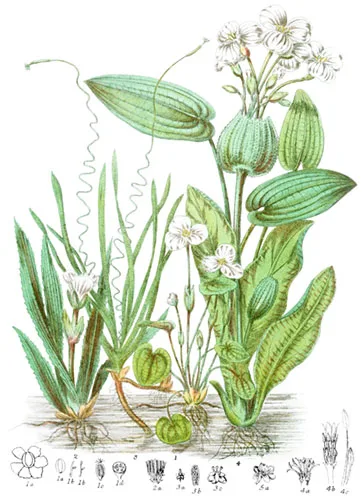
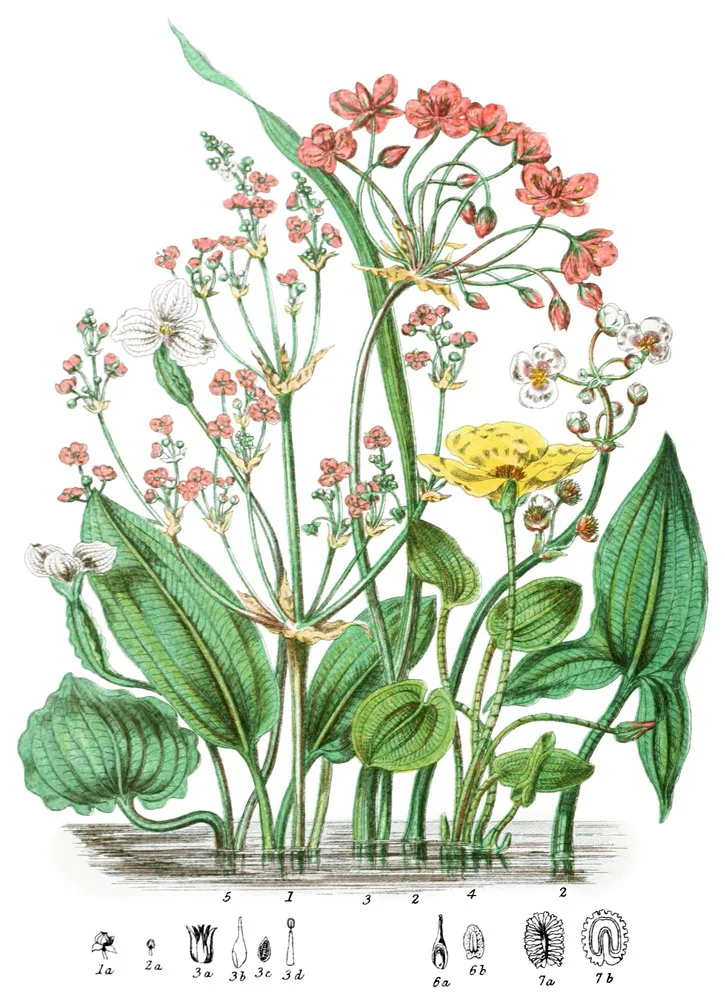
图中植物与部位
-
1.
Alisma plantago
, Water Plantain Streams, England
- 1a. Seed-vessel
-
2.
Sagittaria sagittifolia
, Common Arrow-head Streams, England
- 2a. Stamen
-
3.
Butomus umbellatus
, Flowering Rush Streams, England
- 3a. Pistils
- 3b. Carpel
- 3c. Section of Carpel
- 3d. Stamen
- 4. Limnocharis Humboltii , Humboldt’s Limnocharis Streams, Brazil
- 5. Damasonium indicum East Indies
-
- 6a. Carpel of A. ranunculoides
- 6b. Section of Seed
-
- 7a. Seed-vessel of L. Plumierii
- 7b. Section of Seed
-
- bg.
关于本图版
《植物自然目》(Natural Orders of plants)由伊丽莎白·特温宁绘制,1849 年印行,本图即其中一幅。原书题作“Alismaceæ”。这是该物种在早期博物学出版物中的图像记录之一。
该合集全编共 160 幅图版,此图为其中之一,图版编号 Order 131,对应原书第 131 页,版式为纵幅。图像自原件扫描修复,构图与设色未经改动,授权方式见页面下方。
原书文字(英文 / 法文)
Key characteristics
Aquatic or swamp plants, usually having perennial roots. The leaves are narrow or broad, of very cellular substance, always with parallel veins, often containing a milky juice. The flowers grow in umbels, racemes, or panicles, or are solitary, either purple, yellow, or white. The stamens and pistil are sometimes in different flowers. The calyx has three sepals, the petals are three; the stamens are of definite or indefinite number, the anthers turned inwards. The ovaries are superior, sevearl, one-celled, free and distinct, or united into a single mass; the styles and stigmas of the same number as the ovaries. The fruit is dry, one, two, or many-seeded, either distinct and beaked, or united; the seeds are very minute, solitary, or numerous, and attached to the whole surface of the fruit: they contain no albumen.
This tribe has affinity with Hydrocharidaceæ.
Acrid bitter leaves and eatable fleshy roots belong to these plants.
Select plants in this order
Not all plants listed are illustrated and not all plants illustrated are listed.
- Alisma, derived from the Celtic for water, is dispersed in Europe and America.
- A. plantago (1), although a stiff manner of growth, is one of the most elegant of our aquatic plants, and the flowers are of a peculiar delicate texture and colour. The root is fibrous, from whence all the leaves proceed on erect long stalks; when growing in deep water, or in a flowing stream, the leaves are usually perfectly linear, a tendency which is observed in other water-plants. The roots are thought eatable by the Kalmucks, after the acrid juice is dispelled by drying.
- A. ranunculoides grows chiefly in the swamps and turfy bogs: A. natans in the lakes of Cumberland and North Wales.
- A. repens is a native of South America, adorning the sandy shores of the river Manzanares.
- Sagittaria, named from the Latin, alluding to the form of the leaf, is a genus of considerable beauty, and is interesting as having given the type of one of the floral ornaments of architecture; its arrow-shaped leaf may be clearly traced amongst the sculptures of the choir of the noble cathedral of Rheims.
- S. sagittifolia (2) is very frequent in streams, usually associated with Alisma, and like several other aquatics, widely spread in the world, being equally suited to the temperature of Europe, Siberia, China, Japan, and Virginia. In the warmer climate of China it becomes of more value than with us, the roots attaining such dimensions as to afford an useful supply of food.
- S. sinensis is a species with wider leaves, and the flowers are pure white, without a purple spot.
- S. echinocarpa of Brazil is remarkable for its prickly seeds; some Brazilian species are very astringent, and the juice is used for making ink.
- Butomus umbellatus (3) was by Gerarde (one of the first who described our native plants) declared to be “of all others the fairest and most pleasant to behold;” the umbel of rose-coloured flowers, when in full bloom, about Midsummer, in small rivers, is well deserving of admiration. The leaves are very rough at the edges, usually twisted at the top. Although the plant generally is acrid and bitter, like Alisma, yet the root and seeds are sometimes roasted and eaten by the poor peasants of Sweden, as well as the natives of Northern Asia. In former times they were used medicinally for their emollient cooling properties.
- Actinocarpus differs from Alisma principally in the stellate form of the capsules.
- A. Damasonium is a native of our streams and ditches; A. minor of New South Wales.
- Damasonium indicum (5) is found growing along the edges of streams in the valleys of the Himalaya, and in many other parts of India, mingled with various aquatic plants, which belong both to Southern India and Europe, the more uniform temperature of water favouring this combination in a degree beyond the effect of any local atmosphere in dry situations.
- Limnocharis (4), from the Greek, denoting its marsh habitation, is a beautiful plant, and flourishes perfectly in our conservatories; the leaves have a remarkable pore at the point by which the superfluous moisture is carried off. The texture of both leaves and petals is extremely delicate and transparent.
Locations
These plants chiefly grow in the streams and marshes of the northern countries of the world, but several species inhabit the Tropics; Limnocharis is peculiar to those regions. Sagittaria is very widely dispersed.
Legend
- Alisma plantago, Water Plantain. Streams, England.
- Seed-vessel.
- Sagittaria sagittifolia, Common Arrow-head. Streams, England.
- Stamen.
- Butomus umbellatus, Flowering Rush. Streams, England.
- Pistils.
- Carpel.
- Section of Carpel.
- Stamen.
- Limnocharis Humboltii, Humbolt’s Limnocharis. Streams, Brazil.
- Damasonium indicum. East Indies.
-
- Carpel of A. ranunculoides.
- Section of Seed.
-
- Seed-vessel of L. Plumierii.
- Section of Seed.
本图涉及的植物
- Alisma plantago
- Sagittaria sagittifolia
- Butomus umbellatus
- Limnocharis Humboldtii
- Dimasomium indicum
- Alisma ranunculoides
- Limnocharis Plumierii
属索引
- Actinocarpus
- Alisma
- Butomus
- Damasonium
- Limnocharis
- Sagittaria