Araceæ
Araceæ
The Arum Tribe
- 合集
- 植物自然目
- 绘者
- Elizabeth Twining(伊丽莎白·特温宁)
- 年代
- 1868
- 图版号
- Order 148
- 原书页码
- p.148
- 主色
- 橙
- 授权
- CC BY-SA 4.0
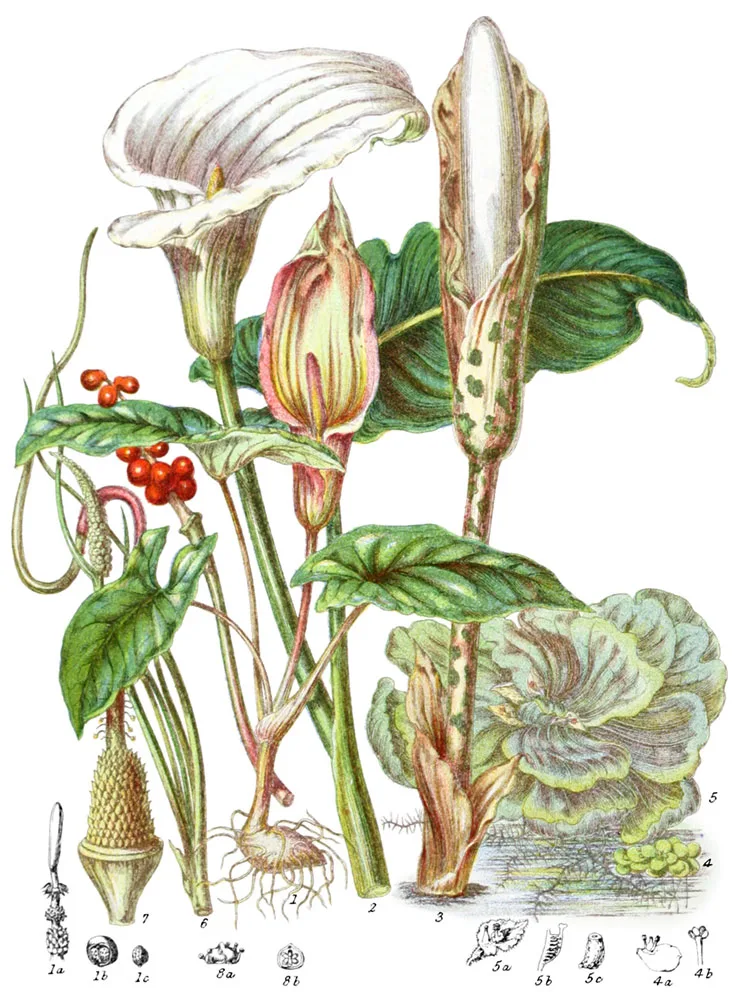
图中植物与部位
-
1.
Arum maculatum
, Cucoo-pint Hedges, England
- 1a. Spadix
- 1b. Fruit open
- 1c. Seed
- 2. Richardia æthiopica , White Arum Cape of Good Hope
- 3. Amorphallus bulbifer , Bulb-bearing Amorphallus East Indies
-
4.
Lemna* gibba
, Common Duck-weed Fresh water, Britain
- 4a. Flower magnified
- 4b. Stamen
-
5.
Pistia stratiotes
Tropics
- 5a. Flower
- 5b. Section of Ovary
- 5c. Seed
- 6. Acorus calumus Thames, England
- 7. Spadix of A. tortuosum India
-
- 8a. Flower of Calla palustris
- 8b. Section of Fruit
-
- bg.
关于本图版
本图选自伊丽莎白·特温宁的《植物自然目》(Natural Orders of plants),原书 1849 年出版。原书题作“Araceæ”。原书为这一物种留下了成幅的彩色图像记录。
该合集全编共 160 幅图版,此图为其中之一,图版编号 Order 148,对应原书第 148 页,版式为纵幅,整幅以橙为主调。图像自原件扫描修复,构图与设色未经改动,授权方式见页面下方。
原书文字(英文 / 法文)
Key characteristics
Shrubs and herbaceous plants without a stem, some of which have a fleshy root, others are climbing, and have aerial roots, and some are aquatic, floating on water. The leaves are sheathing at the base. The flowers are placed on a spadix and enclosed in a spathe, or are simple and in a spathe, sometimes proceeding from the margin of the frond. The calyx and corolla are wanting, or consist merely of a few scales. The stamens and pistil are usually in different flowers, united in Calla, of definite or indefinite number, the filaments often united. The ovary is free, usually one-celled, with a short style and simple stigma. The fruit is a succulent berry with pulpy seeds which usually contain albumen.
This Tribe has affinity with Typhaceæ; Lemna connects it with less developed Orders of plants.
Acrid juices exist in these plants, but the roots contain wholesome starch.
Select plants in this order
Not all plants listed are illustrated and not all plants illustrated are listed.
- Arum is supposed to be derived from the ancient Egyptian name; it is a remarkable genus, taken as the type of this Order, widely dispersed in the hot regions of the world, and extending in the form of one species to Britain. In some countries it finds a suitable temperature on mountains, requiring only a short season for its development. On the Himalaya several species abound of immense size, with green or purple spathes, ending in the slender tail eighteen inches long.
- Arum maculatum (1) is common on hedgebanks throughout England, where it is amongst the first to unfold its glossy leaves in spring. The roots or corns contain a slightly acrid juice, which is immediately dissipated by drying or preparing by fire, and the remaining starch is wholesome as food. In the Isle of Portland, where the plants are abundant, and food sometimes scarce, the inhabitants collect the roots and prepare a powder from them, known and sold as Portland Sago.
- A. tortuosum (7) is one of the Indian species, growing in damp places: the leaves are four feet wide, composed of nineteen leaflets; the spadix is upwards of a foot in length, wavy, and extending beyond the spathe: the roots are eatable.
- A. Dracunculus, the Dragon Arum, has spotted leaves, and strong-scented spathe; like others, it possesses medicinal properties, and was probably use formerly, as A. maculatum is said to have been in the time of Theophrastus.
- Richardia (2) is the fairest specimen of this Tribe, producing ivory-like spathes in full beauty in our conservatories, and affording an interesting example of the more perfect development of the Tribe in the Tropics.
- Comparing this graceful polished plant of Ethioia with the dwarf hairy rough Calla palustris of the marshes of Northern Europe, the contrast is striking.
- Our British Arum forms an intermediate link in the chain.
- Amorphallus (3) is a genus of Bengal, where several species are known to thenatives as affording eatable roots.
- Caladium differs from Arum in bearing stamens at the top of the spadix, glands in the middle, and germens at the base.
- C. odorum has berries the size of a cherry.
- Colocasia was cultivated for food by the ancient Egyptians.
- C. himalensis forms the chief support of the hill-people in some districts of the Himalaya.
- The roots of C. macrorhiza and C. esculentum afford the favourite yams of the South-sea islanders.
- Various species yield medicine, or juices used for blisters in their native countries.
- Scindaspus officinalis is one of the medicinal plants of the Hindoos.
- Dracontium, Arisæma, and Monstera, are among the useful medicines of Brazil.
- The most powerful plant of the Tribe is Dieffenbachia seguina of the West Indies and South America. It grows the height of five or six feet, and is called Dumb Cane, from its effect on the tongue of those who incautiously bite the leaves.
- Pythonium is found as far north as Nagkanda, on the Himalaya, at an elevation of nine thousand feet.
- Pothos, so called from its name in Ceylon, is a parasitic genus, growing and climbing on old trees by means of aerial roots, both in the East and West Indies.
- P. palmata has leaves three feet long, on a stalk of equal or greater length.
- P. pedatus and P. quinquenervis exist on the Andes at eight thousand feet above the sea.
- Acorus (6) was known to the ancients, and is a native of Asia as well as of Europe.
- Lemna (4) is the most simple of all flowering plants, the stem and leaf being combined into a small frond; lying in the frond.
- Pistia (5) is more complete, having two flowers in a spathe; it floats on fresh water like Lemna: the roots have little hooded vesicles at their points. On the Nile at Sennaar, in pools during the rainy season in India, and in water-tanks in Jamaica, this singular plant is to be seen.
Locations
This Tribe abounds in the Tropics, but is rare in Temperate regions, where the species are usually herbaceous; in Tropical countries many are trees, others climbing parasites, with aerial roots. Lemna belongs to Europe and cool parts of Asia.
Legend
- Arum maculatum, Cuckoo-pint. Hedges, England.
- Spadix.
- Fruit open.
- Seed.
- Richardia æthiopica. White Arum. Cape of Good Hope.
- Amorphallus bulbifer, Bulb-bearing Amorphallus. East Indies.
- Lemna gibba,* Common Duck-weed. Frest water, Britain.
- Pistia stratiotes. Tropics.
- Flower.
- Section of Ovary.
- Seed.
- Acorus calumus. Thames, England.
- Spadix of A. tortuosum. India.
-
- Flower of Calla palustris.
- Section of Fruit.
本图涉及的植物
- Arum maculatum
- Richardia æthiopica
- Amophallus bulbifer
- Lemna gibba
- Arum tortuosum
- Pistia stratiotes
- Acorus calamus
- Calla palustris
属索引
- Acorus
- Amorphallus
- Arisæma
- Arum
- Caladium
- Calla
- Colocasia
- Dieffenbachia
- Draconium
- Lemna
- Monstera
- Pistia
- Pothos
- Pythonium
- Richardia
- Scindaspus