Artocarpaceæ
Artocarpaceæ
The Bread-Fruit Tribe
- 合集
- 植物自然目
- 绘者
- Elizabeth Twining(伊丽莎白·特温宁)
- 年代
- 1868
- 图版号
- Order 124
- 原书页码
- p.124
- 主色
- 绿
- 授权
- CC BY-SA 4.0
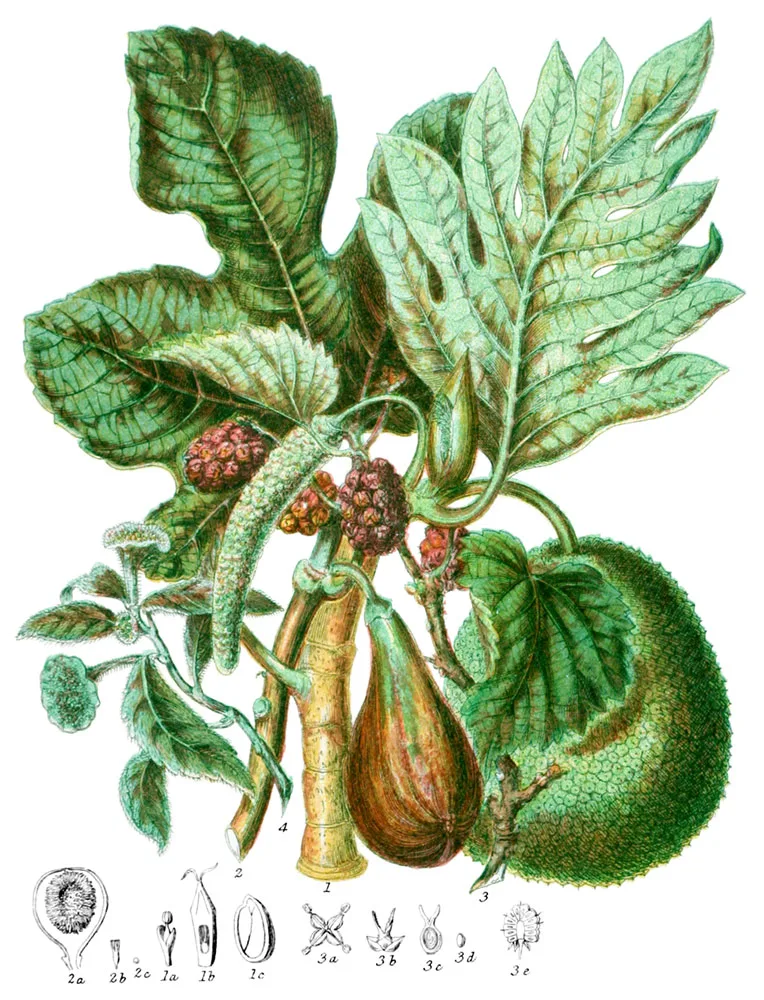
图中植物与部位
-
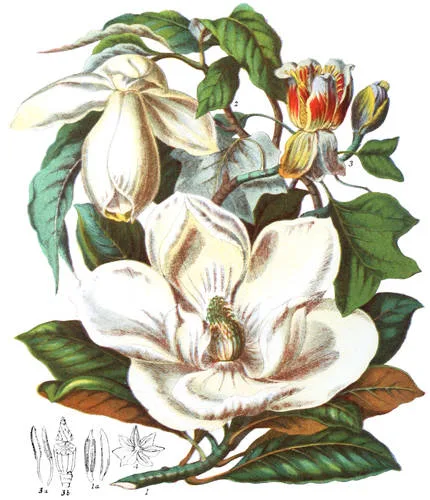
1.
Artocarpus incisa
, Bread-Fruit Tree South Sea Isles
- 1a. Stamen Flower
- 1b. Pistil and Ovary
- 1c. Section of Seed
-
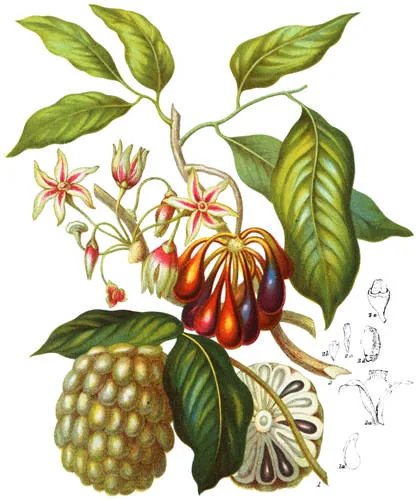
2.
Ficus carica
, Common Fig South Europe
- 2a. Section of Fruit
- 2b. Flower
- 2c. Seed
-
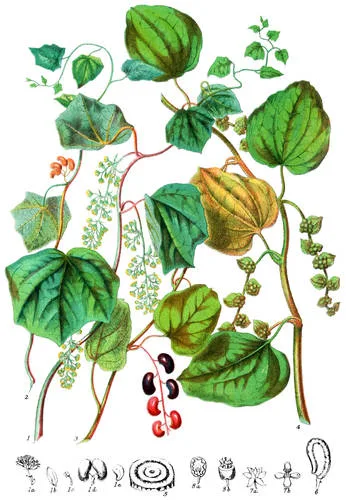
3.
Morus nigra
, Mulberry Italy
- 3a. Stamen Flower
- 3b. Pistil Flower
- 3c. Section of Fruit
- 3d. Seed
- 3e. Ovary
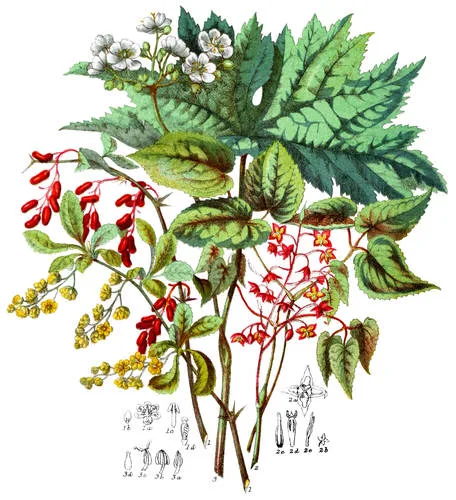
- 4. Dorstenia hispida , Hairy Dorstenia Brazil
关于本图版
这幅图版出自《植物自然目》(Natural Orders of plants),由伊丽莎白·特温宁绘制,1849 年出版。原书题作“Artocarpaceæ”。原书为这一物种留下了成幅的彩色图像记录。
全编共收录 160 幅图版,本图是其中一幅,原书将其列为 Order 124,见第 124 页,版式为纵幅,画面以绿为主色。此图由原件扫描修复而成,使用时请遵循页面标注的授权条款。
原书文字(英文 / 法文)
Key characteristics
Trees and shrubs with a milky juice, sometimes of a climbing nature. The leaves are alternate, simple or lobed, of various texture, with large sitpules rolled up and enclosing the young leaves, leaving a scar when they fall off. The flowers are inconspicuous; the stamens and pistils are in separate flowers. The stamen flowers have sometimes a very small calyx of two to four scales, or it is tubular; the stamens are inserted into the base of the calyx opposite its lobes, and of the same number: the anthers are two-celled, and open lengthwise or into two plates. The fertile flowers are variously arranged, over a fleshy receptacle, concave, globose, or spiked; the calyx is tubular, or in two rows of sepals. The fruit is surrounded by a fleshy involucre, or composed of thick fleshy calyxes, enclosing numerous nuts, or collected into a fleshy mass by the consolidated succulent calyx; the seed is solitary, and contains flesh albumen.
This Tribe has affinity with Urticaceæ and Euphorbiaceæ.
Wholesome fruit, and a milky juice containing caoutchouc, are characteristics of these trees.
Select plants in this order
Not all plants listed are illustrated and not all plants illustrated are listed.
- Artocarpus incisa (1) is one of the most valuable trees of the South Sea Isles, whence it was introduced into the West Indies and to South America. The wood serves to build houses and boats; the leaves, often as much as two feet in length, are used for various purposes; the juice yields a glutinous cement for covering water-vessels; and the fruit, containing a large proportion of starch, affords an abundant supply of nourishment to the natives. It is not eaten in a raw state, but is usually cooked in Palm-oil, or roasted; the taste is insipid, but is thought to resemble that of wheat bread.
- A. integrifolia, the Jaca, is of inferior value as food, but the fruit often weighs twenty pounds.
- Ficus is a genus of very ancient fame, and of peculiar interest, having been chosen as an object to teach divine wisdom to the Jews. The milky juice of the stem and branches is in some species extremely acrid; that of F. toxicaria is a strong poison. In others it is harmless, and in the cow-trees affords a pleasant beverage. The milk of plants generally contains caoutchouc,—that of F. elastica furnishes Indian rubber to the whole peninsula of India. Other species supply the Isles of Indian Ocean. In S. America, F. radula, F. elliptica, and a few more yield it. It is one of the wonderful chemical properties of fruit to be able to convert injurious acrid juices into delicious saccharine substance; in the Fig (2) this power is displayed in a striking degree. The juice of the branches is highly pungent, but when the process of ripening is complete in the fruit, an extraordinary quantity of sugar is secreted, exuding in a clear candid drop at the top, commonly called the tear of the fig. The arrangement of the countless minute flowers within the fleshy receptacle is a singular exception to the normal type of flower and fruit.
- F. indica is the celebrated Banyan tree of India, possessing an extreme capacity of growth; for though it is usually found in barren sandy soil, yet, in the course of a few years, one stem will constitute a grove from its numerous rooting branches, affording red shade to the religious natives of India, and a habitation for countless parasitical plants.
- F. microcarpa, of Java, is of very rapid growth, and formsm a dense and grateful shelter.
- The leaves of F. religiosa, the Peepul of India, terminate in a long slender point, and being of a tough substance, are used by the Chinese to paint upon.
- Morus (3) is more valuable for its leaves than its fruit, although the latter is pleasant and wholesome. The leaves are the chief food in silk-worms, for which the trees are cultivated abundantly in Italy; those which still exist in gardens near London were planted in the time of James I., who wished to establish the silk manufacture in this country.
- M. alba, a nearly similar species, is the most common in Spain.
- Dorstenia (4) is a singular genus, bearing numerous small flowers on a concave receptacle, not closed, like that of the Fig.
- The pungent roots of D. contrayerva are imported from South America, and used as a medicine for dyeing.
- The famous Cow-tree of South America, yielding a copius milky juice, is a species of Brosimum: travellers relate that the negroes may be seen going forth early in the morning to obtain a supply of the milk.
- The nuts of B. alicastrum, like all the seeds of this Tribe, are wholesome, and are of good flavour when roasted.
- Broussonetia papyrifera has a succulent hispid fruit; a kind of paper is made from the bark.
- The celebrated Upas, whose poisonous exhalations have been much exaggerated, is Antiaria toxicaria.
- Cecropia peltata is remarkable for the stem being hollow between the joints.
- The fruit of Maclura is known as the Osage Orange; it yields a yellow juice, with which American Indians stain their faces before going to war.
- Phytocrene, the Water-vine of Martaban, has a soft porous wood, and exudes a pure tasteless fluid, drunk by the natives.
- In the west of India grows Lepuranda saccidora, of whose branches sacks are curiously formed; a suitable portion is cut off and soakced till the fibrous bark can be pulled down off it, when the wood is sawn away, leaving only a piece to close the end of the sack.
Locations
This extensive Tribe exists chiefly in the Tropics. A few species only advance into Temperate regions: none are natives of Europe.
Legend
- Artocarpus incisa, Bread-fruit Tree. South Sea Isles.
- Stamen Flower.
- Pistil and Ovary.
- Section of Seed.
- Ficus carica, Common Fig. South Europe.
- Section of Fruit.
- Flower.
- Seed.
- Morus nigra, Mulberry. Italy.
- Stamen Flower.
- Pistil Flower.
- Section of Fruit.
- Seed.
- Ovary.
- Dorstenia hispida, Hairy Dorstenia. Brazil
本图涉及的植物
- Artocarpus incisa
- Ficus carica
- Morus nigra
- Dorstenia hispida
属索引
- Antiaria
- Artocarpus
- Brosimum
- Broussonetia
- Cecropia
- Dorstenia
- Ficus
- Lepuranda
- Maclura
- Morus
- Phytocrene