Belvisiaceæ
Belvisiaceæ
The Napoleona Tribe
- 合集
- 植物自然目
- 绘者
- Elizabeth Twining(伊丽莎白·特温宁)
- 年代
- 1868
- 图版号
- Order 85
- 原书页码
- p.85
- 主色
- 绿
- 授权
- CC BY-SA 4.0
图中植物与部位
-
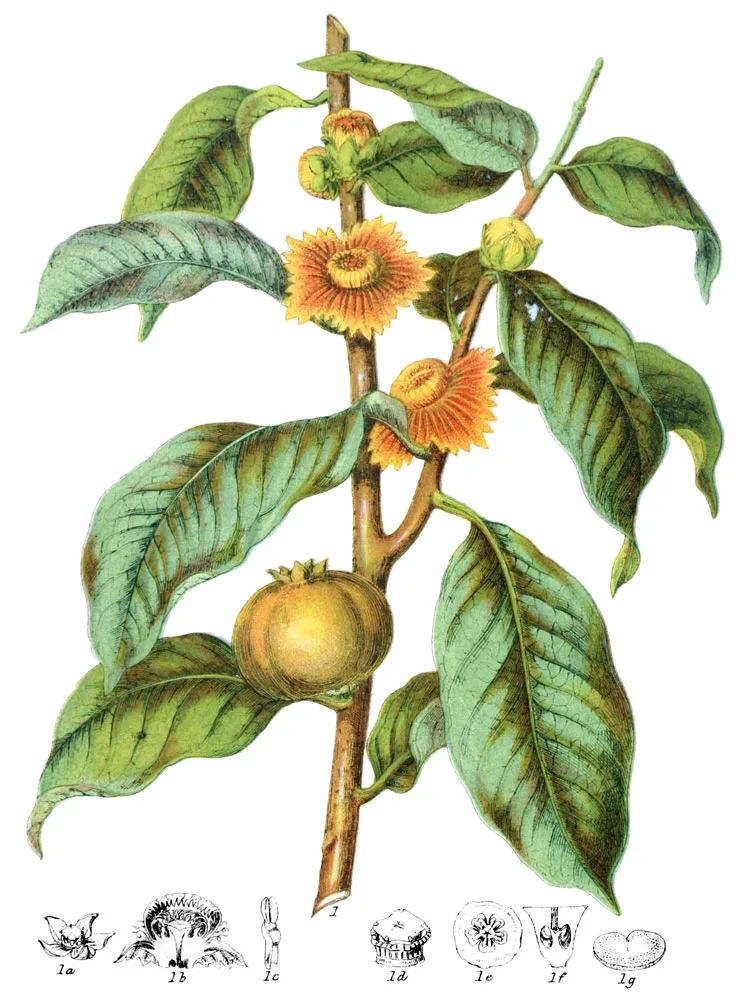
1.
Napoleona imperialis
Oware Senegambia
- 1a. Calyx
- 1b. Section of Flower
- 1c. Stamen magnified
- 1d. Cup and Stigma
- 1e. Cross Section of Ovary
- 1f. Section of Ovary
- 1g. Seed
关于本图版
本图选自伊丽莎白·特温宁的《植物自然目》(Natural Orders of plants),原书 1849 年出版。原书题作“Belvisiaceæ”。原书为这一物种留下了成幅的彩色图像记录。
该合集全编共 160 幅图版,此图为其中之一,图版编号 Order 85,对应原书第 85 页,版式为纵幅,设色以黄绿为基调。图像自原件扫描修复,构图与设色未经改动,授权方式见页面下方。
原书文字(英文 / 法文)
Key characteristics
A few shrubs of small size, having a soft white wood. The leaves are evergreen, alternate, and leathery, with thick channelled stalks, entirely destitute of stipules. The flowers grow from the stem and branches, at the base of the leaf-stalk, surrounded at their base by a few round imbricated scales. The calyx is a thick leathery cup, divided into five ovate segments at the top, not folded over each other in the bud. The corolla is composed of three parts or rings; the outer circle is of one petal, five-lobed, and having in each division seven strong ribs, which in the bud are folded closely together, the thin membranous portion of the petal lying wrinkled between them. As the flower expands, the ribs still give it a plaited appearance. The next ring is a row of slender curled fine-pointed threads. The third is of a cup-shape, the top notched and rolled inwards. The stamens are twenty, and form a circle within the cup, surrounding the short solid style; the filaments are wide at thei base and narrow at the top; the anthers are oblong, two-celled, attached to the top of the filaments. The ovary lies embedded in the mass formed by the base of the corolla, stamens, and disk; it has five cells, in each of which two ovules are suspended from the top of the central axis. The upper part of the style is five-angled, and is terminated by a flat stigma, also having five angles, at the points of which are small glands or pores. The fruit is a soft spherical berry, surmounded by the calyx, with a tough rind and mucilaginous pulp. The seeds are large, kidney-shaped, and contain no albumen.
This Tribe has most affinity with Rhizophoraceæ, chiefly through Kandelia.
The rind of the fruit contains tannin.
Select plants in this order
Not all plants listed are illustrated and not all plants illustrated are listed.
- The principal genus of this Tribe was named Napoleona, by Palisot de Beauvois, who discovered it in Oware, to the south of Benin, in Africa, 1807, when the great conqueror of France was in the ephemeral zenith of his glory. Desvaux subsequently named it Belvisia, in honour of its discoverer, and the tribe was thence called Belvisiaceæ. Napoleona imperialis (1) is a shrub of stately growth, about eight feed in height; the large glossy leaves render it very ornamental even in the winter, but it is at present rarely to be seen in conservatories. The flower and fruit are of remarkable structure; in the latter may be traced a resemblance to that of Careya and Barringtonia, and still more to the Pomegranate amongst Myrtaceæ A singular formation in the wood is found to be nearly similar to that of young plants of Rhizophora, both containing slender bristle-like tubes, which are perceptible on breaking it crosswise. The strong ribs and plaiting of the corolla is also very similar to that of the calyx of Bruguiera gymnorhiza in the Mangrove tribe. But although several points of resemblance to other plants are discernible, yet two remarkable genera of which this tribe is composed are clearly distinguished from every known order. Very little has been ascertained respecting their properties or uses, but the pulpy fruit of Napoleona is said to be eatable, and the Africans prepare a kind of ink from the rind, which is full of tannin. In the unexplored regions of Africa, it is probabl that other species may be discovered. N. imperialis (1) has been found in Senegambia by the French traveller and naturalist, Heudelot.
- Asteranthus, the other genus of this trie, is an evergreen shrub, the leaves two or three inches in length, smooth and sharp-pointed. The calyx has usually the lobes ending in glandular hair. The flower is from two or three inches in diameter, the edge of the petal notched and hairy, strongly ribbed and veined. The conical style is terminated by a six-rayed stigma. The flowers are solitary, without bracts, and are seated in the axils of the leaves, like those of Napoleona.
Locations
This limited Tribe belongs entirely to Tropical Africa.
Legend
- Napoleona imperialis. Oware and Senegambia.
- Calyx.
- Section of Flower.
- Stamen magnified.
- Cup and Stigma.
- Cross Section of Ovary.
- Section of Ovary.
- Seed.
本图涉及的植物
- Napoleona imperialis
属索引
- Asteranthus
- Napoleona