Bromeliaceæ
Bromeliaceæ
The Pine-Apple Tribe
- 合集
- 植物自然目
- 绘者
- Elizabeth Twining(伊丽莎白·特温宁)
- 年代
- 1868
- 图版号
- Order 138
- 原书页码
- p.138
- 主色
- 黄
- 授权
- CC BY-SA 4.0
图中植物与部位
-
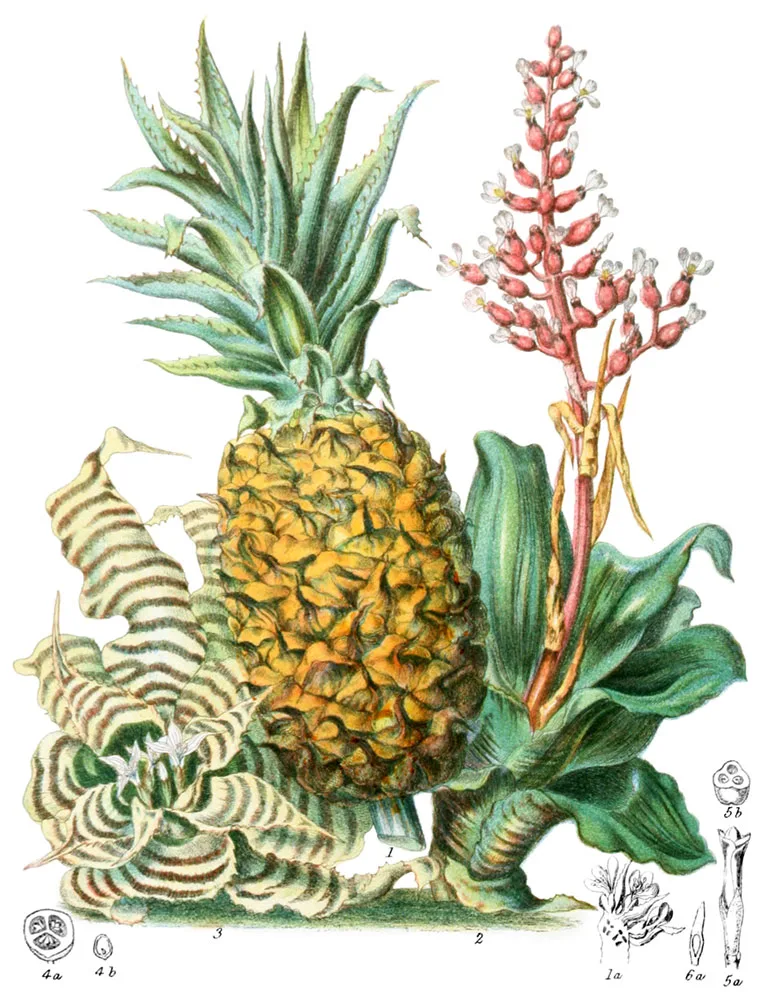
1.
Bromelia ananas
, Pine apple Peru
- 1a. Flower
- 2. Æchmea discolor , Brilliant Æchmea Brazil
- 3. Tillandsia acaulis, zebrina , Zebra-leaved Tillandsia Rio Janeiro
-
- 4a. B. Pinguin , Section of Fruit
- 4b. Section of Seed
-
- 5a. B. fashiosa
- 5b. Flower
-
- 6a. Seed of Pitcairnia ringens
-
- bg.
关于本图版
此图原刊于《植物自然目》(Natural Orders of plants),绘者为伊丽莎白·特温宁,成书于 1849 年。原书题作“Bromeliaceæ”。这是该物种在早期博物学出版物中的图像记录之一。
全编共收录 160 幅图版,本图是其中一幅,原书将其列为 Order 138,见第 138 页,版式为纵幅,设色以橙为基调。此图由原件扫描修复而成,使用时请遵循页面标注的授权条款。
原书文字(英文 / 法文)
Key characteristics
Plants without a stem, or with a very short stem; some are parasitic; the leaves are stiff, fleshy, channelled, often covered with scales, and spiny at the edges and point. The flowers are on branching stalks or in panicles. The calyx is three-parted, or tubular, not withering, more or less cohering with the ovary, usually herbaceous, and sometimes coloured. The petals are coloured, withering or falling off, equal or unequal. The stamens are six, inserted into the tube of the calyx and corolla: the anthers often inwards. The ovary is three-celled, the style single, the stigma three-lobed or entire, sometimes twisted. The fruit is a capsule, or succulent, three-celled, many-seeded; the seeds are numerous, with a leathery skin, or tapering into a slender thread; they contain mealy albumen.
This Tribe has affinity with Amaryllidaceæ and Hæmodoraceæ, but is distinguished by the mealy albumen of the seeds.
Healing properties, and colouring juice, exist in some of these plants.
Select plants in this order
Not all plants listed are illustrated and not all plants illustrated are listed.
- Bromelia was named by Linnæus in memory of a Swede, who wrote on plants in the seventeenth century; Ananas, the general Continental appellation of the Pine-apple, is derived from the name of the fruit in Peru, its native country.
- Bromelia Ananas (1) is acknowledged to be the finest of all fruits; it was introduced into Europe about two centuries ago, and first cultivated in Holland; thence it was brought to England; and the first fruit is said to have been grown in a garden at Richmond in 1715. It was afterwards dispersed in all European countries, and cultivated in all the chief cities as a very choice fruit: in the south of Spain it ripens in the open air in sheltered situations. In the East and West Indies it is much grown, and since the intercourse with the latter islands has become frequent and regular, considerable importations are received during the summer months. In the Tropics the plants rise to the height of four feet; Magellan, in his voyage round the world, found the fruit abundant and delicious in the Moluccas. An English officer in the late Burmese war, thought the finest Pine-apples he ever tasted, were those gathered by the soldiers in the forests at Rangoon. The fruit consists of a swelled and ripened mass of flowers, one of which grows at the base of each leaf; as the flower-buds enlarge, they abstract juice from the leaves til they are reduced to mere bracts, and thus the whole is consolidated into the juicy pulpy fruit. The crown is the upper tuft of leaves, a continuation of the plant after the flower-buds cease In Singapore the fibres of the leaves are manufactured into fine muslin.
- B. pinguin in its wild state bears a small acid fruit (4),* used medicinally in the West Indies; this species grows parasitically on trees in Brazil, spreading over a space of twelve feet, and covered with mosses and other small plants.
- Æchmea discolor (2) is one of the most beautiful plants of this Tribe, introduced lately from Brazil; it forms a brilliant addition to the conservatory, the coral-like branches remaining long in flower.
- The most striking genus, when seen in its native countries, is Tillandsia; some species grow parasitically on trees in Peru and Brazil, almost concealing them with thin masses of pale grey foliage and spikes of bright flowers.
- T. usneoides clothes the trees in many parts of Tropical America with its long silvery branches and leaves, in the same manner as the Lichen Usnea hangs like a grey beard on the Firs of the Alps. Another kind ascends into the temperate climate of the mountains of Mexico.
- T. acaulis (3) is well adapted for cultivation amongst our exotics, being of more lowly form; the leaves are hollowed at the base, and retain rain and dew in sufficient quantity to be valuable to travellers in the season of drought.
- From the spike of Puya languinosa flows a transparent gum; P. chilensis yields a juice found useful in healing wounds in Chile.
- From the root of Bilbergia tinctoria a yellow dye is obtained in Brazil.
- Several species which can exist without earth are used to adorn balustrades and balconies in South America, scenting the air with their delicious fragrance.
Locations
All the plants of this Tribe are natives of America, whence they have extended eastward; and many have become indigenous on the west of Africa, and in the East Indies.
Legend
- Bromelia Ananas, Pine apple. Peru.
- Flower.
- Æchmea discolor, Brilliant Æchmea. Brazil.
- Tillandsia acaulis, zebrina, Zebra-leaved Tillandsia. Rio Janeiro.
-
- B. Penguin. Section of Fruit.
- Section of Seed.
-
- B. fashiosa. Flower.
- Section of Ovary.
-
- Seed of Pitcairnia ringens.
本图涉及的植物
- Bromelia Ananas
- Æchmea discolor
- Tillandsia acaulis
- Bromelia Pinguin
- Bromelia fastuosa
- Pitcairnia ringens
属索引
- Æchmea
- Bilbergia
- Bromelia
- Pitcairnia
- Puya
- Tillandsia