Caprifoliaceæ
Caprifoliaceæ
The Honeysuckle Tribe
- 合集
- 植物自然目
- 绘者
- Elizabeth Twining(伊丽莎白·特温宁)
- 年代
- 1868
- 图版号
- Order 72
- 原书页码
- p.72
- 主色
- 红
- 授权
- CC BY-SA 4.0
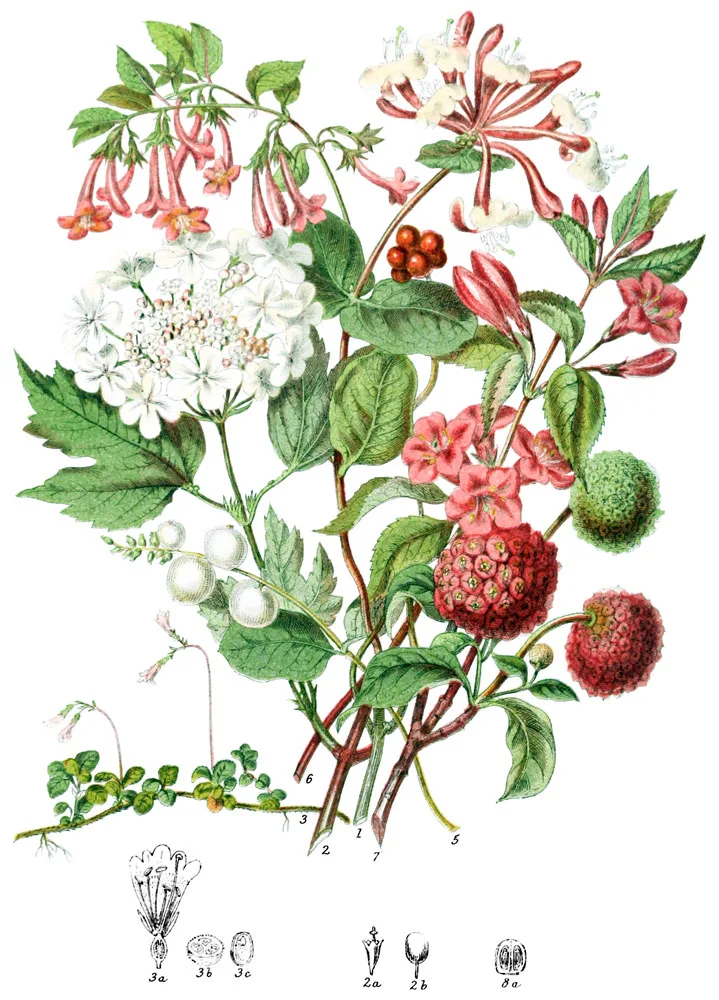
图中植物与部位
- 1. Caprifolium Periclymenum , Honeysuckle or Woodbine England
-
2.
Vibrunum Opulus
, Guelder Rose England
- 2a. Calyx and Pistil
- 2b. Fruit
-
3.
Linnæa borealis
, Two-flowered Linnæa England
- 3a. Flower
- 3b. Fruit
- 3c. Section of Seed
- 4. Abelia floribunda* , Many-flowered Abelia Mexico
- 5. Symphoria racemosa , Snow-berry Canada
- 6. Weigela rosea Northern China
- 7. Benthamia fragifera East Indies
-
- 8a. Sambucus nigra , Elder, Section of Fruit Mexico
关于本图版
本图选自伊丽莎白·特温宁的《植物自然目》(Natural Orders of plants),原书 1849 年出版。原书题作“Caprifoliaceæ”。原书为这一物种留下了成幅的彩色图像记录。
该合集全编共 160 幅图版,此图为其中之一,图版编号 Order 72,对应原书第 72 页,版式为纵幅,整幅以红为主调。图像自原件扫描修复,构图与设色未经改动,授权方式见页面下方。
原书文字(英文 / 法文)
Key characteristics
Shrubs and herbaceous plants, the leaves of which are opposite, entire at the edges or toothed, without stipules. The flowers are of various forms, sometimes having an involucre at the base of the cluster. The calyx is above the ovary, four or five-cleft, usually having two or more bracts at the base; the corolla is composed either of one petal or many, flat or tubular, regular or irregular. The stamens are attached to the petals, equal in number to the lobes of the corolla, and alternate with them. The ovary has from one to five cells, one of which is often one-seeded, the others many-seeded; the single style is crowned by one, or three, or five stigmas. The fruit is dry, fleshy, or succulent, crowned by the persistent lobes of the calyx. The seeds solitary and pendulous, or numerous and attached to the axis, the covering often bony; they contain fleshy albumen.
This order has much affinity with Saxifragaceæ. Sambucus forms a link with Umbellaceæ.
Astringent and tonic properties and a fragrant scent, exist in these plants.
Select plants in this order
Not all plants listed are illustrated and not all plants illustrated are listed.
- Caprifolium, from which this tribe is named, is an old favourite with all classes.
- C. Periclymenum (1) is the most fragrant of british flowers, particularly in the evening; flourishing luxuriantly, in many parts of England, in the hedges. At the base of the tube of the flower there is a store of honey, which the Hawk Moth extracts with its long tongue. The strong stems climb over bushes to a considerable height, bearing numerous flowers; the fibrous covering of the stalks is very tough, and has been woven for use.
- C. Douglassii is one of the finest species of North America, having leaves seven inches long.
- Lonicera is a name given to some of these plants, in memory of a German botanist.
- L. japonica is very elegant, and has been called the “gold and silver flower,” from the lower row of flowers becoming yellow as they begin to wither, whilst the upper ones are a pure white; a habit which prevails more or less in all the species.
- L. flexuosum, from China, is delightfully odoriferous, and very general now in gardens. The fruit is generally red when ripe; but that of L. cærulea, of Switzerland, is blue; in Kamtschatka these berries are a favourite food of the natives.
- Viburnum Opulus (2) is very common in hedges. In a wild state the outer flowers of the cluster are imperfect productions, having neighter pistil nor stamens, but they are much enlarged in size; those of the interior are small and complete. In the garden variety all the flowers are irregularly developed, and so cause it to be well named the Snow-ball tree. The fruit is oval, bright red, very juicy, but bitter and nauseous.
- V. Tinus is the cheerful Laurustinus, one of the hardiest and most ornamental of winter shrubs, introduced long ago from the south of Europe.
- Sambucus, the Elder, is one of the most beautiful of small British trees in all its parts, and is remarkable for the hardness of the wood, for which it was esteemed by the Latins for musical instruments; in old trees it is of a yellow colour, and takes a bright polish. The pith of the young shoots is exceedingly light, and serves for several purpoess. It is very common in hedges and cottage gardens; The sweet-scented flowers are used in various ways, and the clusters of small black berries (8)† are made into excellent wine; in Germany a strong spirit is also distilled from them: both flowers and fruit are poisonous to poultry.
- S. Ebulus is a dwarf kind, more frequent in Germany than England. This genus is widely dispersed, one species belonging to china, others to North America; one has been discovered in Tasmania, with a sweetish, wholesome, white fruit.
- Linnæa (3) is the humble little plant modestly selected by the great naturalist to record his name. In the fir-forests of northern Europe it is frequently seen trailing over the ground, the selender flower-stalks bearing the delicate blossoms in a very graceful manner; the Swedes consider the leaves to have useful medicinal properties.
- Abelia (4) is one of the lately imported plants from Mexico, a land contributing much to European gardens.
- Symphoria (5) is chiefly ornamental in autumn, when the berries are ripe; in their tissue the microscope reveals the existence of spiral vessels.
- Weigela (6), brought over by Robert Fortune, has added another desirable plant to our collection of this Tribe.
- Benthamia (7) was found by Dr. Wallich in various parts of the Himalayas, from 6500 to 8000 feet, with Sorbus, Cratægus, and other European shrubs; the cream-coloured involucre resembles that of Cornus florida. The fruit consists of many carpels grown together, and is of agreeable flavour; in the genial climate of Cornwall it flourishes in the open air.
- Leycesteria is from Nepal; the flowers have large purple bracts, which give a singular appearance.
- Cornus sanguinea of our woods makes the best charcoal for gunpowder; the bitter fruit yields oil to the Tyrolese.
- C. suecica grows on the Cheviot Hills, and in Scotland.
Locations
These plants are natives of the northern countries of Europe, Asia, and America, a few extending into the Tropics; rare in North Africa, and very seldom seen in the Southern Hemisphere.
Legend
- Caprifolium Periclymenum, Honeysuckle or Woodbine. England.
- Viburnum Opulus, Guelder Rose. England.
- Calyx and Pistil.
- Fruit.
- Linnæa borealis, Two-flowered Linnæa. England.
- Flower.
- Fruit.
- Section of Seed.
- Abelia floribunda, Many-flowered Abelia. Mexico.*
- Symphoria Racemosa, Snow-berry. Canada.
- Weigela rosea. Northern China.
- Benthamia fragifera. East Indies.
-
- Sambucus nigra, Elder. Section of Fruit. Mexico.
本图涉及的植物
- Caprifolium Periclymenum
- Viburnum Opulus
- Linnæa borealis
- Abelia floribunda
- Symphoria racemosa
- Weigela rosea
- Benthamia fragifera
- Sambucus nigra
属索引
- Abelia
- Benthamia
- Caprifoium
- Cornus
- Leycesteria
- Linnæa
- Lonicera
- Sambucus
- Symphoria
- Viburnum
- Weigela