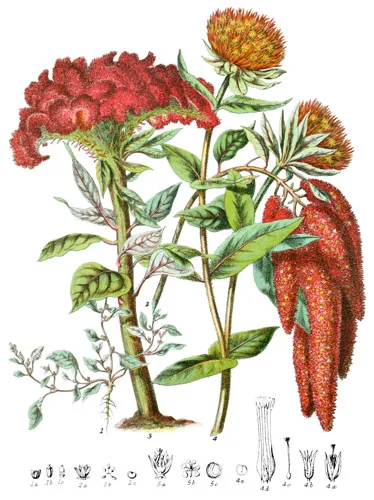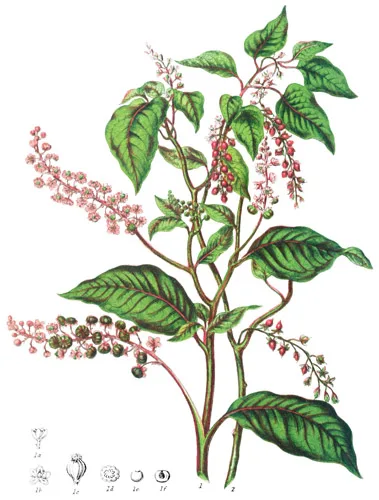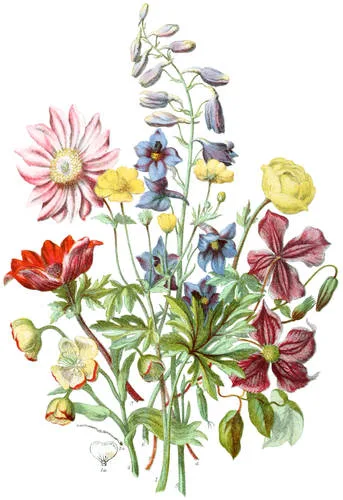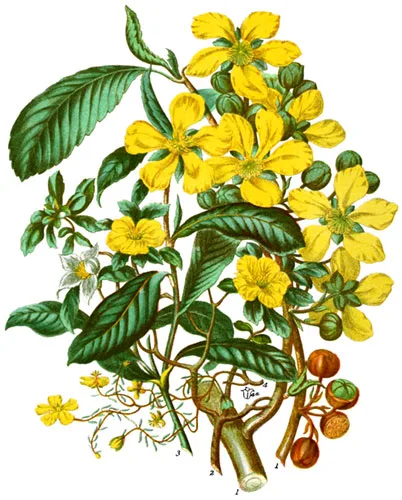
Chenopodiaceæ
Chenopodiaceæ
The Goose-Foot Tribe
- 合集
- 植物自然目
- 绘者
- Elizabeth Twining(伊丽莎白·特温宁)
- 年代
- 1868
- 图版号
- Order 112
- 原书页码
- p.112
- 主色
- 绿
- 授权
- CC BY-SA 4.0
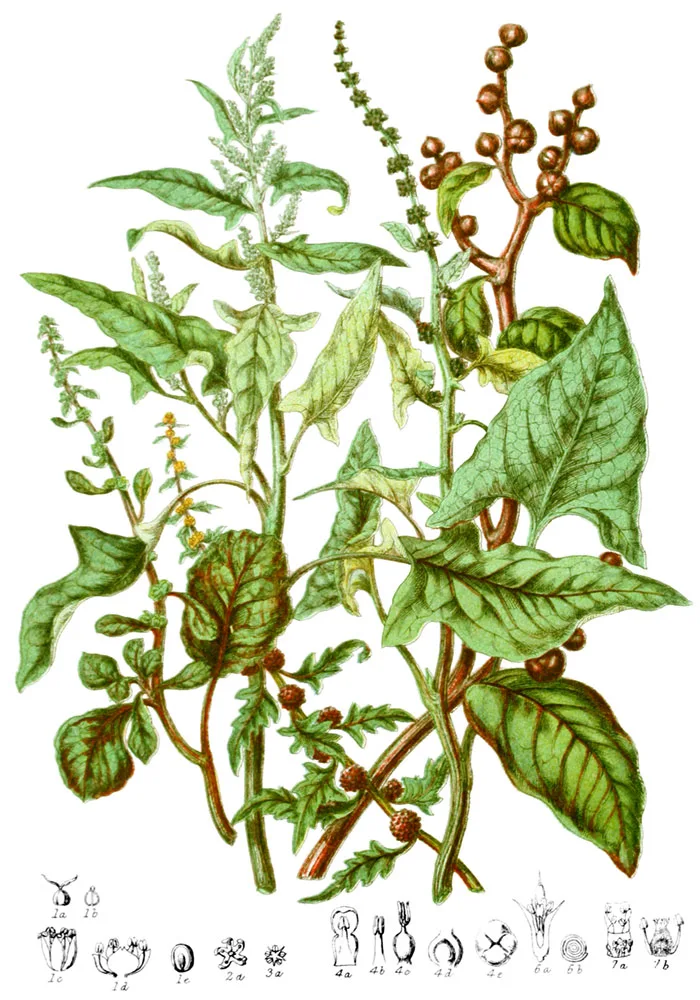
图中植物与部位
-
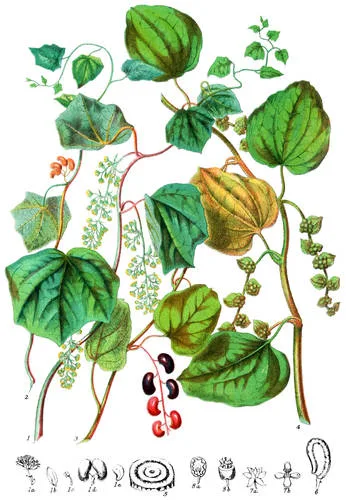
1.
Chenopodium bonus Henricus
, Goosefoot, or Mercury England
- 1a. Ovary and Styles
- 1b. Seed
- 1c. Flower of C. album
- 1d. Section
- 1e. Section of Seed
-
2.
Beta maritima
, Sea Beet Shores, England
- 2a. Flower
-
3.
Spinacia oleracea
, Spinage South Europe
- 3a. Stamen flower
-
4.
Basella rubra
East Indies
- 4a. Sepal and Stamen
- 4b. Stamen
- 4c. Ovary and Styles
- 4d. Section of Ovary
- 4e. Fruit
- 5. Blitum virgatum , Strawberry Blite South Europe
-
- 6a. Flower of Salsola Kali
- 6b. Spiral embryo
-
- 7a. Spike of Salicornia herbacea
- 7b. Fower, magnified
关于本图版
本图选自伊丽莎白·特温宁的《植物自然目》(Natural Orders of plants),原书 1849 年出版。原书题作“Chenopodiaceæ”。此类图版是当时记录物种形态的主要方式。
该合集全编共 160 幅图版,此图为其中之一,图版编号 Order 112,对应原书第 112 页,版式为纵幅,画面以黄绿为主色。图像自原件扫描修复,构图与设色未经改动,授权方式见页面下方。
原书文字(英文 / 法文)
Key characteristics
Under-shrubs and herbaceous plants, some of which are climbing; sometimes having jointed stalks. The leaves are alternate, occasionally opposite. The flowers are small, sometimes the stamens and pistil are in separate flowers. The calyx is deeply divided, sometimes rather tubular at the base; in Basella the sepals form two rows; the stamens are inserted into the base of the clayx, opposite its segments and equal to them in number, or fewer. The ovary is single, above he calyx, or sometimes adhering to the tube of the calyx. The styles are two or four, rarely single, the stigmas undivided. The fruit is membranous, sometimes a kind of berry is formed by the succulent calyx; the seed contains either a flat spiral embryo in albumen, or a conically spiral one without albumen.
This Tribe has affinity with Amarantaceæ and Phytolaccaceæ, but is distinguished by the number and position of the stamens.
Many of these plants contain soda, others sugar, in the root.
Select plants in this order
Not all plants listed are illustrated and not all plants illustrated are listed.
- Chenopodium, from the Greek for goose-foot, is a genus very frequent in Europe, usually on waste ground, or on heaps of rubbish, where C. bonus Henricus (1) is to be found. This species was formerly cultivated in gardens, and eaten as a vegetable; the mucilaginous leaves are still, in country places, thought good for healing slight wounds.
- C. olidum also affords wholesome food.
- C. maritimum may be preserved as a pickle; when burned it produces soda, like several other plants of this tribe.
- C. quinoa of Peru is one of the common eatable herbs of that country; its seeds contain wholesome farinaceous matter.
- The shape of the leaf varies in different species, but they are all more or less of a triangular form; and that of C. bonus Henricus sufficiently justifies the choice of the generic name, resembling as it so nearly does the webbed foot of a goose.
- Beta (2), from the old Celtic word for red, has long yielded a good supply of nutritious food in its root, enlarged by cultivation, but is of late years become greater importance to man for the sugar obtained from two species.
- B. vulgaris of the south of Europe is the common Beet-radish, eaten both raw and cooked, used as a pickle, and is a substitute for coffee, now affording excellent sugar from the root; a find varnish may also be made from it.
- B. cicla is extensively grown in Germany, France, and Switzerland, the large leaves are used for soups.
- B. maritima (2) is a native of many parts of our south coast; its succulent nature renders it eatable as a herb, but the root is small, black without, pale within.
- Although the power of manufacturing sugar in so northern a country as France is considered of great value, yet the most important use of Beta is in the enormous root of Mangel-wurzel, as winter food for cattle.
- Spinacia (3) has the stamens and pistil in separate flowers; it has been a constant herb in English gardens for nearly three centuries; being very hardy, it is sown in the early spring, and affords a plentiful supply of its leaves, which have a pleasant sub-acid flavour.
- Basella (4) is the name of the plant in Malabar; it is much cultivated in the East Indies and China, and is also amongst the various vegetables which the French esteem and use more abundantly than the English.
- B. tuberosa of Quito has a large fleshy root.
- Blitum (5) is said to derive its name from the Celtic for insipid; the calyx enlarges and becomes succulent, enclosing the seeds, the whole cluster having at least the aspect of a strawberry.
- Salsola Kali is one of the valuable plants yielding in its ashes a large supply of soda; it grows on the sea-shore of temperate countries, and is easily recognized by its prickly-pointed leaves and three spiny bracts of the flowers (6).*
- S. soda abounds on the coasts of Spain, and forms barilla.
- S. sativa yields the best soda, now very extensively used in the manufacture of glass and soap, and for a variety of other purposes. The name Salicornia denotes its saline nature and horned calyx, which enlarges as the seed ripens, forming a covering to the seed-vessel.
- S. herbacea (7)† is common on the river shores of our east coast, where it is known as marsh Samphire, and made into a pickle.
- The silvery grey Atriplex is found throughout Europe, in salt marshes, on mud shores, on heaps of rubbish, and other rough places.
- One species of this apparently mean and despicable genus affords wholesome food; A. hortensis is cultivated extensively in gardens around Paris.
- Acnida cannabina is the Virginian hemp of N. America.
- Thelygonum cynocrambe abounds in slender saline crystals; it has medicinal propreties, and is also occasionally eaten.
Locations
This Tribe inhabits waste places in all parts of the world, most abundant in Temperate regions, frequent in salt marshes. Basella belongs to the Tropics.
Legend
- Chenopodium bonus Henricus, Goosefoot, or Mercury. England.
- Ovary and Styles.
- Seed.
- Flower of C. album.
- Section.
- Section of Seed.
- Beta maritima, Sea Beet. Shores, England.
- Flower.
- Spinacia oleracea, Spinage. South Europe.
- Stamen flower.
- Basella rubra. East Indies.
- Sepal and Stamen.
- Stamen.
- Ovary and Styles.
- Section of Ovary.
- Fruit.
- Blitum virgatum, Strawberry Blite. South Europe.
-
- Flower of Salsola Kali.
- Spiral embryo.
-
- Spike of Salicornia herbacea.
- Flower, magnified.
十二观
- 实测花色 黄绿、橙黄
- 纵幅 1.43∶1
- 含 7 个物种
- 21 处解剖图
- 1868 年刊
- Order 112
这不是词条,是一条看画的次序:先站定看整体,再看名字与形色、构图与刀工,然后问它几时开、从哪里来、经了谁的手;最后是中国诗文——同一朵花,中国古人是怎么看的。十二观读完,这幅图就打开了。
-
第一眼
论画以形似,见与儿童邻。
—— 宋·苏轼《书鄢陵王主簿所画折枝》
只求画得像,是小孩的眼光。苏轼不是不要形似,是说形似之后还有一层:神。这一幅是竖的:眼睛从下往上走,落点在上半部。先让整株立起来,再看细节。第二步凑近一寸:主线之外另有 21 处解剖小图——那是画家怕你看不清,替你把花剖开了。第三步,找绿色最重的一小块:整幅的明暗秩序,是从那里排开的。
-
名与实
此幅未见可靠的学名,只能以原书题名相称——早期图谱里这种情形并不少见。此幅既无通行中文名,学名也不可靠,只能以原书题名相称——图谱里总有几幅这样的图,只能靠画面本身说话。
-
形与色
就这一幅实测:花色占画面的 10.7%,叶色 26.0%,主相是黄绿、辅以橙黄。这个比例与色相,是这一幅独有的。此图为一幅博物插画:一株植物被从山野或温室中取出,安置在纸的中央,根、茎、叶、花、果依次交代,务求可辨、可据、可传。此幅以绿为主,绿近嫩苔,是花萼与叶的主色。这一路颜色多来自叶、萼与枝,花只占很小一块——图谱的次序向来如此:先立植株,再点花色。画幅高而窄,形与色的关系因此看得格外清楚:先读轮廓,再读色层,最后才看笔触。
-
构图与呼吸
画幅高而窄,主株一路向上,上下留白多,是图谱中最常见的立轴式构图。(高宽比约 1.43∶1)另附 21 处局部解剖,主体与细部互为注脚。这一幅排得满:枝叶占到画面的 41%,重心近于正中——标本式的画法,图的是看得全。老图谱爱把主株摆在偏中线的位置,左右留得不一样多:这一点偏心,正是画面活起来的原因。
-
一刀一色
十九世纪后半叶,石版与彩色石印渐成主流:颜色可以直接印出,不再依赖手工,线条反倒退居其次。图像的“准确”提高了,手性却淡了。工艺留下的破绽比题跋更诚实:刻工不会撒谎,上色的人赶时间的时候会。
-
时序
图版多标花期,因花期是植物一年中最容易被辨认的十余日;其余月份,它只是一丛叶。图上所记的 1868 年是刊行之年,不是花期;真正的花藏在原书的采集记录里,通常比出版早一两年。记下这一季:物候是最好用的鉴赏工具,见过一次活的花,再看图就不会只看颜色。
-
故土
来源不一,或本地山野,或远洋引种。十九世纪的植物园与温室,是这些植物离开故土后的第一个住所。《植物自然目》成于1849,那一代人对这类植物的知识,多半来自温室里的活体,而不是山野。
-
书与人
《植物自然目》(Natural Orders of plants)由伊丽莎白·特温宁绘,成于1849。此幅为其中Order 112,见原书第 112 页。图谱是集体工程:绘图、刻版、上色、编纂各有其人,署名的往往只有第一个。
-
诗境
天地有大美而不言,四时有明法而不议。
—— 《庄子·知北游》
博物画所做的,正是替不言者立言。把这一句放回画面:绿色的花冠就是诗句的落点——诗先写气,画后写形,两者在此处接上了。
-
文心
六法者何?一、气韵生动是也;二、骨法用笔是也;三、应物象形是也;四、随类赋彩是也;五、经营位置是也;六、传移模写是也。
—— 南齐·谢赫《古画品录》
一千五百年前,谢赫给了六条看画的标准:气韵、用笔、形似、设色、构图、临摹。前五条今天仍然管用——在这幅图版上一样样对过去,就是一次完整的读画。中国有《本草纲目》《植物名实图考》,欧洲有从《本草》插图到彩色石印的谱系;两条传统都相信:图能补文字的不足。读古文不必求全解,先认下这一句:它把“看花”换成了“看人”,你再看这幅图,眼里就多了一层。
-
花语
博物画的象征不在花语,而在“记录”本身:它相信一株植物值得被准确画下,这份信念是科学时代最朴素的道德。花语是给人与人的关系用的;植物自己只关心有没有传粉的虫。这两套语言,可以并行不悖。
-
带走一双眼睛
把这三件事带走:先整体后细节;先线后色;先看画再翻书。任何一张老图版,都可以用这三条读。二百年后,这株植物的后代或许仍在某处活着;而纸上这一株,永远停在 1868 年的那个季节。
本图涉及的植物
- Chenopodium bonus Henricus
- Beta maritima
- Spinacia aleracea
- Basella rubra
- Blitum virgatum
- Salsosa Kali
- Salicornia herbacea
属索引
- Acnida
- Atriplex
- Basella
- Beta
- Blitum
- Chenopodium
- Salicornia
- Salsola
- Spinacia
- Thelygonum