Coniferaceæ
Coniferaceæ
The Fir Tribe
- 合集
- 植物自然目
- 绘者
- Elizabeth Twining(伊丽莎白·特温宁)
- 年代
- 1868
- 图版号
- Order 128
- 原书页码
- p.128
- 授权
- CC BY-SA 4.0
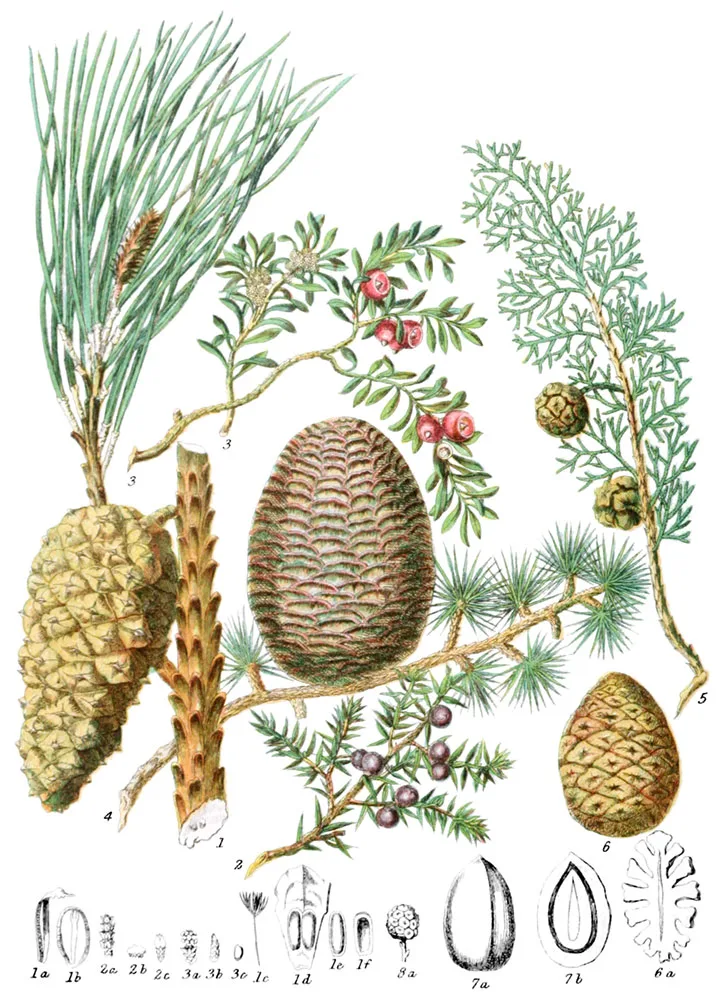
图中植物与部位
-
1.
Pinus maritima
, Sea-coast Pine South coast, Europe
- 1a. Stamen
- 1b. Section of Seed
- 1c. Many Coyledons of Seed
- 1d. Scale and Seed
- 1e. Seed
- 1f. Section of Seed
-
2.
Juniperus communis
, Juniper Britain
- 2a. Stamen flowers
- 2b. Scale and Anthers
- 2c. Pistil flower
-
3.
Taxus baccata
, Yew Britain
- 3a. Stamen flower
- 3b. Pistil flower
- 3c. Seed
- 4. Larix Cedrus , Cedar Mount Lebanon
- 5. Cupressus sempervirens , Cypress Levant
-
6.
Cone of Wellingtonia
- 6a. Section of Cone
-
- 7a. Seed of Araucaria
- 7b. Section of Seed
-
- 8a. Cone of Cryptomeria japonica
关于本图版
这幅图版出自《植物自然目》(Natural Orders of plants),由伊丽莎白·特温宁绘制,1849 年出版。原书题作“Coniferaceæ”。此类图版是当时记录物种形态的主要方式。
全编共收录 160 幅图版,本图是其中一幅,原书将其列为 Order 128,见第 128 页,版式为纵幅。此图由原件扫描修复而成,使用时请遵循页面标注的授权条款。
原书文字(英文 / 法文)
Key characteristics
Large trees and shrubs, with branching stems, full of resin. The woody tissue is marked with circular scars. The leaves are evergreen, linear, rigid, entire at their margins, veinless, rarely lobed, and with forked viens, usually in bundles wrapped at their base in a membranous sheath. The flowers are without calyx or corolla, but surrounded by bracts: some consist of only a single stamen, or a few united, usually collected on a common stalk into a kind of catkin. The anthers are two, or many-lobed, bursting longitudinally, often surmounted by a crest. The pistil flowers are in cones; the ovary rises from the base fo a membranous bract, bearing two or more ovules. The fruit is composed the enlarged and hardened cone of scale-shaped ovaries and bracts; or it is solitary, as in Taxus, and has the seed has a hard crustaceous covering, th embryo is in the midst of the fleshy oily albumen, and has two or many cotyledons.
This Tribe has close affinity with Cycadaceæ.
Various kinds of resin are secreted by these trees.
Select plants in this order
Not all plants listed are illustrated and not all plants illustrated are listed.
- Pinus, the chief genus of this cone-bearing Order, is of extensive value; the word is of Celtic origin, and hence have been derived all the European names.
- P. sylvestris, the Scotch Pine, or Fir, as it is generally called, is the only British example; its timber, known as Deal, is the most useful and durable of all the woods of Temperate climates, and it yields pitch and oil of turpentine for important uses.
- P. maritima (1) has its leaves in pairs, and cones solitary.
- P. Pinaster bears cones in clusters.
- P. Pinea is the Stone Pine which adorns the Mediterranean coast of Italy, sometimes growing out of the rocky slopes, and with its crown of dark foliage forming a very picturesque object. The Greeks still use the wood for ships.
- P. palustris of N. American swamps, has leaves a foot long; P. canariensis has similar foliage, and mingles strangely with the rest of the vegetation of the Peak of Teneriffe, between 4000 and 6000 feet.
- P. apulcensis, of Mexico, is distinguished by extremely twisted branches.
- P. occidentalis belongs especially to St. Domingo and Cuba.
- The cones are the different species vary in size, those of P. excelsa, of the Himalaya, are fourteen inches long and slender; those of P. pungens of N. America have sharp bent prickles on each scale.
- Abies, the true Fir, belongs chiefly to N. America; A. alba, the white Spruce, extending to within ten miles of the Arctic Sea.
- The Larch, of Germany and Switzerland, Larix communis, is one of the most frequent and beautiful trees on the lower range of the Alps, reaching to 6000 feet elevation; the leaves are deciduous, the wood valuable for building, becoming a fine red brown exposed, unpainted to the Alpine climate: the bark contains tannin.
- The Cedar of Lebanon (4) once existed in extensive forests on the sides of Libanus, the only native locality; but from the time of Solomon, when vast numbers of the trees were hewn down to build the Temple, it has become very scarce there. No other tree of this tribe has a more majestic aspect, especially when countless cones stand erect on the horizontal branches.
- Juniperus (2) is a native of open places and hills in the northern parts of Europe; on the Alps, also it grows abundantly; the youand the berries are used in the preparation of ardent spirits.
- J. Bermudiana, a tree forty feet high, affords the cedar-wood for buildings in the West Indies, and the cases for our Cumberland lead pencils.
- J. Virginiana is the red Cedar, a highly fragrant and durable wood for cabinet work.
- J. recurva, with long drooping branches appears occasionally on the Himalaya.
- Taxus (3) is found chiefly in mountainous woods in Europe, N. America, and Japan; in Germany it still abounds, but it is much less frequent in Britain than forerly. Until the time of Henry VIII., the wood was in constant demand for bows. Yew-trees live to a great age, and acquire large trunks; two of the most remarkable are those near the forest of Brotonne, in France, said to be verging towards 1500 years. In the Temperate countries they Flourish on plains, on the Andes they find a suitable temperature at 8000 feet.
- Cupressus (5), common in the Levant and in South Europe, is frequently planted around palaces, and in cemetaries. It endures to great longevity in favourable soil and climate; a Cypress at Somma in Lombardy is said to have sprung from the earth before the Christian era, and is still regarded with veneration; when Buonaparte planned the famous Strata Sempione, the ancient Cypress was carefully avoided. The famous gates of Constantine’s cathedral, at Constantinople, made of the wood, existed upwards of 1100 years.
- Schubertia disticha, known as the deciduous Cypress, belongs to Mexico, and is there much esteemed; the finest examples in this country are in the gardens of Syon House, Isleworth.
- Araucaria imbricata was introduced by Sir Joseph Banks, a tree of stately, symmetrical growth, the branches clothed with perennial rigid leaves, at first pointing upwards; gradually with age becoming bent downwards.
- A. excelsa, of Norfolk Isle, is lofty and grand.
- The seeds of A. Bidwillii (7),* of Australia, being nearly free of turpentine, are eaten by the natives.
- Amongst the noblest of trees ranks the Dammara Pine of New Zealand, often growing with a straight stem of 100 feet.
- The graceful Deodara of the Himalaya, is now acclimatized in our gardens, although its native place is from 7000 to 12,000 feet on the mountains of Asia.
- Cryptomeria japonica (8),† lately imported from the extensive plain of Shanghae, is of extreme elegance of growth.
- The last discovered tree of this tribe, now added to English plantations from California, is the surpassing Wellingtonia gigantea. About 100 trees exist in a forest on the slopes of the Sacra Nivada, near the head waters of San Antonio, in 38° N. Lat., 5000 feet above the sea. The stems rise 245 feet in height, unbranched, until towards the summit; the branches droop and bear cones (6) at their points; the Indians shake out the seeds, roast, and eat them, whole or bruised. Pinus and Araucaria appear to have grown abundantly in this island during a former epoch of its existence, fossil remains being found at Whiby and at Lyme Regis.
Locations
This Tribe inhabits various countries from the Tropics of Asia to the Arctic regions. The chief portion exists in Temperate climates, in Europe, Siberia, China, N. America. Pinus belongs to the Northern Hemisphere, Araucaria to the Southern.
Legend
- Pinus maritima, Sea-coast Pine. South coast, Europe.
- Stamen.
- Section of Seed.
- Many Cotyledons of Seed.
- Scale and Seeds.
- Seed.
- Section of Seed.
- Juniperus communis, Juniper. Britain.
- Stamen flowers.
- Scale and Anthers.
- Pistil flower.
- Taxus baccata, Yew. Britain.
- Stamen flower.
- Pistil flower.
- Seed.
- Larix Cedrus, Cedar. Mount Lebanon.
- Cupressus sempervirens, Cypress. Levant.
- Cone of Wellingtonia.
- Section of Cone.
-
- Seed of Araucaria.
- Section of Seed.
-
- Cone of Cryptomeria japonica.
本图涉及的植物
- Pinus maritima
- Juniperus communis
- Taxus baccata
- Larix Cedrus
- Wellingtonia
- Araucaria
- Cryptomeria japonica
属索引
- Abies
- Araucaria
- Cryptomeria
- Cupressus
- Juniperus
- Larix
- Pinus
- Schubertia
- Taxus
- Wellingtonia