Convolvulaceæ
Convolvulaceæ
The Bind-Weed Tribe
- 合集
- 植物自然目
- 绘者
- Elizabeth Twining(伊丽莎白·特温宁)
- 年代
- 1868
- 图版号
- Order 97
- 原书页码
- p.97
- 授权
- CC BY-SA 4.0
图中植物与部位
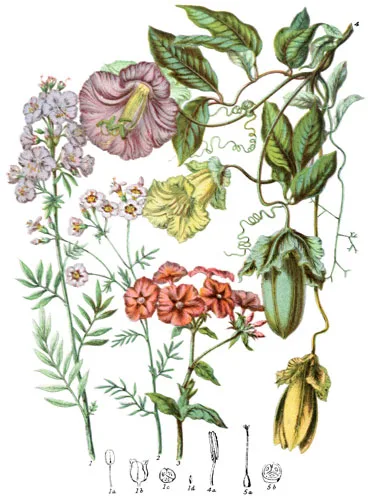
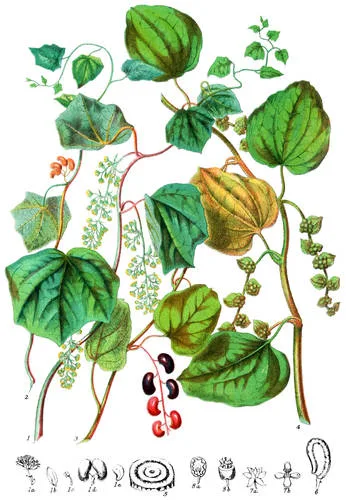
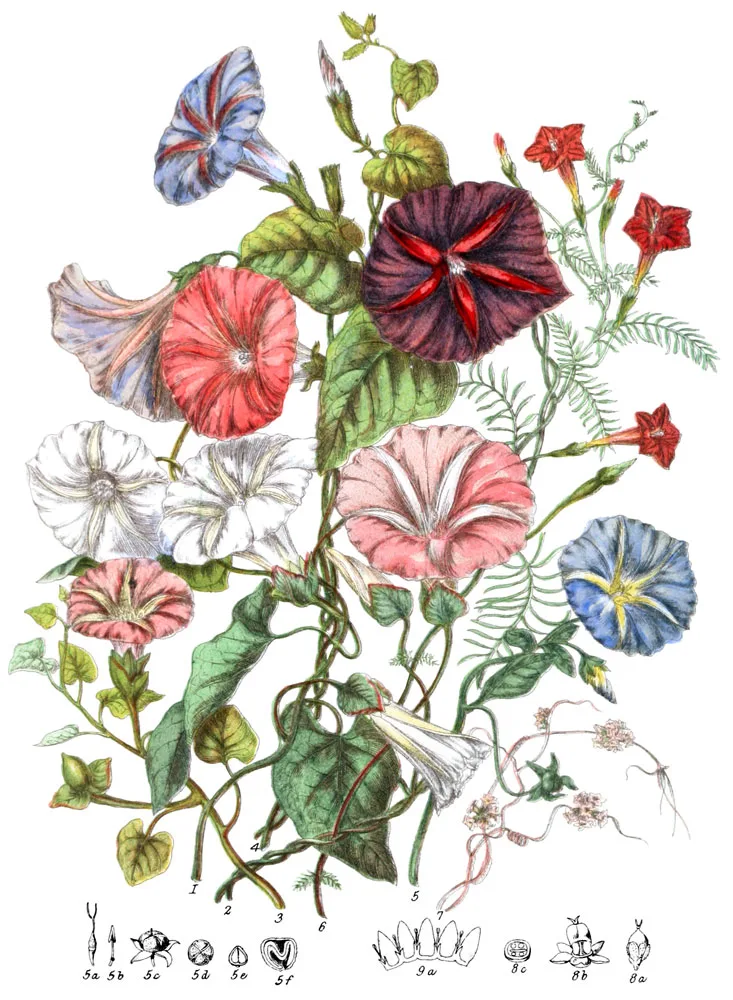
- 1. Convolvulus sepium , Great Hedge Bindweed England
- 2. Convolvulus Americana , American Bindweed America
- 3. Convolvulus Soldanella , Sea-shore Bindweed Coast, England
- 4. Ipomea purpurea , Major Convolvulus America
-
5.
Convolvulus tricolor
, Minor Convolvulus South Europe
- 5a. Ovary and Pistil
- 5b. Stamen
- 5c. Capsule
- 5d. Top of Capsule
- 5e. Cell with two Seeds
- 5f. Section
- 6. Ipomea quamoclit , Fine-leaved Ipomea East Indies
- 7. Cuscuta epithymum , Lesser Dodder
-
- 8a. Cuscuta verrucosa , Ovary and Calyx
- 8b. Fruit
- 8c. Section of Ovary
-
- 9a. Cuscuta Europæa , Flower opened
关于本图版
本图选自伊丽莎白·特温宁的《植物自然目》(Natural Orders of plants),原书 1849 年出版。原书题作“Convolvulaceæ”。原书为这一物种留下了成幅的彩色图像记录。
该合集全编共 160 幅图版,此图为其中之一,图版编号 Order 97,对应原书第 97 页,版式为纵幅。图像自原件扫描修复,构图与设色未经改动,授权方式见页面下方。
原书文字(英文 / 法文)
Key characteristics
Shrubs and herbaceous plants, usually twining, and containing milky juice; the stalk and leaves are smooth, or simply downy; a few only are erect shrubs, and a few are leafless climbing parasites. The leaves are undivided, or lobed, seldom pinnatifid, and are without stipules. The flowers grow at the ends of the branches, or from the base of the leaf-stalks, or in dense clusters; the flower-stalks ahve usually two bracts, which enlarge after flowering. The calyx has five divisions, often unequal, persistent. The corolla is of one petal, attached to the base of the ovary, regular, and deciduous; the limb is five-lobed and plaited. The stamens are five, inserted into the base of the corolla, alternate with its segments. The ovary has from two to four cells, seldom only one, few-seeded. The style is single, usually parted at the top, sometimes with as many divisions as those of the ovary, and arising from their base. The stigmas are obtuse or acute. Around the base of the ovary is an annual disk. The capsule has from one to four cells, and is dry or succulent. The seeds have a small quantity of mucilaginous or fleshy albumen.
This Tribe has affinity with Boraginaceæ and Polemoniaceæ.
An acrid milky juice exists in these plants.
Select plants in this order
Not all plants listed are illustrated and not all plants illustrated are listed.
- Convolvulus is a genus of very beautiful, though ephemeral flowers; it contains also the beautiful Batatas of the East and West Indies, and the medicinal gum-resin Scammony of Arabia.
- C. sepium (1) is a graceful ornament of our hedges; the flowers, as usual in this tribe, wither after a few hours, but in cloudy weather remain open till towards the evening, though they generally close before rain. The calyx being protected and shaded from any outward influence by the two large bracts is exceedingly pure and transparent in texture, affording in the microscope an excellent view of the circulation of juices in the cells. The root is said to possess properties equal to Scammony.
- C. americana (2) is a corresponding species in the hedges of America, and scarecely differs except in the bright pink colour of the flower.
- C. Soldanella (3) is one of the creeping-rooted plants which bind the sand of our east coast in Essex and elsewhere, and is one of the three British plants existing in the Galapagos Isles. The leaves are small and tough, as is common in such situations; but the flowers are fragile, expand in the morning, and are of short duration.
- These species, and a few others, have lately been named Calystegia, on account of the bracts.
- Ipomea purpurea (4) is one of the general summer favourites in gardens, exhibiting daily an interesting variety of colours; the deep blue predominating whilst the plant is in full vigour, gradually fading with its strength and the decline of temperature, the last flowers being generally pink. This suggests two ideas—whether the development of blue depend on the power of the plant to acquire carbon, or on the state of light in the atmosphere.
- C. tricolor (5) has been long admired as a flower of pleasing lively aspect.
- C. arvensis, of our waysides, is found also in Madeira.
- Ipomea quamoclit (6) is one of the few examples of a finely-divided leaf in this order; it was introduced into our conservatories early in the seventeenth century, from the East Indies; the West Indies also includes it in its flora. A traveller and botanist, now in St. Domingo, mentions it as adorning a grave with its brilliant scarlet flowers. It has likewise been found entwining round Euphorbia nereifolia in South China.
- I. tuberosa, the arbour vine of Jamaica, extends its stems to a very considerable length.
- I. pes-capræ stretches runners 200 feet along the sandy beach of Panama.
- The root of I. pandurata, is used as Jalap in the United States; but I. Jalapa, from Xalapa, in Mexico, affords the chief supply of that medicinal resinous drug.
- I. Turpethum, of the East Indies, Malay Isles, New Holland, and the Isles of the Pacific, affords a valuable medicine.
- The leaves of I. mauritima are used for fomentation in Brazil, and several other Tropical species possess valuable properties.
- Pharbitis cærulea yields medicine from its seeds; P. cathartica from the root.
- Piptostegia is a medicinal genus of Brazil.
- The Mexican poison Guaco is said to be a kind of Convolvulus.
- Cuscuta forms the type of the parasitical leafless section of this order; it resembles mistletoe in the manner of attaching itself to other plants, the stuckers penetrating as far as the first wood, and never farther; it, however, differs in its early growth, commensing by rooting in the earth, and only afterwards becoming detached, and deriving its sole nourishment from the plant to which it clings by means of the small suckers on its stalk.
- C. epithymum (7) is frequent on heaths, entwining its thread-like stems around furze and other plants, twisting in close coils, then branching off and bearing clusters of delicate and beautifully shaped flowers.
- C. europea is less common, and is chiefly found on thistles, nettles, and flax.
- C. epilinum, of Germany, has of late years been observed on flax in this country, and was probably introduced with that seed.
- In Bohemia, C. monogyna is often clinging over willows and poplars.
- A gigantic species in Affghanistan covers willows thirty feet high.
- C. racemosa is used medicinally in Brazil; the fresh juice for hoarseness, the dried powder for healing wounds.
Locations
This Tribe is abundant in the Tropics, found in all Temperate regions, rare in cold climates, and unknown in the coldest. Cuscuta is less frequent in Tropical countries, where its place is filled by Cassytha among the Laurel tribe.
Legend
- Convolvulus sepium, Great Hedge Bindweed. England.
- Convolvulus Americana, American Bindweed. America.
- Convolvulus Soldanella, Sea-shore Bindweed. Coast, England.
- Ipomea purpurea, Major Convolvulus. America.
- Convolvulus tricolor, Minor Convolvulus. South Europe.
- Ovary and Pistil.
- Stamen.
- Capsule.
- Top of Capsule.
- Cell with two Seeds.
- Section.
- Ipomea quamoclit, Fine-leaved Ipomea. East Indies.
- Cuscuta epithymum, Lesser Dodder.
-
- Cuscuta verrucosa. Ovary and Calyx.
- Fruit.
- Section of Ovary.
-
- Cuscuta Europæa. Flower opened.
本图涉及的植物
- Convolvulus sepium
- Convolvulus americana
- Convolvulus Soldanella
- Ipomea purpurea
- Convolvulus tricolor
- Ipomea quamoclit
- Cuscuta epithymum
属索引
- Calystegia
- Convolvulus
- Cuscuta
- Ipomea
- Pharbitis
- Piptostegia