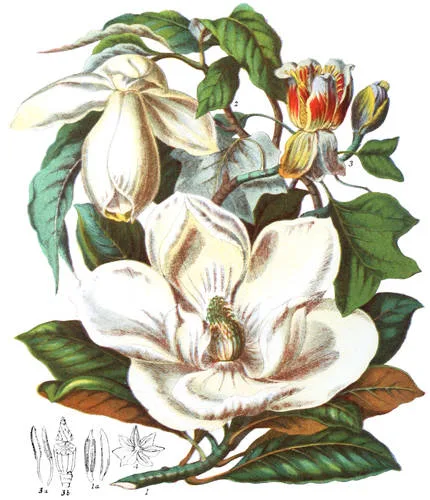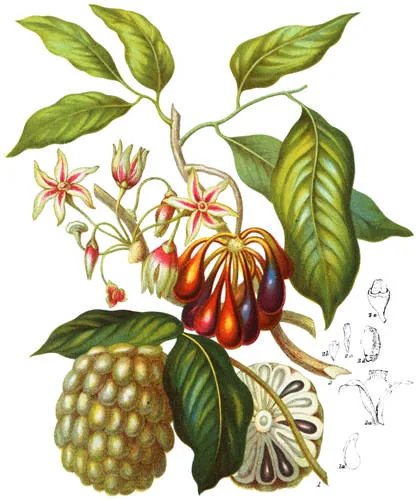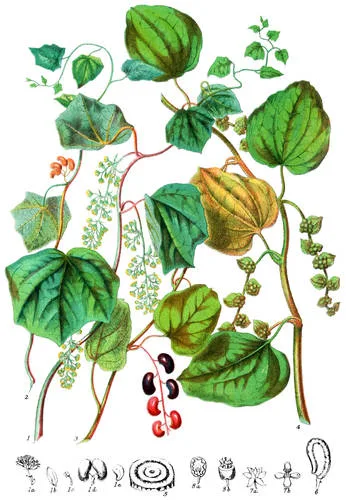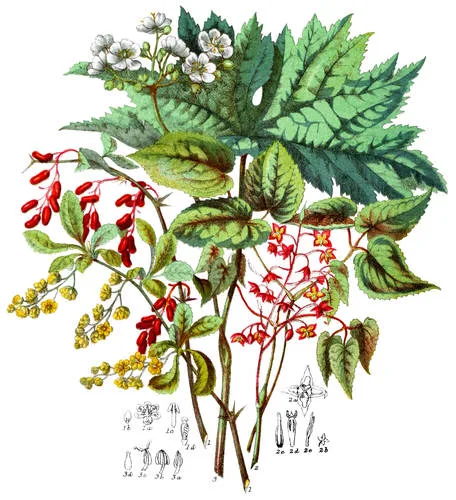
Droseraceæ
Droseraceæ
The Sun-Dew Tribe
- 合集
- 植物自然目
- 绘者
- Elizabeth Twining(伊丽莎白·特温宁)
- 年代
- 1868
- 图版号
- Order 18
- 原书页码
- p.18
- 授权
- CC BY-SA 4.0
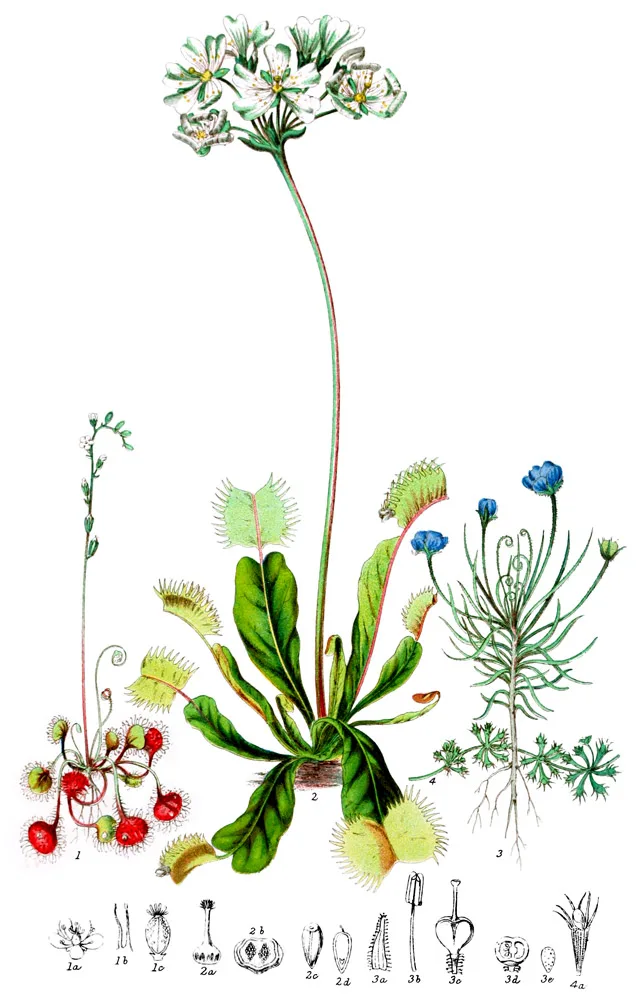
图中植物与部位
-
1.
Drosera rotundifolia
, Round-leaved Sun-dew Bogs, Britain
- 1a. Flower
- 1b. Section of Ovary, and Pistil
- 1c. Unnamed*
-
2.
Dionea muscipula
, Venus’s Fly-trap Carolina
- 2a. Pistil
- 2b. Section of Ovary
- 2c. Seed
- 2d. Section
-
3.
Byblis liiflora
, Flax-flowered Byblis New Holland
- 3a. Sepal magnified
- 3b. Stamen
- 3c. Pistil
- 3d. Section of Ovary
- 3e. Seed
-
4.
Aldrovanda vesiculosa
, Bladder-leaved Aldrovanda Italy and India
- 4a. Leaf, with its veiscle
关于本图版
《植物自然目》(Natural Orders of plants)由伊丽莎白·特温宁绘制,1849 年印行,本图即其中一幅。原书题作“Droseraceæ”。此类图版是当时记录物种形态的主要方式。
该合集全编共 160 幅图版,此图为其中之一,图版编号 Order 18,对应原书第 18 页,版式为纵幅。图像自原件扫描修复,构图与设色未经改动,授权方式见页面下方。
原书文字(英文 / 法文)
Key characteristics
Herbaceous plants, some of which are small, and covered with glandular hairs. The leaves are alternate, having sometimes fringed stipules at the base of the leaf-stalk; the stalks are curled round in the early state of growth. The flower-stalks spring from the root, and are likewise curled round when young, after the manner of Ferns; the calyx has five sepals, which remain, and enclose the seed-vessel; the petals are five, attached to the base of the ovary, folded over each other in the bud. The stamens are distinct, either equal in number to the petals and alternate with them, or two or three times as many; the anthers are erect, gaping by and by chinks, or by pores at the top, as in Byblis (3). The ovary is single, the styles are three or six, either quite separate or slightly connected at the base. The seed-vessel is a capsule, of three or five valves, bearing the seeds on ribs in the middle, or at the base. The seeds are naked, or furnished with an aril, and contain fleshy albumen.
This Order has affinity with Violaceæ, but the number of styles, and the rolled-in stalks, distinguish them.
Select plants in this order
Not all plants listed are illustrated and not all plants illustrated are listed.
- Drosera is so named from the Greek for dew, because of the pellucid drops which are almost constantly present on the glandular hairs of the leaves, even when exposed to the sun. All the species inhabit morasses or bogs.
- D. rotundifolia (1) is a native of bogs in various parts of Britain, and on the continent of Europe; it is usually foud amidst Sphagnum, the Bog-moss, in a soft moist situation: the whole plant has acrid, caustic juices, pervading even the viscid liquid exuding from the glands of the hairs. Flies and other small insects are attracted to the leaves, where they are detained by the irritable, glutinous hairs. The delicate little flowers open singly, and but for a short time.
- D. longifolia is often found in the same localities.
- D. anglica is a larger plant, more rare, and grows chiefly in the bogs of the north of England. Britain contains only a very small portion of this singular tribe of plants, which, though limited to a few genera, is yet greatly multiplied in species of Drosera. Nearly every region of the world where bogs exist has a representative of it. In South America they abound. Some are of extremely minute size, scarcely an in ch in height, of which are D. uniflora, D. minima, D. pauciflora.
- D. brevifolia, of Texas and Florida, nearly resembles our round-leaved Sun-dew, but the flowers are larger.
- D. cistifolius of Florida has red and yellow flowers.
- D. villosa is a native of Sphagnum bogs on the Oregan Mountain, near Rio Janeiro, at an elevation of from 3000 to 6000 feet.
- D. sessilifolia, D. montana, and several other species, grow in Brazil, either on the sands of the coast, or in ravines, or damp valleys of the rivers of Minas Geraes, and on mountain bogs and marshes 3700 feet above the sea.
- D. graminifolia inhabits the lofty range of mountains called Serra da Caraça, at 6000 feet, producing its delicate flowers in February.
- D. ethiopica is a small African species, with many leaves disposed in a circle about the root.
- D. capensis has long stalks, with leaves two inches long.
- D. indica has beautiful pink flowers, and leaves very minutely pinnated.
- D. aurea is a small species found at Port Jackson in Australia.
- D. secunda and D. pulchella were discovered in King George’s Sound; D. tomentosa grows on the north coast. This latter stains paper a bright deep purple, and, when prepared with ammonia, yields a clear yellow. Probably several of the Swan River species might be of use in dyeing.
- Dionea (2) is a remarkable instance of an irregularly developed leaf; the stalk is winged, and has the appearance of a leaf, whilst the real leaf consists of a double plate, which folds together when touched, bordered by strong teeth, closing firmly to retain any insect that has been attracted by the glutinous juice on the surface of the leaf or hairs.
- Byblis (3) was named after the daughter of Miletus, who shed tears until she was changed into a fountain; the slender leaves of this delicate little bog plant distilling drops of water from their points. It was brought from New South Wales early in this century, and cultivated in the noble garden at Cashiobury, where, at the time, was the finest collection of Australian plants. The flowers resemble those of flax in form and colour. The blue andthers open by pores at the summit. Each cell of the seed-vessel contains many seeds.
- Aldrovanda (4) was first observed by the naturalist Amadeus in the marshes of Dulioli, in Italy; but he went to reside in Bologna, and had no further opportunity of observing marsh plants. It was afterwards carefully examined and described by Aldrovandus. The flowers are minute, and appear only in small number at the ends of the branches. Like many aquatic plants, it propagates by buds from the stalk, which send out rootlets. The remarkable part is the little folded vesicle at the end of the leaves, which enables the plant to float. It has the property of staining paper red, showing the whole form of the plant, like the Lichen Roccella, or Orchil.
Locations
This tribe inhabits marshes, bogs, and morasses, in all parts of the world. Drosophyllum lusitanicum grows on the barren sands of Portugal.
Legend
- Drosera rotundifolia, Round-leaved Sun-dew. Bogs, Britain.
- Flower.
- Section of Ovary, and Pistil.
- Dionea muscipula, Venus’s Fly-trap. Carolina.
- Pistil.
- Section of Ovary.
- Seed.
- Section.
- Byblis liniflora, Flax-flowered Byblis. New Holland.
- Sepal magnified.
- Stamen.
- Pistil.
- Section of Ovary.
- Seed.
- Aldrovanda vesiculosa, Bladder-leaved Aldrovanda. Italy and India.
- Leaf, with its vesicle.
本图涉及的植物
- Drosera rotundifolia
- Dionea muscipula
- Byblis liniflora
- Aldrovanda vesiculosa
属索引
- Aldrovanda
- Byblis
- Dionea
- Drosera
- Drosophyllum